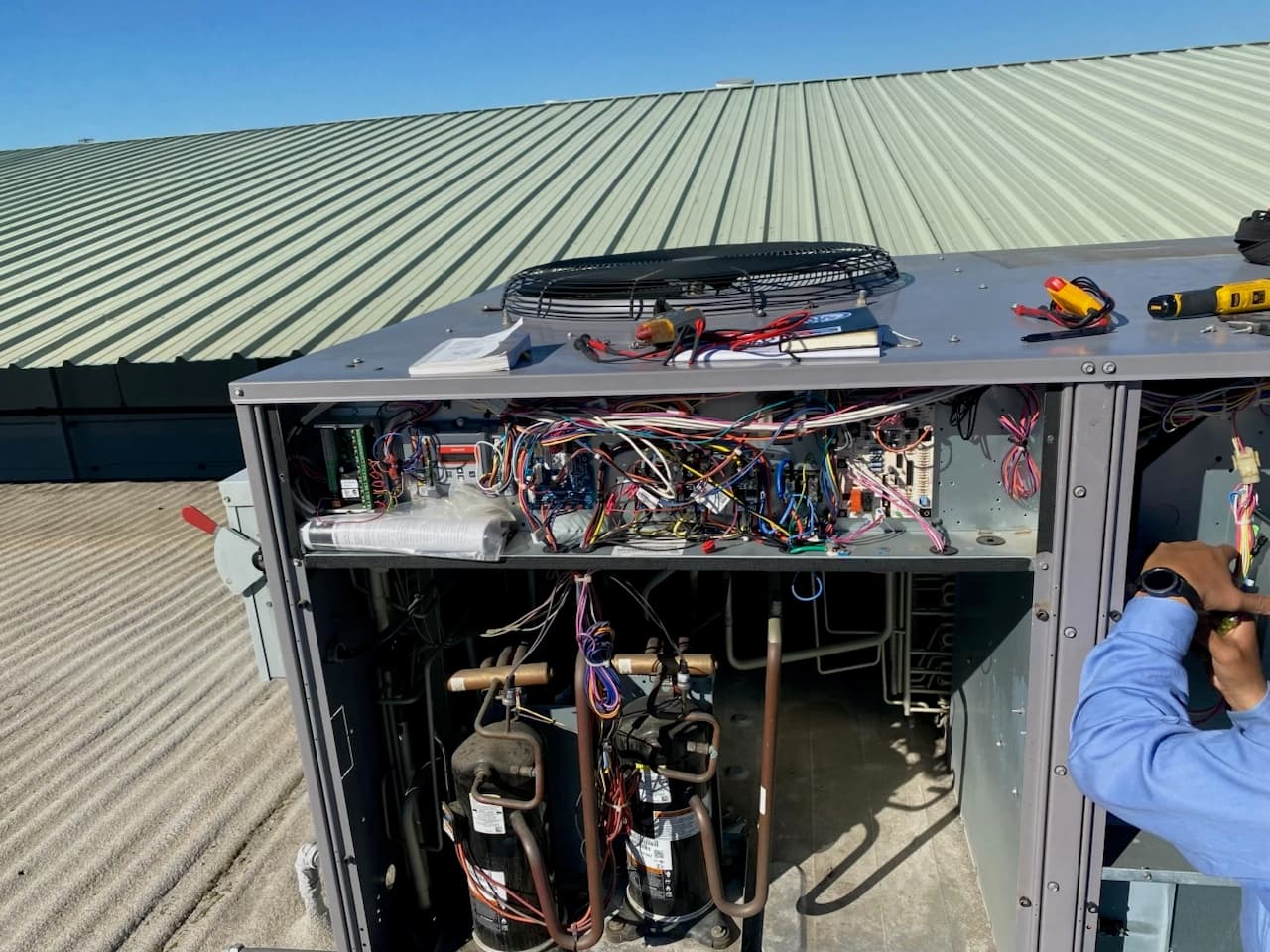
Three layers of control, three places to look
Commercial controls are easiest to understand as layers. A problem at one layer is often blamed on another, and the wrong blame sends a technician to the wrong place.
- Field devices: sensors, thermostats, actuators, dampers, valves, and relays. These fail by drifting, sticking, or breaking.
- Unit and zone controllers: the logic inside rooftop units, VAV boxes, and equipment controllers. These fail through configuration errors, bad firmware, or lost communication.
- Supervisory layer: the front end, schedules, trends, and alarms. These fail through neglect: nobody reads the alarms, schedules do not match occupancy, and passwords belong to someone who left.
The quiet problems that waste energy and cause complaints
| Condition | How it shows up | What we verify |
|---|---|---|
| Stuck or disconnected economizer damper | Cooling runs when outdoor air is cool; high utility use | Actuator travel, linkage, outdoor air and mixed air sensors, changeover logic |
| Drifted space or return sensor | Hot-cold complaints in the same zone | Reading versus a calibrated reference |
| Schedule overrides left on | Systems running nights and weekends | Schedule versus actual run hours from trends |
| Simultaneous heating and cooling | Equipment fights itself; comfort and cost both suffer | Deadbands, reheat logic, and setpoint conflicts |
| Lost communication | Points show stale values or alarms never arrive | Network wiring, addresses, and controller status |
| Unlocked thermostats | Occupants reset setpoints | Lockouts, ranges, and override timers |
Economizers deserve special attention. A failed economizer rarely creates a complaint, so it can sit broken for years. California's energy code expects economizer controls and fault detection on many rooftop systems, and we check these against current Title 24 requirements during projects and maintenance.
Point-to-point verification: how we prove the system works
The most reliable way to find control problems is to check every point from the field device to the screen. The front end shows a damper at 40 percent; we confirm the damper is actually at 40 percent. It shows 72 degrees; we confirm the room is at 72 degrees. Where the two disagree, we have found a problem before anyone files a complaint.
- Command each output and observe the physical result at the device.
- Compare each sensor against a reference measurement and record the offset.
- Force alarms to verify that notification reaches the right person.
- Trend critical points during a test window to catch hunting or short cycling.
- Record all findings as a punch list with photos and device identifiers.
Sequences of operation worth writing down
A building without a written sequence of operation is run on tradition. We rebuild the intended sequence for each system type and test the equipment against it:
- Occupied, unoccupied, and morning warm-up or pre-cool modes.
- Economizer enable conditions and minimum outdoor air position.
- Supply air temperature and static pressure reset.
- Staging of compressors, heating stages, and boiler or chiller plant equipment.
- Demand-controlled ventilation where CO2 sensors are used.
- Alarm points, setpoints, and who receives each notification.
These documents pay off when a controls vendor changes, an energy auditor visits, or a manager wants to understand why the building behaves as it does.
Our approach versus the quick-fix approach
A comfort complaint usually produces a setpoint change. That makes one person happy and moves the problem somewhere else, often into the utility bill. We treat complaints as clues: pull the trends, test the sensor, check the damper, and fix the cause.
We also avoid locking you into something proprietary that only we can touch. Where we modify programming, we document it and give you the backup. Where equipment links to our DaVinci Portal, service history and readings travel with the asset. Controls tie directly into the work we do on RTUs, chiller plants, and boilers.
Upgrades, retrofits, and acceptance testing
Upgrade projects range from replacing a set of failed thermostats with programmable models to adding unit controllers across a campus or integrating a new central plant. When equipment is replaced or controls altered in a way that triggers Title 24 acceptance testing, the work includes functional tests and the paperwork required by the local authority. Requirements change with each code cycle, so we confirm the current version with your building department. For bid-level work, we coordinate with controls engineers and integrators, and we can supply certified payroll for public work. See our Title 24 and permits guide.
Who this is for (and who it isn't)
This work suits owners and operators who want their buildings to be run on evidence: school districts, property management companies with multiple sites, medical and office campuses, retail and grocery chains, and public agencies that need documented sequences and verified economizers.
It is not meant for homeowners with a thermostat question or for anyone who only wants the schedule changed with no look at why it was changed. If you manage commercial space and want it controlled properly, call (714) 594-9194 or start with a maintenance plan that includes controls verification.
What a typical visit looks like
- Inventory controllers, thermostats, and any building automation system
- Compare schedules and setpoints to how the building is actually used
- Verify sensors, actuators, and economizer logic against measured conditions
- Correct overrides, sequences, and alarms; document the changes
- Review trends after adjustment to confirm savings and stability
Problems we most often find
- Schedules left at default so equipment runs when nobody is there
- Equipment overridden manually and never returned to automatic
- Drifting or miswired sensors producing comfort complaints
- Economizers that never actually modulate
FAQ
Do you install building automation systems?
We install and service thermostats and controls on rooftop and mechanical equipment, and work with larger automation systems on a project basis.
Can better controls really cut energy use?
Often. Correct schedules, setpoints, and economizer operation are among the cheapest efficiency gains in an existing building.
Can you connect to our existing system?
In most cases. Send us what is installed and we will confirm the integration approach.
Building Controls & Automation: where we work
Orange County is our home base. For larger commercial and public projects we also work across Los Angeles County, the Inland Empire, San Diego County, and Ventura County.