Commercial Rooftop HVAC Replacement
RTU Replacement & Installation in Orange County
Full-scope rooftop unit replacement — sized to your actual load, coordinated from crane pick to final inspection, and built around your operating hours instead of the other way around. UA Local 250, PLA and prevailing-wage ready for public agency and portfolio-scale work.
What's actually involved in a proper RTU replacement
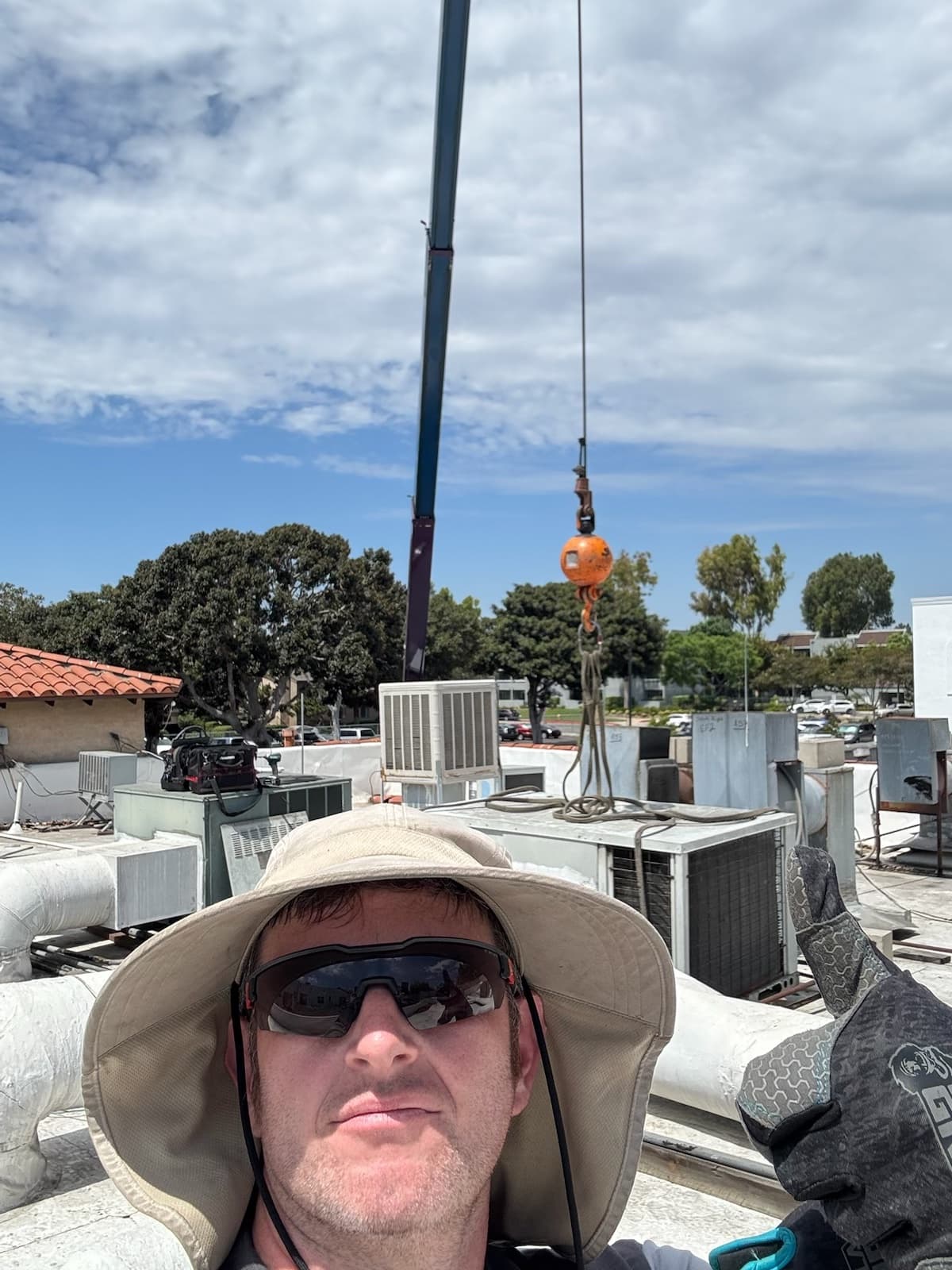
Crane scheduling, rigging, and roof access planned so the lift happens on schedule and doesn't become the bottleneck.
New unit matched to the existing curb where possible, or adapted correctly — this is where a 'simple swap' most often turns into a bigger job if it's not checked upfront.
Full mechanical, electrical, and condensate work brought up to current code, not just bolted to what was there before.
Permit and inspection coordination handled, with equipment selected to meet California Title 24 energy requirements for the replacement.
After-hours and weekend replacement windows available when a shutdown during business hours isn't an option.
Sequenced replacements across multiple units or multiple properties for portfolios and facility teams managing more than one site.
Decisions we walk you through — not around
Change-out vs. retrofit
A straight change-out replaces the unit on the existing curb and connections. A retrofit adjusts curb, ductwork, or electrical to fit a different unit type or capacity. We'll tell you which one your site actually needs before quoting — not default to whichever is easier to sell.
Repair vs. replace
Age, refrigerant type, and what's actually failing all factor in — not just a flat percentage-of-replacement-cost rule. See our repair-vs-replace guidance for the full framework.
Sizing for actual load
Replacement equipment sized to real load, hours of operation, and required air changes for the space — not just matched to the old unit's tonnage by default.
Lifecycle planning for portfolios
For multi-unit sites and property portfolios, we can help sequence replacements across a budget cycle instead of waiting for simultaneous failures.
Brands we install and replace
Trane, Carrier, Daikin, York, Lennox, Mitsubishi Electric, and other commercial-grade manufacturers. If it's commercial equipment, we've likely worked on it — ask us.
When replacement beats another repair
Most rooftop units do not fail all at once. They fail in installments: a contactor one summer, a condenser fan motor the next, then a compressor that trips on high pressure every afternoon in August. Each repair looks reasonable on its own. Taken together they describe a unit that is consuming your repair budget while still delivering mediocre comfort. The question is not whether the unit can be fixed again. It almost always can. The question is whether another repair buys enough reliable operating life to be worth it.
The signals that favor replacement tend to cluster. A unit past its mid-teens that needs a major component (compressor, heat exchanger, refrigerant circuit repair) is the clearest case, particularly if it runs on a refrigerant being phased down. A cracked or corroded heat exchanger is a safety item, not a budget item. Two or more significant repairs in a couple of years says something about everything that has not failed yet. And a unit that short-cycles or cannot hold setpoint after competent repairs is often mismatched to the space it now serves.
- Compressor failure on a unit well into its service life, especially on an older refrigerant
- Heat exchanger cracks, rust-through, or failed flame rollout history on the gas section
- Cabinet or base rail corrosion that has compromised the structure or the curb seal
- Repeated refrigerant leaks in the coil rather than at a single fitting
- Economizer that has been disabled or bypassed for years and cannot be brought back to working order
- Comfort complaints that persist after the unit is verified to be operating within spec
A good contractor will also tell you when a repair is still the right call; a newer unit with a failed motor or board is a repair. The second opinion diagnostic exists for the situation where you have a replacement proposal in hand and are not sure the diagnosis behind it holds up. The full framework is in the rooftop unit guide.
Right-sizing: why like-for-like is often wrong
The default replacement is a unit with the same tonnage as the one coming off. It is fast to quote and easy to approve. It is also frequently the wrong answer, because the original unit was sized for a building that no longer exists. Tenant improvements have moved walls. A retail bay became a restaurant with a hood pulling air out of the space. An open office got densified or emptied out. Windows were replaced with better glazing. Lighting went to LED and cut internal heat gain substantially. Each of those changes shifts the cooling and heating load, and the unit on the roof never got the memo.
Oversizing is the more common error and the more damaging one. An oversized unit satisfies the thermostat quickly, shuts off, and never runs long enough to pull moisture out of the air: the space reads 72 degrees and feels clammy, compressors and contactors wear out from short cycling, and energy use runs higher than a correctly sized unit would show. Undersizing shows up as a unit that runs continuously on hot afternoons and never catches up. Both get blamed on the equipment when the real issue is the sizing decision made before the crane arrived.
A proposal worth signing should reference the actual conditions of the space: occupancy and hours, internal loads from equipment and lighting, envelope and orientation, ventilation requirements for the current use, and any kitchen exhaust or process load that affects building pressure. On a single-zone retail or office space that has not changed use, matching the existing tonnage after a sanity check is often fine. On anything renovated, re-tenanted, or re-purposed, a load review before equipment selection is the difference between a unit that works and one that gets complained about for fifteen years. The VRF vs RTU vs split comparison covers cases where the right answer is not a rooftop unit at all.
If a proposal lists a tonnage without explaining why, ask. The answer should mention the space, not just the nameplate on the old unit.
Curb adapters, structural checks, and crane logistics
Modern rooftop units rarely share a footprint with the units they replace. Manufacturers have changed cabinet dimensions, moved supply and return openings, and shifted weight distribution across the base rails. The curb on your roof was built for the old unit. Bridging the gap is the job of a curb adapter: a fabricated transition that bolts to the existing curb, matches the new unit's base, and redirects supply and return air to the existing duct openings without creating a leak path or a condensate trap.
Adapters are routine, but they need to be engineered, not improvised. A poorly designed adapter leaks conditioned air into the roof cavity, creates turbulence that costs airflow, or raises the unit enough that the condensate drain loses its slope. Field-fabricated solutions of leftover sheet metal and tape are a persistent source of rooftop problems that get misdiagnosed as equipment faults for years. Where the new unit is substantially heavier than the old one, or the roof has aged, structural capacity under the curb should be reviewed before the order is placed. On older tilt-up and wood-framed roofs this is not a formality.
Planning the crane pick
The crane is the most visible part of the job and the one most likely to go wrong without planning. The pick plan has to account for unit weight and dimensions, reach from the staging location to the curb, overhead obstructions, and the condition of whatever the crane will sit on. In dense parts of Orange County and Los Angeles, that often means closing part of a parking lot, occupying a street lane, or working from an alley, each of which needs coordination with the owner, neighboring tenants, and frequently the city for an encroachment or street-use permit. Permit lead times vary by jurisdiction and are not something to discover the week of the lift.
- Confirm crane access, outrigger footprint, and ground conditions during the site survey, not on pick day
- Identify street, lane, or parking closures early and apply for the relevant permits in advance
- Sequence old-unit removal and new-unit set to minimize open-roof time and crane hours
- Plan disposal and refrigerant recovery from the old unit before it leaves the roof
- Schedule the pick around the business, with early-morning or weekend windows where traffic or operations demand it
Permits, Title 24, and acceptance testing
In California, a commercial RTU replacement is a permitted mechanical alteration, and the energy code (Title 24, Part 6) applies to the replacement equipment and the associated work. The specifics change with each code cycle and vary somewhat in how individual jurisdictions interpret and enforce them, so confirm current requirements for your city at the time of the project. In general terms, you should expect the replacement unit to meet current minimum efficiency, the work to require a mechanical permit and inspection, and certain features (economizers, demand control ventilation, fault detection and diagnostics, thermostat and control requirements) to be triggered depending on the unit size and application.
Acceptance testing is the piece that catches owners off guard. For many commercial HVAC alterations, the energy code requires that specific systems be field-tested and documented on acceptance forms by a qualified technician after installation. Economizer operation, demand control ventilation, and supply fan controls are common examples. The forms become part of the permit record. A contractor who does not mention acceptance testing in the proposal either does not plan to do it or plans to bill it later. The Title 24 and permits guide walks through the sequence and the paperwork in more detail.
Unpermitted replacements remain common because they are faster up front. They also create problems at sale, refinance, insurance claim, and tenant turnover, and leave you without the inspection record confirming the gas, electrical, and condensate work was done correctly. For public agencies and anything publicly funded, permitting and acceptance documentation are not optional; the public agency procurement guide covers how those projects differ.
Economizers, controls, and the refrigerant transition
An economizer is a damper assembly that lets the unit cool with outside air when conditions allow instead of running the compressor. Along coastal Southern California, where mornings and evenings are mild for much of the year, a working economizer can carry a meaningful share of cooling hours. The problem is that economizers are the most frequently broken component on existing rooftops: seized actuators, failed sensors, dampers wired shut by a technician tired of nuisance calls. A replacement is the moment to get the economizer right and document that it works. The energy code generally expects one on units above a certain capacity, and acceptance testing is where it gets verified.
Controls deserve the same attention. A new unit wired to a twenty-year-old thermostat with no schedule, or dropped into a building automation system without anyone updating points and sequences, inherits every operating problem the old unit had. At minimum, a replacement should include a review of schedules and setpoints for how the space is used today; where there is a BAS, integration and point verification belong in the scope. The controls and automation service handles this, and the controls and energy guide explains what to expect.
Refrigerants: what is changing
The industry is shifting away from higher global warming potential refrigerants toward lower-GWP alternatives, many of which fall into the A2L class (mildly flammable). New commercial equipment is increasingly designed for them, and the installation, service, and code requirements differ from what technicians have worked with for decades. For an owner, the practical implications are that the refrigerant in your new unit will likely differ from the old one, that technicians servicing it need training and tooling for the new class, and that the regulatory timeline for older refrigerants affects the long-term serviceability of anything you choose not to replace. The details are moving and differ between federal and California rules, so treat specific dates and thresholds as something to confirm. The California refrigerant compliance guide covers the landscape in general terms.
Phased replacement across a portfolio
Property managers and multi-site operators rarely have one rooftop unit to replace. They have forty, spread across a dozen roofs, installed in waves when the buildings were built or last renovated, and now aging out in the same waves. Waiting for each unit to fail individually means emergency replacements at the worst time of year, premium pricing on rushed equipment and crane availability, and no control over when the capital gets spent. A phased program replaces the decision-by-crisis pattern with a schedule.
The starting point is a condition inventory: age, refrigerant type, repair history, operating readings, and a frank assessment of remaining life for every unit. From that, units get sorted into tiers and replacements get grouped by property, jurisdiction, and season so that crane mobilizations, permits, and shutdown windows are shared rather than repeated. Units on the same roof get done together. Winter and shoulder-season slots get used for work that does not need to wait for a failure.
The DaVinci Portal is built for this. Every unit carries a QR-coded asset record with its service history, readings, and photos, so the inventory is a running record rather than a spreadsheet that goes stale. The property management page covers the portfolio view, and the preventive maintenance program guide explains how PM data feeds lifecycle planning.
| Tier | Typical conditions | Action |
|---|---|---|
| Immediate | Safety defect, failed compressor on an old unit, structural corrosion | Replace in the current cycle; expedite permits and crane |
| Near-term | Phased-down refrigerant plus repeated repairs, or chronic comfort failures | Schedule within the next budget cycle, grouped by roof and jurisdiction |
| Planned | Aging but stable; economizer or controls issues fixable | Hold on PM, correct controls, re-evaluate annually with logged readings |
| Maintain | Newer units in good condition | Standard PM, document readings, no replacement planning yet |
Tenant versus landlord responsibility, and planning the downtime
Who pays for a rooftop unit depends on the lease, and leases vary widely. Many commercial leases assign routine maintenance and minor repair to the tenant while reserving capital replacement to the landlord, sometimes with amortization passed back through operating expenses. Others make the tenant fully responsible for HVAC serving their premises, including replacement. Some cap the tenant's annual exposure. Both parties should know which clause governs before a proposal goes anywhere, because a contractor cannot resolve that question and a replacement that proceeds without clarity tends to end in a dispute over the invoice.
Where the landlord owns the equipment, a documented condition assessment supports the capital decision and any pass-through. Where the tenant is responsible, a written record that the replacement was permitted and done to code follows the premises at turnover. Either way, the party ordering the work should insist on documentation that would satisfy the other party if it were ever questioned. The tenant improvement HVAC guide covers the related case where a new tenant's use changes the equipment requirement.
Downtime that does not surprise anyone
A single-unit swap with good access is typically a one-day event on the roof, with that unit's zone unconditioned for most of the day. Multi-unit or complicated jobs run longer. What matters is that the window is known in advance, falls when the loss of conditioning is tolerable, and has a plan if something extends it. Restaurants want the work before open or on a dark day. Medical offices need it outside clinic hours or with temporary cooling for sensitive spaces. Schools want summer or a break. Warehouses with temperature-sensitive product need portable cooling or a sequence that keeps part of the system running.
- Confirm the shutdown window and who on your side is the point of contact during the work
- Identify any space or process that cannot tolerate the outage and plan temporary conditioning for it
- Arrange roof access, parking or lane closures, and any security or badging requirements ahead of time
- Agree on what happens if a structural, electrical, or gas issue is discovered once the old unit is off
- Set the expectation for startup, testing, and the first few days of monitoring after the unit is running
Commissioning and the documentation you should receive
Setting a unit on a curb and turning it on is installation. Commissioning is the verification that it is doing what it was selected to do. On a rooftop replacement that means confirming refrigerant charge against the manufacturer's method, measuring supply airflow and static pressure, verifying that the economizer and ventilation dampers operate correctly across their range, checking gas pressure and combustion on the heating section, confirming electrical readings on every motor, and testing every safety and control sequence. Readings get recorded. Deviations get corrected before the job is called complete.
The documentation package is what turns a good installation into an asset you can manage: startup and commissioning readings, the permit and inspection record, acceptance test forms, warranty registration, equipment submittals, and photographs of the curb adapter, connections, and finished installation. On Davinci Mechanical projects, that record lives on the unit's QR-coded asset page in the DaVinci Portal, so whoever services the unit in year eight can see how it read on day one. Most warranty disputes and misdiagnoses on newer equipment trace back to nobody knowing what the baseline was.
Commissioning also sets up the maintenance program. A unit with documented baseline readings can be trended, so a slow refrigerant leak or a drifting economizer sensor shows up as a deviation in a quarterly visit rather than as a failure on the hottest day of the year. The maintenance plans page describes the tiers, and the root-cause diagnostics guide explains why baseline data changes how problems get solved.
What to ask for in a replacement proposal
A proposal that reads "replace existing 10-ton RTU, like for like" with a single number at the bottom tells you almost nothing about what you are buying. Proposals from competent commercial contractors are longer because the work is longer. A proposal that addresses most of the items below without being asked is a reasonable signal about how the job will go. One that addresses none of them is a signal too.
- The sizing basis for the proposed unit, with reference to the space and its current use rather than only to the old nameplate
- The specific equipment model, efficiency rating, refrigerant, and whether an economizer and any required controls are included
- Curb adapter scope: who fabricates it, how it is sealed, and whether structural review is included or excluded
- Crane and rigging scope, including the staging location and any street, lane, or parking permits and who obtains them
- Electrical scope: disconnect, wiring, breaker sizing, and any service upgrade needed for the new unit
- Gas and condensate scope: piping, regulator, venting, drain routing, and overflow protection
- Permit, inspection, and Title 24 acceptance testing responsibility, with the forms named
- Controls scope: thermostat or BAS integration, schedule setup, and point verification
- Refrigerant recovery and disposal of the old unit, documented
- Startup and commissioning readings, with a stated list of what gets measured and recorded
- The documentation package you will receive and the format it comes in
- Warranty terms for equipment and labor, and who registers the manufacturer warranty
- Shutdown window, after-hours or weekend options, and the plan for hidden conditions discovered during the work
For public agencies, school districts, and larger private portfolios, replacement projects move into formal bidding, prevailing wage, and sometimes project labor agreements. Davinci Mechanical is the commercial and union (UA Local 250) division of Scottish Tom's Heating & Air, CA license #1083101, PLA and prevailing-wage ready with certified payroll. The bid projects page covers how that work is structured, and the contractor selection guide is useful when comparing proposals from several firms. For a replacement in Orange County or a larger project elsewhere in Southern California, start with the contact page.