For GCs, owners & program managers
Invite us to bid your commercial mechanical project, in California or nationwide
We price and build large commercial HVAC, refrigeration, chiller, and boiler scopes as a union mechanical contractor: UA Local 250 member, PLA and prevailing-wage ready, with certified payroll and closeout documentation built in. Our home base is Orange County; for larger projects elsewhere we pursue the work state by state, with licensing, labor, bonding, and service coverage settled before we submit a number.

Scopes we bid
Portfolio-wide rooftop replacements and new installs with crane scheduling, curb adapters, controls, and closeout documentation.
Chillers, boilers, pumps, and piping: replacement, retrofit, and new plant work.
Walk-ins, reach-in programs, rack and remote-condensing systems for food retail and distribution.
Commercial water heater and boiler replacement for hotels, schools, healthcare, and multifamily.
Municipal, state, school, and federal facilities under PLA, prevailing-wage, or Davis-Bacon requirements.
Summer-window modernizations and campus-wide equipment replacement.
Temperature-critical spaces where documentation and uptime are non-negotiable.
Large-footprint RTU systems, heat, ventilation, and temperature-controlled storage.
How an out-of-state bid works with us
- Screen. We review the plans, specs, bid date, wage and labor requirements, and bonding terms.
- Confirm the path. Licensing in the project state, business and tax registration, insurance endorsements, and surety authorization.
- Plan labor. Core crew plus local referral under the applicable agreement or PLA, prevailing wage, or Davis-Bacon requirements.
- Price. Takeoff, equipment quotes and lead times, rigging, mobilization, permits, and a clear list of clarifications and exclusions.
- Deliver. Submittals, coordination, startup, commissioning support, and closeout documents.
- Support. Warranty and maintenance coverage explained up front, with equipment records in the DaVinci Portal.
What to send with a bid invitation
- Drawings and specifications, with all addenda
- Bid date, bid form, and submission method
- Project location and schedule constraints
- Prevailing wage, PLA, or Davis-Bacon requirements
- Bond and insurance requirements
- Site access and logistics (roof, crane, hours)
- Owner or GC contact for questions
We respond to qualified invitations promptly and will tell you early if a project isn't a fit.
Read before you invite us
Bid work by facility type and agency
Schools, hospitals, government buildings and military installations each have their own oversight, procurement path and access rules. Start with the facility type, then the agency, then the paperwork guides.
K-12, colleges, hospitals, government, federal and military, courts, airports, utilities, data centers, labs and more, each with five regional pages.
How specific school districts, colleges, counties, cities, installations, airports and water agencies typically buy mechanical work.
Where bids are posted, how to read a package, and what makes a bid responsive.
SAM.gov, IDIQ and MATOC vehicles, Davis-Bacon, bonds, base access, and working with primes.
What triggers state review, infection-control practices, and shutdown planning.
When Division of the State Architect review applies and how to sequence summer work.
Bid-project FAQ
Do you bid projects outside California?
Yes, on a project-by-project basis for larger commercial and public mechanical scopes. Before bidding we confirm the licensing path, labor agreement, insurance, and bonding for the project state and state it in the proposal.
What do you need to price a project?
Plans and specifications (including addenda), the bid date and form, schedule constraints, wage or PLA requirements, bonding requirements, and site access information.
Will you work as a subcontractor to our GC?
Yes. We bid to general contractors and construction managers as the mechanical subcontractor, and can also contract directly with owners.
Can you support the project after turnover?
We document equipment in the DaVinci Portal at closeout and can structure warranty and maintenance coverage. For out-of-area sites we explain the service plan in the proposal.
Are you union?
Yes, Davinci Mechanical is a UA Local 250 member, PLA and prevailing-wage ready, with certified payroll.
What makes a bid package we can act on
The fastest way to get a real number from a mechanical contractor is to send a package that answers the questions the estimator would otherwise have to ask. A set of drawings without the specification book leaves out the equipment requirements. A specification without the mechanical schedule leaves out the capacities. An invitation without the bid date, the form of bid, or the bonding requirement leaves the contractor guessing about the effort involved. Incomplete packages do not get worse pricing so much as slower pricing, and on a tight bid cycle slow becomes no bid.
A complete package for a mechanical scope has the full drawing set including architectural, structural, and electrical sheets, not only the mechanical sheets, because the roof structure and the electrical capacity determine what is actually buildable. It has the project manual with Division 23 specifications and the general and supplementary conditions, since the conditions govern payment, retention, liquidated damages, and schedule. It has every addendum issued to date. It has the bid form, the bid date and time, the method of submission, and the bonding and insurance requirements. And it has whatever the owner knows about labor requirements, site access, and working hours, because those drive the labor cost more than the equipment does.
- Complete drawing set: mechanical, architectural, structural, electrical, and site sheets.
- Project manual with Division 23 specifications and the general and supplementary conditions.
- All addenda issued, with a way to receive future ones.
- Bid form, bid date and time, submission method, and bonding or insurance requirements.
- Labor requirements: prevailing wage, PLA, Davis-Bacon, or none.
- Site constraints: access, hours, phasing, occupied-building rules, and the owner's hard dates.
- Pre-bid site walk date, and whether attendance is mandatory.
When a general contractor sends only the mechanical sheets to speed things up, we will ask for the rest. A rooftop unit weight that the structural drawings cannot support, or an electrical service with no spare capacity, is cheaper to discover before the bid than after award.
How we qualify an opportunity
We respond to qualified invitations promptly, and part of responding promptly is deciding early whether to bid at all. Every invitation gets screened against the same questions before an estimator opens the drawings. Is the mechanical scope substantive enough to justify a project team, or is it a handful of units that belongs in our service operation? Is the schedule achievable given current equipment lead times, or does it assume a delivery window that no manufacturer will meet? Do the labor requirements fit our union structure? Are we licensed, or can we become licensed in time, where the project is located? Can we serve the equipment after turnover, or describe credibly how it will be served?
If the answers work, we commit the estimating effort and tell you we are bidding. If they do not, we tell you that too, as early as we can, so you can fill the slot with another bidder. A declined invitation is not a reflection on the project; it usually means the fit is wrong for reasons of geography, schedule, or scope. We would rather be a bidder you can count on for the projects we accept than one who takes every package and submits half of them.
During estimating we read for the things that get mechanical bidders into trouble: specification sections that reference equipment no longer manufactured, sequences of operation that assume controls the drawings do not show, phasing requirements buried in the general conditions, and site conditions that the drawings have not caught up with. Where we find a conflict, we submit a pre-bid question so the answer reaches every bidder through an addendum. Where the question cannot be answered in time, we state our assumption in the proposal.
We will tell you early if a project is not a fit. An honest decline on day two is more useful to a general contractor than a withdrawn bid on day fourteen.
The reality of bidding nationwide
Our home base is Orange County, California, and that is where our license, our labor relationships, and our service operation live. We bid larger commercial and public mechanical projects elsewhere on a project-by-project basis, and we are specific about what that involves because a contractor who glosses over it is setting the owner up for a problem after award.
Contractor licensing is state by state. California's C-20 classification does not transfer, and each state has its own licensing body, its own classifications, its own experience and examination requirements, and its own timeline. Some states have reciprocity arrangements with others; some license at the municipal level as well as the state level; a few have no state mechanical license at all. Before we bid a project in another state, we confirm the licensing path and the time it will take, and if that path cannot be completed before the project needs it, we do not bid as prime. We may still participate as a subcontractor under a properly licensed general contractor where that structure is lawful, or partner with a local licensed mechanical contractor, and we state the arrangement in the proposal. We do not claim licenses we do not hold.
Labor follows a similar logic. The United Association has local unions across the country, and our UA Local 250 affiliation gives us a path to work with the local in the project's jurisdiction, under its agreement and with its workforce, which is how union mechanical contractors generally staff out-of-area projects. Bonding and insurance have to be confirmed for the project's state and the owner's requirements. And the question of who services the equipment after we demobilize has to be answered before award, not after. The nationwide commercial HVAC bidding guide covers these realities in detail for owners and general contractors who are evaluating out-of-area bidders.
| Item | What we confirm | Where it appears |
|---|---|---|
| Licensing | The path to a valid license in that state, or a lawful subcontract or partnership structure | Stated in the proposal |
| Labor | Agreement with the local UA jurisdiction and the project's wage or PLA requirements | Stated in the proposal and the labor compliance plan |
| Bonding and insurance | Capacity and coverage meeting the owner's requirements in that state | Bid bond and certificate with the submission |
| Service after turnover | Who responds to warranty and service calls, and how fast | Stated in the proposal |
| Mobilization | Travel, lodging, staging, and equipment logistics for that site | Built into the schedule and price |
Working as a mechanical subcontractor to general contractors
Much of the project work we bid comes through general contractors and construction managers rather than directly from owners. We understand what a GC needs from its mechanical sub: a number that holds, a scope letter that states clearly what is in and what is out, a schedule commitment that reflects real lead times, submittals that do not stall the job, and a superintendent who shows up to coordination meetings and solves problems with the other trades rather than writing letters about them.
Our scope letters are specific. They list the specification sections included, the drawings priced, the addenda acknowledged, the equipment basis, the exclusions, and the assumptions where the documents were silent. A GC comparing mechanical bids should be able to see immediately whether two numbers cover the same work. Where our price depends on a clarification we could not get before bid day, the assumption is written down rather than left for a change order argument later.
Coordination with the other trades is where mechanical subcontractors earn their place. Rooftop curbs have to be located with the roofer and the structural engineer. Electrical loads and disconnect locations have to be settled with the electrician before rough-in. Controls integration has to be agreed with the controls contractor, or with us if we are carrying controls. Ceiling space has to be shared with fire sprinkler, plumbing, and electrical. We participate in that coordination early and bring our own drawings to the table, and we are prepared for the model-based coordination that larger projects increasingly require.
Labor, prevailing wage and PLA readiness
Davinci Mechanical is a UA Local 250 signatory. On every project, union scale, fringe benefits, apprenticeship ratios, and training fund contributions are part of how we operate, which means prevailing-wage and Project Labor Agreement projects do not require us to change how we staff or pay. Certified payroll is produced by our normal payroll process and submitted on the schedule the project requires, whether through California's electronic system for state public works or through the federal forms for Davis-Bacon projects.
Project Labor Agreements have spread across Southern California school districts, community college districts, counties, and some cities, and are common on large private projects as well. A PLA sets the labor terms for every contractor on the project and generally requires contractors to work through the signatory unions for the covered crafts. For a non-union mechanical contractor, a PLA is an obstacle that requires signing on for a single project and staffing through the hall for the first time. For us it is the normal arrangement, and we have no transition to make. Owners and general contractors bidding PLA-covered work can treat our labor compliance as settled rather than as a risk to be managed.
Workforce availability is the other half of labor readiness. Larger projects need crews that can scale up for rough-in and equipment setting and scale down for finish and commissioning. Union mechanical contractors staff that curve through the local hall, which is a practical advantage on compressed schedules such as school summer windows. The California prevailing wage guide explains the compliance framework for owners who are new to it; confirm current determinations and procedures with the Department of Industrial Relations or the project's labor compliance program.
Schedule, lead times and mobilization
Mechanical equipment is frequently the longest lead item on a construction schedule, and lead times for rooftop units, chillers, boilers, custom air handlers, and refrigeration racks have moved around considerably in recent years. We price with current manufacturer lead times, not assumed ones, and we flag in the proposal where the owner's schedule depends on an equipment delivery that the market may not support. Where a schedule is tight, we identify in the bid the submittal and release dates that have to be met for the equipment to arrive in time, so the general contractor and owner know what their side of the schedule requires.
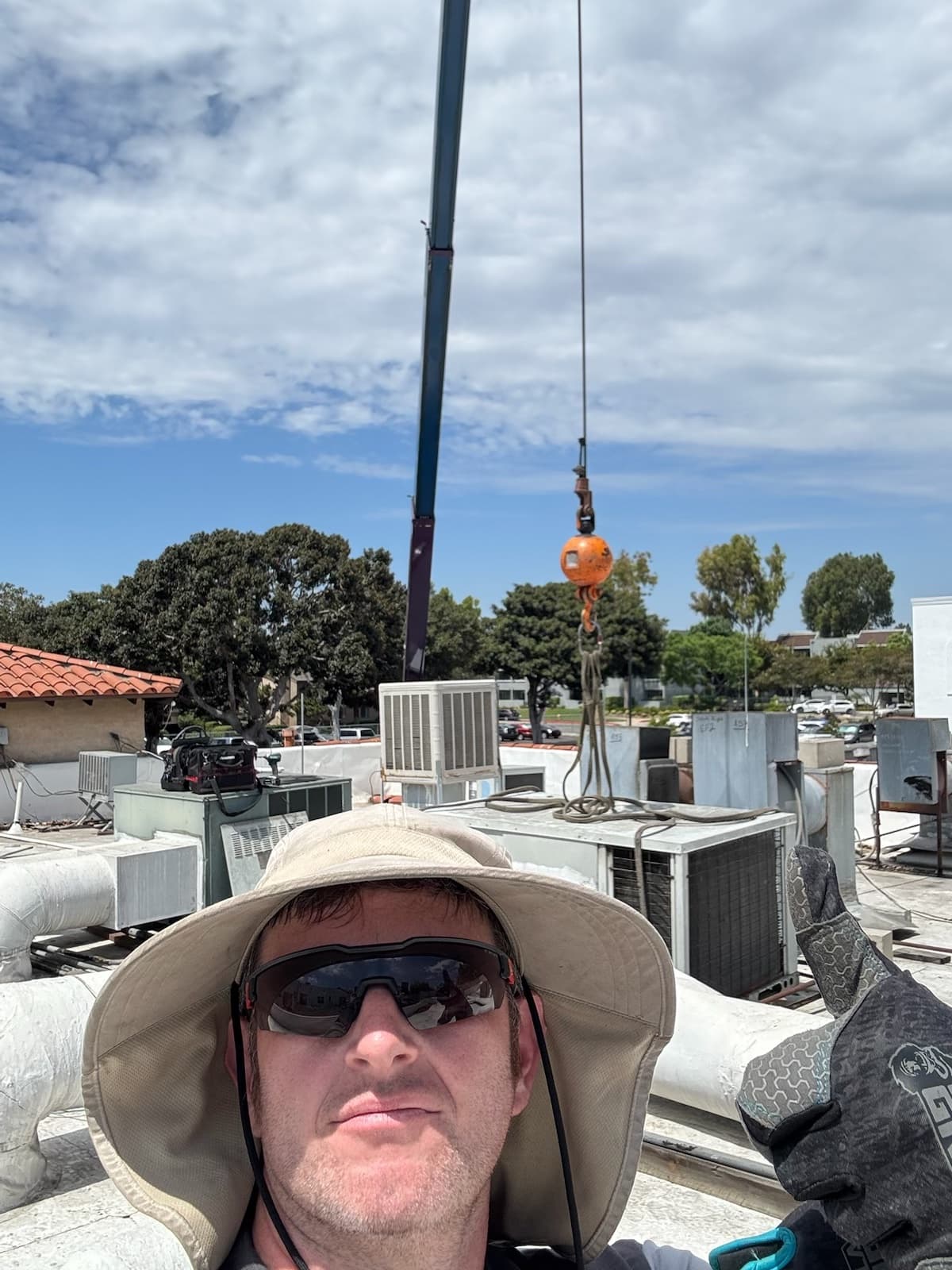
Mobilization planning starts with the site. Crane access and staging for rooftop work, laydown for piping and ductwork, parking for a crew, access hours, badging and background checks on secure or school sites, and the operator's hard dates all shape the plan. On occupied buildings we phase so that conditioning is maintained and shutdowns are short and scheduled. On remote or out-of-state sites we plan travel, lodging, and equipment logistics and build them into the schedule and the price rather than discovering them after award.
Once mobilized, we hold schedule by coordinating the handoffs that mechanical work depends on: roofer, electrician, controls, structural, inspections. Our projects page describes how we run submittals, construction, commissioning and closeout in detail. The short version is that we build the closeout package as the project runs, we load every new asset into the DaVinci Portal with its startup readings, and we are not finished until the owner's team has a working record and the retention is released.
- Price with current equipment lead times and name the release dates the schedule depends on.
- Plan crane, staging, access, and site rules during estimating, not after award.
- Phase occupied-building work to maintain conditioning and minimize shutdowns.
- Build travel and logistics for out-of-area sites into the schedule and price.
- Coordinate trade handoffs and inspections to milestones, and assemble closeout as the work proceeds.
Where we bid and what we bid
We bid multi-unit rooftop replacement programs, chiller, cooling tower and central plant work, boiler and hydronic heating replacements, commercial refrigeration and cold storage systems, commercial water heater and domestic hot water plants, kitchen ventilation and make-up air, VRF and ductless systems, and building controls integration, as prime or as mechanical subcontractor. We work only on commercial, institutional, and public property.
Within Southern California we actively pursue work in Orange County, Los Angeles County, the Inland Empire, San Diego County and Ventura County. The agencies, school districts, colleges, and institutions whose solicitations we follow are listed under bid work, organized by region. The facility types we build in and how each one shapes a project are described under sectors. Beyond California, we pursue larger projects state by state as described above, and we say in every proposal exactly how the project will be licensed, staffed, bonded, and served.
To invite us, send the package described at the top of this page through the contact page or directly by email, with the bid date in the subject line. We confirm receipt, screen the opportunity, and tell you quickly whether we are bidding.