What is actually in a central plant
Owners tend to talk about 'the chiller,' but the plant is a loop of interdependent parts, and the weakest one sets the ceiling for the rest. Knowing which part you are really dealing with is the first step in a sensible service or replacement decision.
| Component | Job | Typical failure pattern |
|---|---|---|
| Chiller (screw, scroll, centrifugal, or air-cooled) | Removes heat from the chilled water loop | Fouled tubes, low charge, oil return problems, failed starters or drives, tripped safeties from high head pressure |
| Cooling tower | Rejects heat to atmosphere through evaporation | Scale and biological growth, failed fill, fan gearbox or motor wear, drift eliminator damage, basin leaks |
| Condenser water pumps | Move water between chiller and tower | Seal leaks, impeller wear, misalignment, cavitation from low basin level |
| Chilled water pumps and VFDs | Circulate cold water to air handlers and fan coils | Bearing failure, drive faults, loss of differential pressure control |
| Controls and sensors | Stage equipment and protect it | Drifted temperature probes, bypassed safeties, outdated staging logic |
Air-cooled chillers sit on a roof or pad and reject heat directly to outdoor air; water-cooled plants trade that simplicity for better efficiency and a tower that needs real water treatment. Our commercial chillers and hydronic systems guide goes deeper on the tradeoffs.
Failure modes we look for before they become outages
Most chiller trips are symptoms. The safety that opened is doing its job; the question is what pushed the machine to the edge. We work backward from the fault code to the condition that caused it.
- High condensing pressure: usually tube fouling, a tower that cannot reject load, non-condensables, or a condenser water flow problem rather than the chiller itself.
- Low evaporator temperature or freeze-stat trips: low chilled water flow, a stuck bypass valve, or a refrigerant charge problem that has been hiding behind a clean-looking sight glass.
- Short cycling: an oversized machine on a light load, bad staging, or a loop with too little water volume.
- Oil and motor issues: winding insulation trends, oil analysis results, and starter contact wear tell the story months before a compressor locks up.
- Approach temperature drift: the gap between leaving condenser water and refrigerant saturation temperature is one of the cleanest early-warning numbers a plant produces.
A fouled condenser tube bundle raises head pressure slowly, and operators compensate by running another tower cell. The plant keeps working, the energy use climbs, and the real cause stays buried until a hot week pushes the machine over its limit.
Cooling towers, water treatment, and Legionella risk
A cooling tower is an open water system exposed to outdoor air, which makes it a place where Legionella can grow if water management slips. ASHRAE Standard 188 and its companion guidance for building water systems expect owners to maintain a written water management program, with defined control limits, monitoring, and corrective actions. California jurisdictions and insurers increasingly expect to see one for towers; confirm what applies to your building.
We handle the mechanical side of that program: basin and fill inspection, drift eliminator condition, make-up and blowdown hardware, flow and conductivity controls, and fan and drive reliability. Chemical treatment is performed by your water treatment provider, and we coordinate with them so scale, corrosion, and biological control are not working against each other. When a tower is shut down seasonally or for a long weekend, we will tell you what the restart procedure should include.
The sequence of operation is the real specification
Two identical chillers can behave very differently depending on how the plant is told to stage them. We read the sequence of operation the way an engineer would, then compare it against what the plant actually does.
- Confirm the call for cooling and the chilled water supply setpoint, and whether it resets with load or outdoor conditions.
- Verify that flow is proven before the chiller is allowed to start, and that condenser water is proven on water-cooled machines.
- Check lead-lag staging, rotation, and minimum run and off timers so one machine does not carry all the hours.
- Confirm tower fan staging, condenser water setpoint, and any wet-bulb based reset.
- Test safeties and alarms by simulating the condition, not by assuming the point is mapped.
Where a plant has been running on manual overrides for years, we document the intended sequence, restore it, and leave a written copy at the plant. Our building controls service handles the programming side when a rewrite is needed.
Our approach versus the quick-fix approach
The common pattern with plant problems is a reset, a part swap, and a promise that it should be fine. That clears the alarm and leaves the cause alone. Our approach is slower at the start and cheaper in the long run for the building.
| Question | Quick-fix visit | Davinci approach |
|---|---|---|
| Chiller tripped on high head | Reset and observe | Log approach temperatures, check tower and flow, then decide whether tubes need cleaning |
| Pump seal leaking | Replace the seal | Check alignment, coupling, and system pressure first so the new seal survives |
| End-of-life question | Quote a like-for-like swap | Review load, refrigerant path, and staging, then present repair and replace options with the reasoning |
| Paperwork | Invoice only | Readings, photos, and findings stored against the asset record in the DaVinci Portal |
Replacement projects: planning, rigging, and downtime
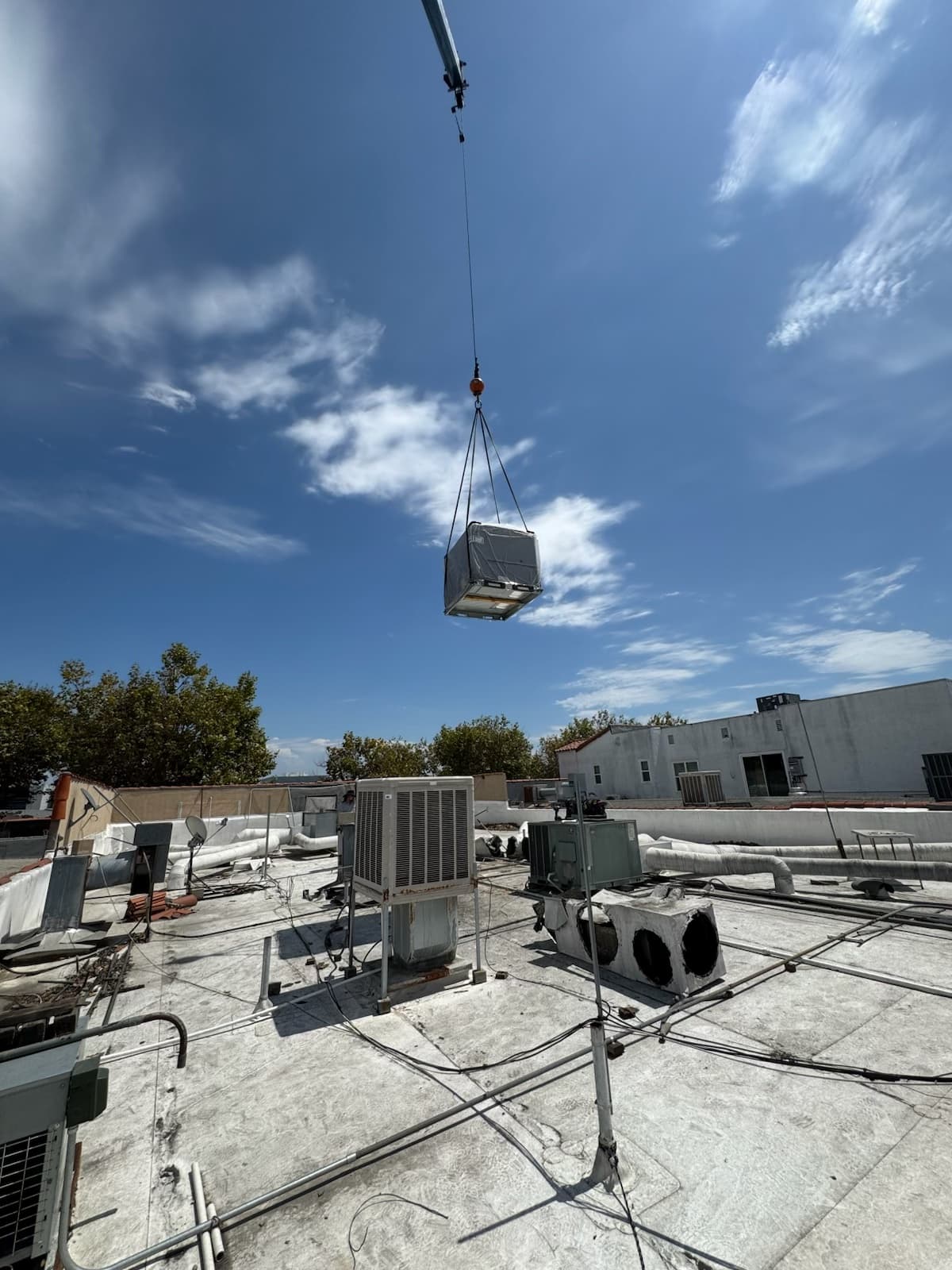
A chiller replacement is a logistics project as much as a mechanical one. Crane or rigging access, structural review for a new frame or pad, electrical capacity, refrigerant type, and the shutdown window all have to line up before the old machine is touched. For many occupied buildings the practical answer is a temporary chiller connection, phased cutover, or a weekend outage with a rehearsed sequence.
- Load and performance review so the new machine is sized for the building as it operates today, not as it was drawn decades ago.
- Permit and Title 24 compliance review, including any acceptance testing the change triggers; confirm current requirements with the local building department.
- Refrigerant planning under current federal and California rules, including recovery and reclaim of the old charge. See our refrigerant compliance guide.
- Start-up and commissioning with the manufacturer, followed by a post-install performance record.
Public owners and larger private projects can run through our bid project process, including prevailing wage and certified payroll where required, with UA Local 250 labor available for the work.
What you receive when we finish
Plant work leaves a trail. Every service or replacement visit ends with records you can hand to an auditor, an engineer, or the next technician.
- Checklist of readings taken: entering and leaving water temperatures, approach, amp draw, pressures, and flow where measurable.
- Photos of nameplates, tubes, tower fill, basin condition, and any failed parts, filed against the asset.
- Written findings ranked by urgency, with the cause identified rather than just the symptom.
- Current sequence of operation and alarm list, including any deviations we found and corrected.
- Refrigerant log entries for any recovery or addition, supporting leak-inspection obligations.
- For replacements: start-up report, commissioning results, controls backup, and O&M documents.
Who this is for (and who it isn't)
This service fits hospitals and clinics, schools and public agencies, hotels, large retail, property management groups, and industrial owners who run chilled water because their buildings depend on it. It also fits engineers and construction managers who need a mechanical contractor for a bid-level plant replacement.
It is not a good fit if you are looking for the lowest possible number to patch a plant and move on, or if the property is residential. We are a commercial contractor, and our value is in diagnosis, documentation, and work that holds up. If that matches what you need, start with a second-opinion diagnostic or call (714) 594-9194.
What a typical visit looks like
- Review the plant: chillers, pumps, towers, controls, and recent operating history
- Take full operating readings and compare against design and prior visits
- Inspect and test safeties, strainers, VFDs, valves, and control sequences
- Report findings with prioritized repairs and a forward capital outlook
- Document the plant by asset in the DaVinci Portal for the next visit
Problems we most often find
- Falling delta-T pushing chillers to run more than the load requires
- Fouled condenser tubes or coils raising approach temperature and amp draw
- Neglected water treatment causing scale, corrosion, and biological growth
- Controls overridden to manual and never returned to automatic
FAQ
Do you service both air-cooled and water-cooled chillers?
Yes. We work on air-cooled and water-cooled plants and the equipment around them: pumps, towers, VFDs, valves, and controls.
Can you help plan a chiller replacement?
Yes. Replacement planning covers load verification, refrigerant choice, rigging and power, temporary cooling, and phasing so the building stays comfortable.
Do you bid central plant projects?
Yes, as prime or mechanical subcontractor, in Orange County and beyond on a project-by-project basis.
Chiller & Central Plant Service: where we work
Orange County is our home base. For larger commercial and public projects we also work across Los Angeles County, the Inland Empire, San Diego County, and Ventura County.