Building Controls & Automation in Riverside, CA
Controls in Riverside buildings often outlive the people who programmed them. Schedules drift, economizer dampers stick, and sensors read wrong, so units run harder than the weather requires. In a city where cooling dominates energy use, correcting economizer operation, setpoints, and occupancy schedules is one of the most practical improvements available. We verify sensors, test damper actuators, and document the sequences so government and institutional owners know what the system is doing.
A government, university, and healthcare center with historic downtown buildings, Magnolia Avenue retail, and a hot, dry summer that keeps rooftop equipment near its limits for months.
How building controls & automation work plays out in Riverside
The schedule on a Riverside rooftop unit is often a fossil. The county or city office on the downtown government campus runs its units from 5 a.m. to 8 p.m. because a tenant in 2009 worked those hours. The retail center near the Galleria at Tyler cools empty inline space on Sunday mornings. The medical building on Central Avenue has three thermostats fighting each other across a suite that was reconfigured twice. In a city where cooling is the dominant energy cost for commercial property, those lost hours add up to a large share of the utility bill, and the equipment wears accordingly.
Economizers are the second opportunity. Riverside nights and shoulder seasons are cool and dry enough that free cooling is genuinely available for weeks at a time in spring and fall, and the economizer that would use it is often stuck closed, stuck open, or disabled by a sensor that reads 20 degrees off. Stuck open is the worse failure in summer, because the unit is drawing in hot outside air while the compressor runs. Smoke season adds a wrinkle: there are days when the outdoor air is unsuitable, and the controls should let an operator lock out the economizer intentionally rather than leaving staff to discover the problem by smell.
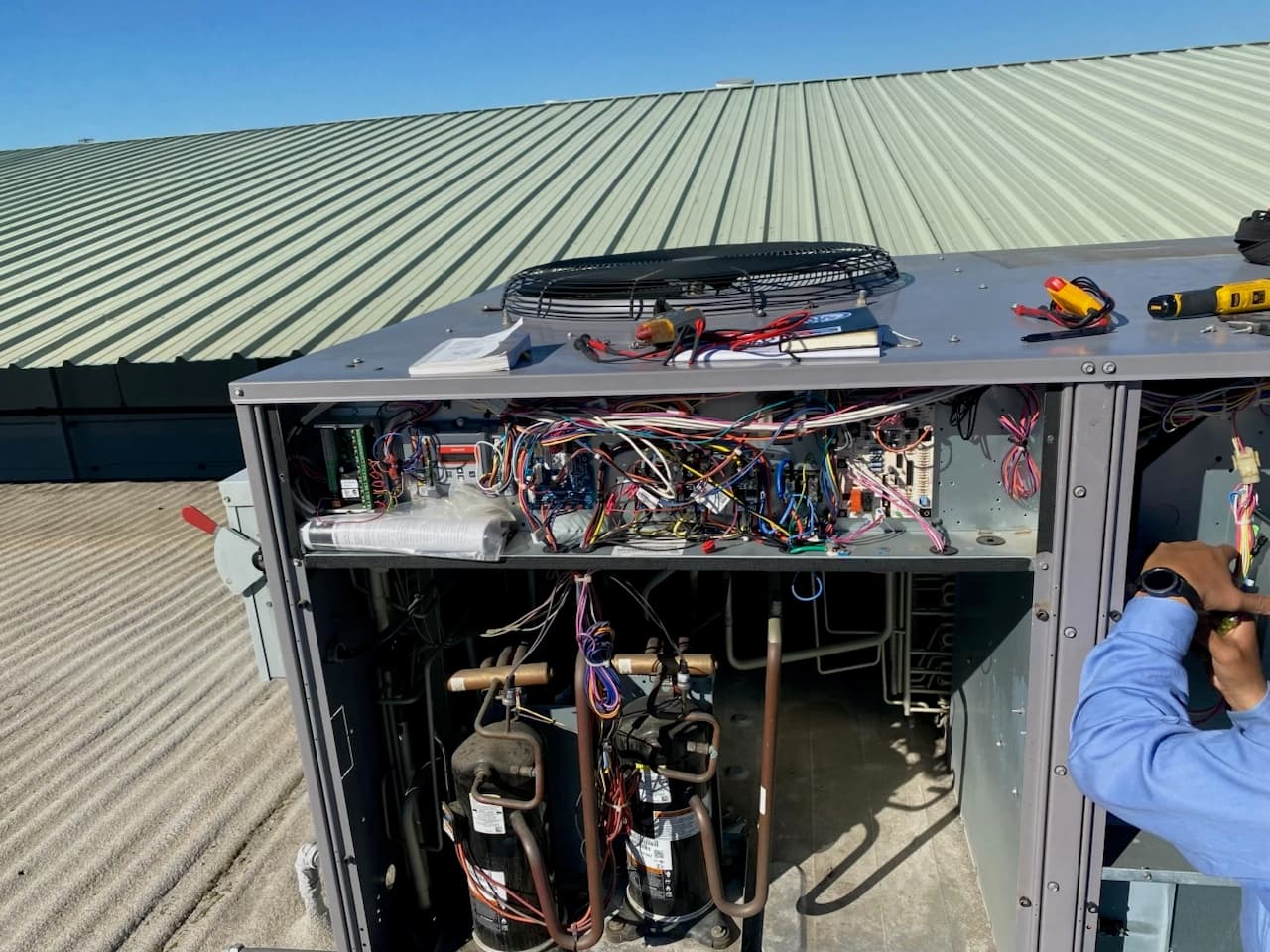
For public and institutional buildings with full building automation systems, including the university campuses, the hospitals, and the larger government buildings, the work is an audit of what the system is actually controlling, sensor calibration, damper actuator testing, sequence verification, and documentation that a new facilities manager can read. For smaller properties, it is often as simple as replacing stand-alone thermostats with networked controls that enforce a real schedule and alert on faults. The building controls page describes both ends of that range, and every sequence change is recorded in the portal.
Riverside's climate and what it does to this equipment
Riverside sits in a basin that traps heat. Summer afternoons routinely climb well past the point where a rooftop condenser is working near its design limit, and nights often fail to cool the building structure enough to give equipment a rest. Smog and fine particulate settle on coils faster than in coastal Orange County, citrus-area dust and pollen add to the load, and wildfire smoke events in the surrounding hills can clog filters in days. Santa Ana conditions in fall bring dry heat and debris. Equipment here needs coil cleaning cadence and refrigerant charge checks built around peak season, not the calendar average.
For the equipment background behind this page, read our building controls and energy guide or the full Building Controls & Automation service page.
- Downtown and Mission Inn areaGovernment buildings, courts, restaurants, and older multi-story commercial properties where mixed equipment generations share one roof or mechanical room.
- UCR and University Avenue corridorCampus-adjacent dining, student-oriented retail, and research and instructional buildings with strict space-temperature expectations.
- Magnolia Avenue medical and retail corridorMedical office buildings, outpatient clinics, and strip retail running along one of the city's busiest commercial arteries.
- Hunter Park and Airport Industrial areasLight industrial, distribution, and manufacturing buildings near the 91 and 60 interchange and the municipal airport, many with rooftop packaged units and walk-in refrigeration.
- Schedule, setpoint, and sequence review across rooftop and central equipment
- Sensor calibration and economizer verification
- Alarm and trend setup so problems surface early
- Programmable and networked thermostat installation
What a building controls & automation visit includes, and the problems we most often find
- Inventory controllers, thermostats, and any building automation system
- Compare schedules and setpoints to how the building is actually used
- Verify sensors, actuators, and economizer logic against measured conditions
- Correct overrides, sequences, and alarms; document the changes
- Review trends after adjustment to confirm savings and stability
- Schedules left at default so equipment runs when nobody is there
- Equipment overridden manually and never returned to automatic
- Drifting or miswired sensors producing comfort complaints
- Economizers that never actually modulate
Building Controls & Automation in Riverside: questions we get
Our Riverside public building has an automation system from the early 2000s. Is it worth fixing or should we replace it?
Should we disable economizers in Riverside during wildfire smoke events?
Do you install building automation systems?
Can better controls really cut energy use?
Can you connect to our existing system?
Other services in Riverside
Building Controls & Automation nearby in Inland Empire (Riverside & San Bernardino Counties)
Commercial HVAC and refrigeration across Inland Empire (Riverside & San Bernardino Counties)