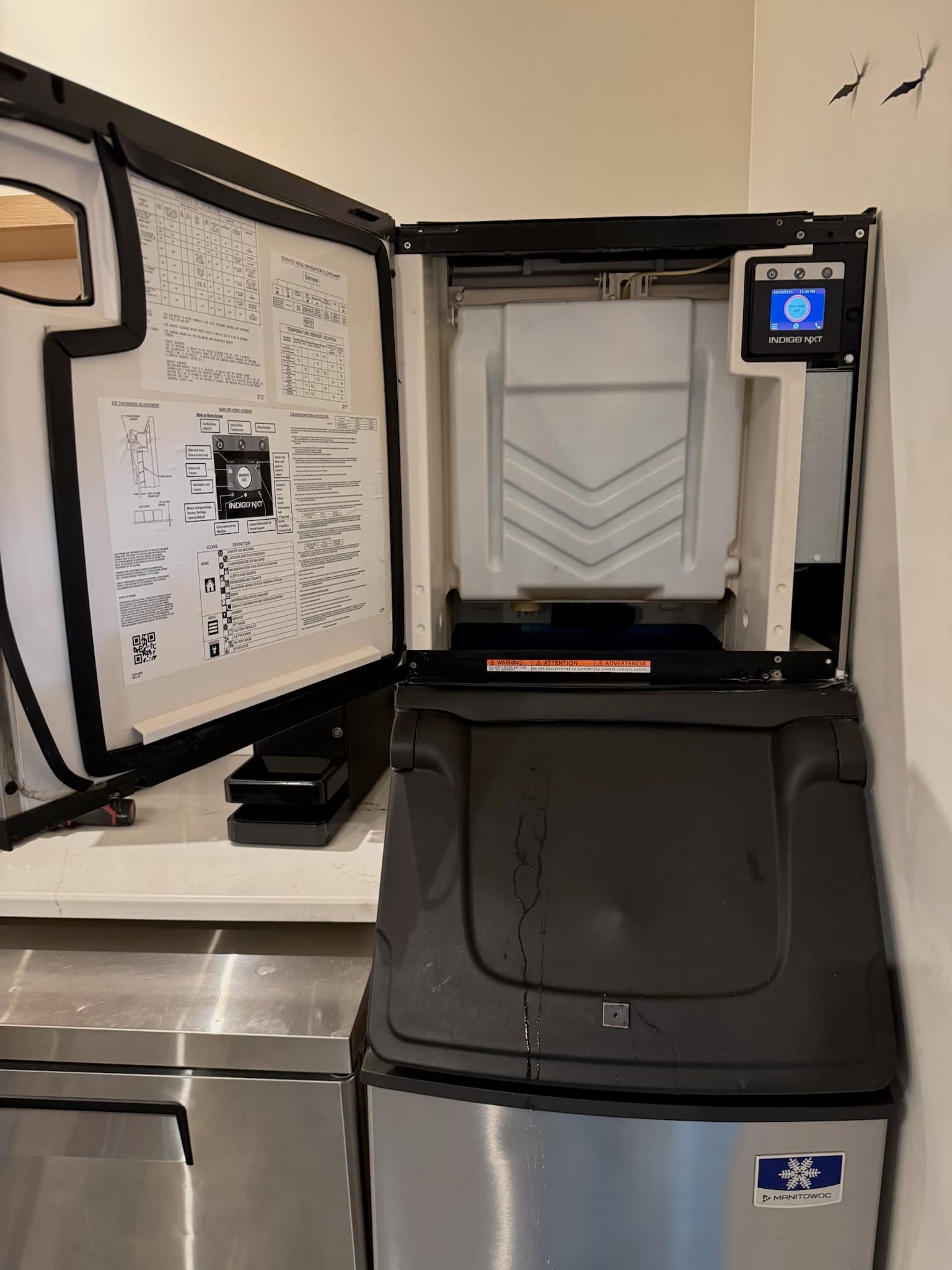
How a commercial ice machine makes ice
Every machine runs a refrigeration circuit, with compressor, condenser, expansion device, and evaporator, plus a water system that feeds, circulates, and drains. In a cuber, water flows over a chilled evaporator plate and freezes into cubes, then a harvest cycle uses hot gas to release them into the bin. Flake and nugget machines freeze water inside a cylinder and scrape it with an auger. Each design has different weak points, and a technician who treats them identically will misdiagnose.
Machines are air-cooled, water-cooled, or remote-condenser. Air-cooled units dominate in tight spaces but depend on clean airflow and ambient temperature. Remote condensers move heat to a roof or outdoor location, which suits hotels and healthcare buildings but adds line sets and wiring to the failure list. Water-cooled units use large volumes of water and are restricted or discouraged in many drought-aware jurisdictions, so confirm local requirements before specifying one.
Symptoms, causes, and what we check
| Complaint | Likely causes | What we measure or inspect |
|---|---|---|
| Low or no production | Scaled evaporator, restricted water inlet, dirty condenser, low charge | Inlet water pressure, harvest and freeze times, condenser temperature, evaporator condition |
| Cloudy or soft ice | Water quality, scale, poor purge | Water TDS, filter age, water curtain and distribution tube |
| Bad taste or odor | Biofilm, spent filter, dirty bin | Water filter date, bin liner condition, sanitation history |
| Machine will not harvest | Hot gas valve fault, low ambient, sensor failure | Valve operation, thermistor values, harvest termination |
| Bin overflows or melts ice | Bin thermostat or sensor drift, door gasket, drain backup | Sensor position, drain slope, gasket seal |
| Short cycling or tripping | Fan failure, dirty coil, electrical fault | Amp draw, condenser fan, voltage under load |
Water quality is the root of most ice problems
Southern California water is hard in many areas, and mineral scale is the single biggest cause of premature ice machine failure. Scale insulates the evaporator, extends freeze times, clogs spray bars and water valves, and eventually damages sensors and pumps. Filters and scale-inhibiting cartridges only help if they are changed on schedule and sized to the machine's flow.
We ask for a local water profile where it matters, set filter replacement intervals around actual flow and not the calendar alone, and flag when pretreatment such as softening or reverse osmosis could pay for itself in avoided service and replacement. Our commercial ice machine guide goes deeper on filtration choices.
Sanitation: what we do and why it matters
Biofilm forms in any wet, dark, cool space, and an ice bin is exactly that. Manufacturers specify cleaning and sanitizing procedures with approved chemicals and contact times, and health codes expect them to be followed. A wipe-down of the bin is not the same thing as a descale and sanitize cycle.
- Remove all ice from the bin and discard it.
- Run the manufacturer's descale cycle with an approved cleaner to remove scale from the water path.
- Disassemble accessible components such as the water distribution tube, curtain, and sensors, then clean by hand.
- Run the sanitize cycle with approved sanitizer at the specified concentration and contact time.
- Clean and sanitize the bin interior, door, and scoop holder.
- Rinse as the manufacturer requires, restart, and discard the first batches.
- Record date, product used, and technician, and attach the record to the asset.
Our approach compared with the quick clean-and-reset
A common ice machine call ends with a technician pulling a few parts, spraying the evaporator, and restarting the machine. If it makes ice that afternoon, the call is closed. This ignores why it stopped, and the root cause, usually water quality, a dirty condenser, or an overlooked drain, remains.
We separate three tasks that are frequently blurred together: repairing a fault, cleaning and sanitizing, and correcting the conditions that caused the fault. A good visit does all three or tells you plainly which ones are outstanding. The condenser coil is cleaned and airflow clearance confirmed. The drain is tested and water flow measured. The refrigerant circuit is checked for charge and pressures. Only then do we call the unit serviced.
Checklist for buying or placing a machine
- Size production for peak-day demand and bin capacity, not average usage; healthcare and hospitality peaks differ sharply from restaurants.
- Confirm ambient temperature in the installation space; hot back-of-house rooms cut output significantly.
- Provide a floor drain or properly sloped indirect drain with an air gap.
- Plan filtration for the actual water supply and allow service clearance for filter changes.
- Leave clearance for condenser airflow on all sides the manufacturer requires.
- Decide on a water-cooled option only after verifying local restrictions and water cost impact.
- Choose a bin location that keeps scooping and loading hygienic and away from floor drains or chemical storage.
Documentation and scheduled service
Each machine is logged in the DaVinci Portal with model, serial, filter dates, sanitation history, readings, and photos. For restaurants, hotels, hospitals, and schools, that record answers the question every inspector eventually asks: when was this last cleaned, and by whom. Sanitation intervals and filter changes can be built into a maintenance plan, with frequency based on volume of use, with busy bars and hospital floors needing more attention than a low-traffic office break room.
Who this is for (and who it isn't)
We serve restaurants and bars, hotels, healthcare and senior care, schools, grocery and food retail, and property managers who supply ice machines to tenants. It suits anyone who treats ice as part of their food safety program and wants a record to prove it.
If you want a machine reset at the lowest cost with no cleaning or water conversation, or if the unit is in a residence, we are not the best match. Commercial-only focus means our time is reserved for clients who use the records and act on the findings.
What a typical visit looks like
- Check ice quality, production rate, and bin sensor operation
- Full descale of water lines and evaporator plate
- Sanitize all food-contact surfaces per manufacturer spec
- Inspect water filtration and replace if due
- Photo-document the cleaning for your compliance records
Problems we most often find
- Scale buildup from hard water slowing production and clouding ice
- Bin sensors misreading and causing over- or under-production
- Water filters overdue for change, affecting both taste and machine health
- Visible slime or mold in the bin — the most common health-inspection flag
FAQ
How often should ice machines be sanitized?
Most manufacturers recommend sanitizing every six months minimum, more often in high-mineral water areas. We'll set the interval based on your machine and water supply.
Can you fix low production without a full replacement?
Often, yes. Scale buildup, refrigerant charge, and water filtration are the most common causes of low ice production and are usually repairable.
Ice Machine Service: where we work
Orange County is our home base. For larger commercial and public projects we also work across Los Angeles County, the Inland Empire, San Diego County, and Ventura County.