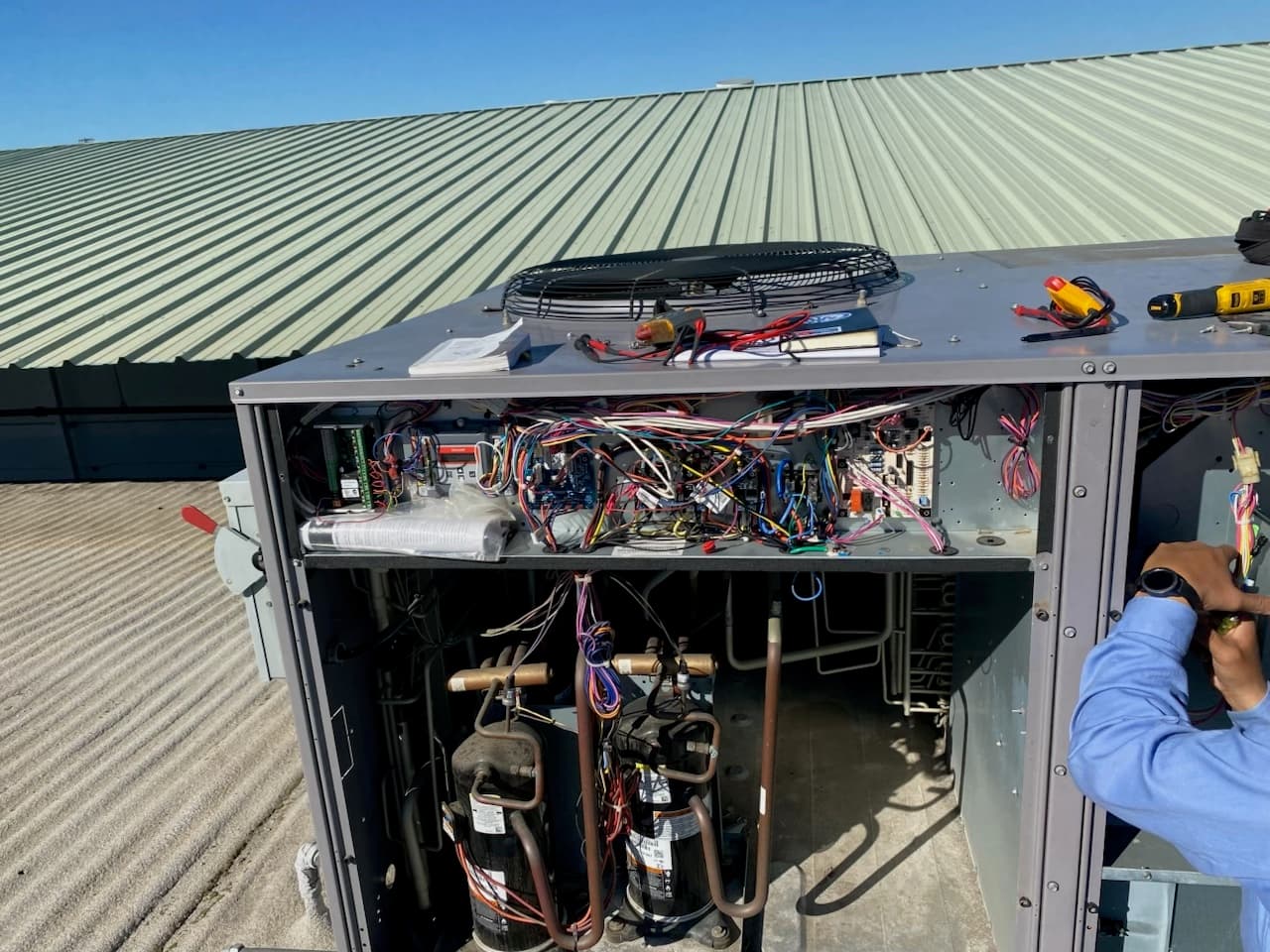
What a real preventive maintenance program contains
The foundation is an asset inventory: every rooftop unit, split system, walk-in, ice machine, water heater, and control panel at the site, identified, tagged, and recorded. Without that, a plan cannot be scoped honestly or audited later. We build the inventory in the first visit and enter each asset into the DaVinci Portal with nameplate data, location, and baseline readings.
From the inventory comes a task schedule per asset type, a frequency based on duty and exposure, and a reporting format. Each visit then measures and records, not just inspects and signs. That is the line between preventive maintenance and a walk-through.
How scope changes with visit frequency
| Cadence | Best suited to | Representative scope |
|---|---|---|
| Annual | Low-duty equipment, small offices, secondary spaces | Full inspection, coil cleaning, electrical and refrigerant checks, safety testing, controls review |
| Bi-annual | Mixed commercial properties with seasonal loads | Cooling-season and heating-season tune-ups, economizer and sensor verification, drain and belt service |
| Quarterly | Restaurants, medical, retail with long hours, coastal sites | Filter changes, coil cleaning, defrost checks, gasket and drain inspection, trend review against prior readings |
| Monthly or custom | Critical facilities, grocery, multi-building campuses | Frequent checks on refrigeration, water systems, and high-risk equipment with alarm review |
Equipment type matters as much as site type. A rooftop unit on a lightly used office can run fine on two visits per year, while a walk-in in a busy kitchen or an ice machine in a hospitality bar usually needs more. We recommend frequency by asset, not by building, and explain the reasoning.
What gets documented, and why
- Readings. Pressures, temperatures, amperage, and airflow indicators recorded at each visit so trends can be seen across seasons.
- Photos. Coil condition, belts, drains, and any failing components, tied to the asset record.
- Findings and priorities. Observations ranked by urgency: immediate safety or product risk, near-term repair, and budget-planning items.
- Refrigerant and compliance logs. Charge adjustments, leak checks, and recovery records to support refrigerant rules.
- Controls and schedule verification. Setpoints, occupancy schedules, and economizer operation checked and documented.
- Summary reports. Readable by a non-technical owner, with the detailed record available for auditors or lenders.
For property managers, that record serves lease administration and CAM reconciliation. For public agencies and schools, it supports capital planning. For restaurants and clinics, it supports inspections and insurance.
How we decide what your plan should include
- Walk the property and inventory equipment with age, condition, and criticality.
- Review the failure history you have, including invoices and any call logs.
- Rank each asset by the consequence of failure: product loss, tenant impact, safety, or regulatory exposure.
- Set frequency and task depth by asset, then roll them into a site schedule that minimizes disruption.
- Agree on reporting recipients and escalation rules, including who can approve repairs and up to what scope.
- Review and adjust after the first year using the data collected.
Plans are described on our plans page, but the final scope is always written for the site. Our preventive maintenance program guide explains the reasoning in more detail.
How this differs from filter-change contracts
Low-cost service agreements often amount to a technician visiting, swapping filters, glancing at the unit, and logging a checkmark. Nothing is measured, so nothing can be compared next visit. Problems are discovered when they fail, and the contract holder discovers that the agreement did not cover the repair.
We structure plans so that measured data drives decisions. If the amp draw on a condenser fan has crept up for three visits, that is a replacement before it fails. If a walk-in is defrosting longer each month, we find out why. And if a rooftop unit is reaching the end of its practical life, we tell you with enough lead time that it becomes a budget line, not a crisis. This is also how maintenance feeds into commercial repair decisions with fewer surprises.
Checklist for evaluating any maintenance proposal
- Does it list the specific assets covered, or only a vague scope like all HVAC?
- Are tasks defined per equipment type with measurable checks?
- Is there a written report after each visit, with readings and photos?
- Does it state which repairs, parts, and after-hours calls are covered, and which are not?
- Is response time for emergencies defined?
- Who owns the asset records if the relationship ends?
- Does the contract address refrigerant logs and compliance recordkeeping?
- Is there a periodic review where scope is revisited against what the data shows?
Who this is for (and who it isn't)
Plans fit facility managers, property management firms, multi-site restaurant and retail operators, medical and veterinary practices, schools and public agencies, hospitality operators, and building owners who want documented upkeep. They work best when someone on your team will read the reports and authorize the follow-up that the data justifies. Our industry pages show how scope changes by sector.
A plan is not the right choice if you want the lowest recurring charge for a filter swap, if you do not intend to act on findings, or if the property is residential. We would rather decline an engagement that will not deliver value than sell one that will not be used.
What a typical visit looks like
- Walk every covered asset — RTUs, refrigeration, ice machines, water heaters
- Take and log readings against each unit's history, not a generic checklist
- Flag anything trending toward failure before it becomes a breakdown
- Deliver a photo-logged report after every visit
- Free diagnostic on any repair that comes out of the visit
Problems we most often find
- Equipment that 'seemed fine' failing without any maintenance history to catch the trend
- Multiple pieces of equipment aging out around the same time with no replacement plan
- Surprise repair costs that a documented PM history would have flagged months earlier
- Multi-location accounts with no consistent record across sites
FAQ
What's the difference between the plan tiers?
Tiers differ by visit frequency and included labor. Quarterly is best for kitchens and refrigeration-heavy sites; annual fits lighter-use office or retail space.
Can one plan cover multiple locations?
Yes — multi-site accounts are common. We'll set up the Portal so each location's equipment and history stay organized separately.
Maintenance Plans: where we work
Orange County is our home base. For larger commercial and public projects we also work across Los Angeles County, the Inland Empire, San Diego County, and Ventura County.