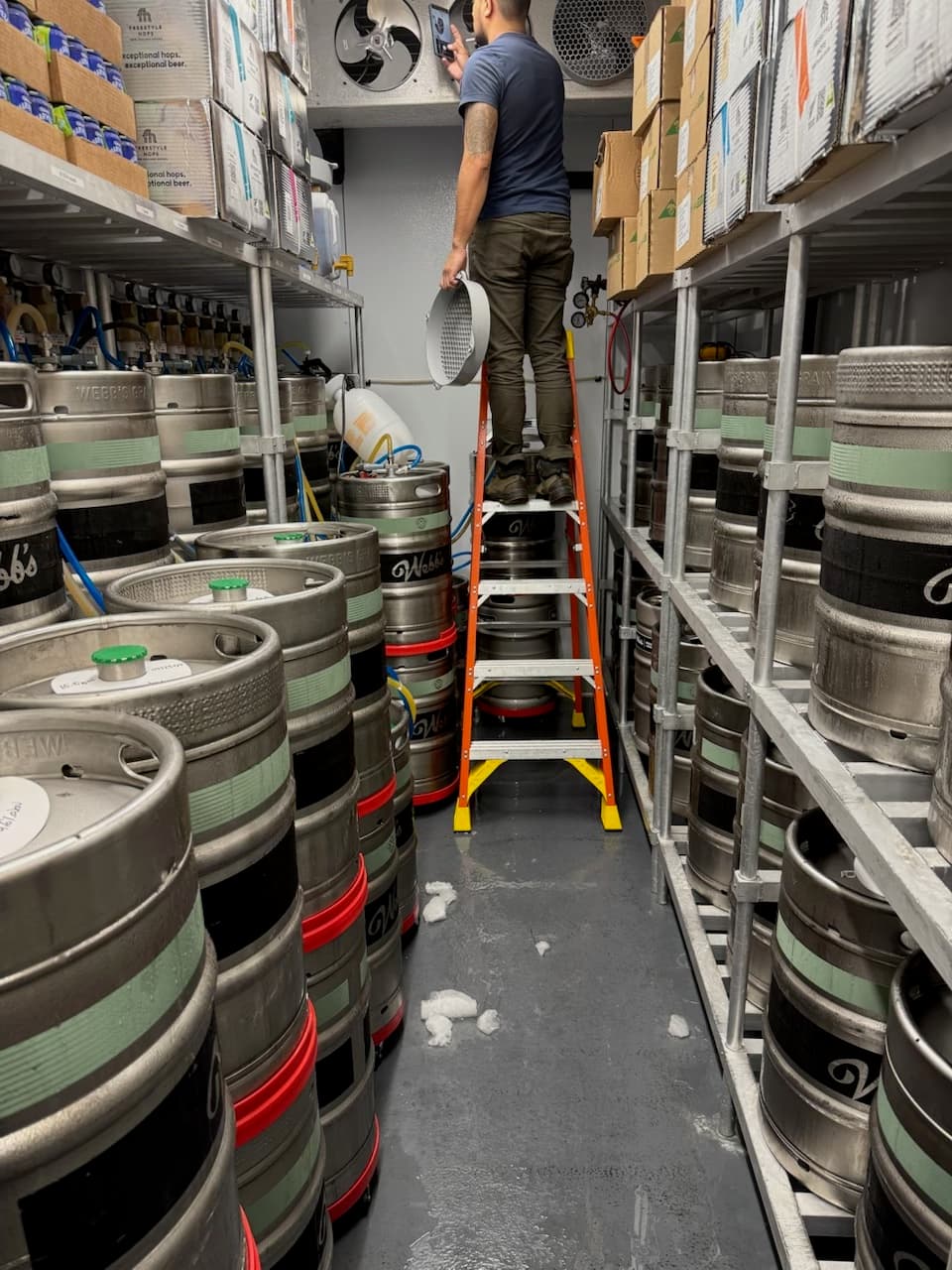
Know which kind of system you have
Refrigeration problems are diagnosed differently depending on the architecture, and many operators do not know which one they own. The categories below cover most of our calls.
| System | Where it is found | What typically goes wrong |
|---|---|---|
| Walk-in with remote condensing unit | Restaurants, bakeries, clinics, small grocers | Condenser fouling, defrost failures, low charge from slow leaks, door and gasket loss |
| Walk-in with outdoor or rooftop condensing unit | Restaurants with limited yard space | Heat exposure, refrigerant line insulation damage, UV and roof heat on controls |
| Reach-in with self-contained condensing | Kitchens, bars, convenience stores | Dirty condensers in greasy air, evaporator fan failure, door gasket wear |
| Display cases on remote rack | Grocery and specialty food retail | Rack control issues, case defrost scheduling, expansion valve hunting |
| Ultra-low and pharmacy or lab units | Medical, veterinary, research | Alarm and monitoring gaps, door-open events, compressor wear under cascade operation |
The failure modes that cost product
Defrost problems
Evaporator coils collect frost by design, and the defrost cycle clears it with electric heaters, hot gas, or off-cycle air. When a heater element, termination thermostat, or timer fails, ice builds across the coil, airflow collapses, and box temperature climbs even though the compressor is running hard. The visible clue is a frozen coil and a warm room. Replacing the compressor in that situation is a costly error we see more than we should.
Condenser and ventilation problems
Condensing units reject heat to the air around them. In a kitchen, that air is full of grease and lint. On a roof in summer, it is hot enough to cut capacity. A condenser that is dirty or starved for air pushes head pressure up, stresses the compressor, and shortens its life. Cleaning and clearance are routine, but only happen when somebody owns the task.
Slow refrigerant loss
A system that gets topped off every season has a leak. Adding refrigerant without finding the leak is both unprofessional and, for larger systems, subject to leak inspection and repair rules. See the next section.
Refrigerant rules you should be aware of
Federal and California rules govern how refrigerants are handled, recovered, recorded, and replaced. Systems above certain charge thresholds have leak inspection, repair, and record requirements, and California's regulations on high-GWP refrigerants are tightening the choices for new and retrofit equipment. Requirements and dates change, so confirm what applies to your equipment with current guidance. Our refrigerant compliance guide summarizes the framework in plain language.
In practice, we log refrigerant type, quantity added or recovered, and leak findings for every visit, and we recommend leak repair rather than recharge. If a system uses a refrigerant that is becoming difficult to source, we tell you early so replacement can be planned instead of forced.
Health code and food safety considerations
Environmental health inspectors look at holding temperatures, thermometer placement and accuracy, gasket and door condition, condensate management, and ice buildup. A box that runs near the limit during an inspection is a violation waiting to happen. Our work is aimed at giving you margin: stable holding temperatures, working door seals and closers, and clean drains.
- Interior thermometers visible and calibrated.
- No standing water or ice on floors, door thresholds, or shelving.
- Evaporator drain pans and lines clear, with heat tape or trace where needed in freezers.
- Door gaskets continuous, flexible, and sealing on all sides.
- Light fixtures and fan guards intact and cleanable.
- Product loading that leaves airflow paths around the evaporator.
How our approach differs from a top-off-and-go call
The common refrigeration call is brief: add refrigerant, replace a fan motor, clear a drain, and move on. That can solve the problem in front of you and leave the cause untouched. When a compressor is replaced without finding why it failed, the new one commonly fails the same way, because the original cause was high head pressure, liquid slugging, a plugged filter drier, or electrical stress.
We measure the system. Superheat and subcooling tell us about charge and metering device behavior; amp draws indicate motor and compressor health; defrost termination temperature and timing prove the cycle; box air temperature at several points shows whether airflow is working. The result is a repair based on evidence, which is exactly what the walk-in cooler and freezer guide recommends. For a broader view of system design, see the commercial refrigeration systems guide.
A quick operator checklist between service visits
- Record box temperature at the same times each day and look for trends, not just limits.
- Look at the evaporator coil monthly for frost patterns; uneven frost is an early warning.
- Check that no shelving or product blocks the evaporator fans.
- Wipe gaskets and test them with a sheet of paper; if it slides out easily, the seal is gone.
- Keep the condensing unit area clear, and report grease or debris accumulation.
- Report water on the floor, unusual fan noise, or short cycling before they become failures.
Records, monitoring, and planned service
Every refrigeration asset we service receives a QR tag and a record in the DaVinci Portal, including model, refrigerant type, readings, and photos. For multi-box sites, that makes it obvious which unit has a history and which one is quietly declining. A scheduled maintenance plan covers coil cleaning, defrost verification, and leak checks on a cadence suited to the kitchen or store environment, which is usually less costly than reacting to losses.
Who this is for (and who it isn't)
We work with restaurants, grocery and specialty food retail, medical and veterinary clinics, schools and institutional kitchens, hospitality operators, and property managers responsible for tenant refrigeration. It suits operators who value product protection and a clean inspection record and want a technician who explains what was found.
If you are looking for the cheapest one-time top-off, a home or residential refrigerator repair, or someone who will not document refrigerant work, this will not match what you need. We keep commercial-only focus so our time goes to systems that justify the rigor.
What a typical visit looks like
- Check current box temperature against setpoint and recent trend
- Inspect door seals, drains, and evaporator/condenser coils for buildup
- Take superheat, subcool, and pressure readings against manufacturer spec
- Address the root cause — not just a temporary recharge
- Log readings to the asset so drift is caught early next visit
Problems we most often find
- Door seals and hinges that no longer hold a tight close
- Evaporator coils iced over from a defrost cycle issue
- Condenser coils caked with grease or debris, especially near kitchen exhaust
- Slow refrigerant leaks that show up as gradual temperature drift, not sudden failure
FAQ
Can you service equipment during business hours?
We can work around service windows for kitchens and retail floors, including early-morning or after-hours visits when product safety is time-sensitive.
Do you handle health-department documentation?
Yes — temperature and pressure readings are logged to the asset in the Portal, so you have a record ready for inspection.
Commercial Refrigeration: where we work
Orange County is our home base. For larger commercial and public projects we also work across Los Angeles County, the Inland Empire, San Diego County, and Ventura County.