Building Controls & Automation in Oxnard, CA
Coastal retail, medical and logistics buildings in Oxnard gain a lot from tuned controls. Mild shoulder-season weather makes economizers valuable, yet salt-fouled outdoor air sensors and sticking dampers can quietly waste that benefit or bring in humid air. We verify schedules, setpoints, economizer operation and sensor accuracy, and put thermostat programming and BAS settings on record. For cold-storage sites, alarm and logging setup is checked so excursions are caught and documented.
Ventura County's largest city, built around agricultural packing, cold storage and food processing, the Port Hueneme harbor area, regional retail at The Collection and the Esplanade, and several hospitals, all under a salt-laden coastal climate.
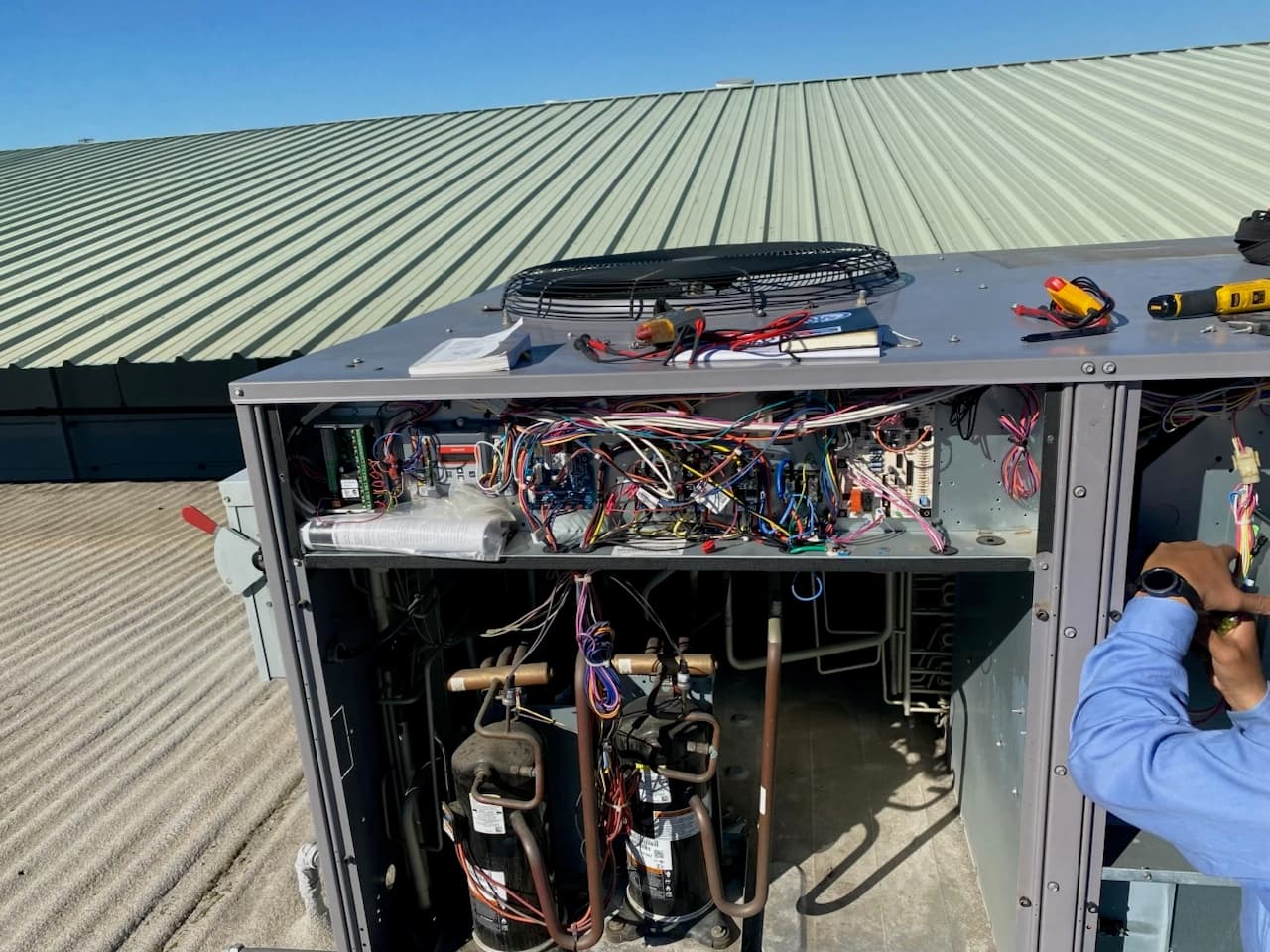
How building controls & automation work plays out in Oxnard
Oxnard's weather is a gift to a building that knows how to use it. Outdoor air sits in the economizer sweet spot for a larger share of the year than almost anywhere in Southern California, which means retail at the Esplanade and RiverPark, offices near the 101 and Gonzales Road, and the warehouse-office buildings along Channel Islands Boulevard can cool with outside air most mornings and many afternoons without running a compressor. That only works if the economizer is actually working, and on a coastal roof the outdoor-air sensor drifts, the damper linkage corrodes and sticks, and the controller quietly reverts to mechanical cooling with nobody noticing except the utility meter.
Humidity complicates the free-cooling story. A dumb economizer that opens on dry-bulb temperature alone can drag in fog-saturated air that leaves a grocery sales floor or a medical waiting room clammy, so the control strategy in Oxnard has to account for moisture, not just temperature. Food plants and cold storage have the opposite priority: the controls that matter are temperature logging, alarm thresholds and notification paths on the refrigerated rooms, because a silent alarm failure is a product-loss event.
Our controls work covers thermostat and schedule verification on smaller buildings, economizer and sensor verification against the Title 24 acceptance requirements on rooftop units, and building automation review on larger medical, institutional and industrial buildings: trend logs, setpoints, lockouts, alarm routing, and a documented record of what the system is supposed to do so the next technician does not undo it. Refrigeration alarm and logging setups are tested end to end, including who gets the call at 2 a.m. For the mechanical side of the equipment these controls run, see the commercial rooftop unit guide.
Oxnard's climate and what it does to this equipment
Oxnard has one of the mildest climates in Southern California, with a persistent marine layer, cool nights, and summer highs that stay moderate near the water. The mildness is deceptive for equipment. Salt-laden air, morning fog and high humidity attack condenser coils, fasteners, cabinet panels and electrical terminals, while airborne farm dust and fine soil clog coils and filters during dry, windy stretches. Santa Ana wind events occasionally push hot, dry air to the coast and spike loads quickly. Systems here tend to fail from corrosion and fouling long before they fail from heat.
For the equipment background behind this page, read our building controls and energy guide or the full Building Controls & Automation service page.
- Agricultural packing and cold-storage corridorsPacking houses, coolers and processing buildings on the Oxnard Plain, where walk-in-scale and engineered refrigeration runs through harvest peaks.
- Port Hueneme and the Channel Islands Boulevard industrial beltMarine-adjacent warehouses, distribution and light industrial space in the harshest salt-air band of the city.
- The Collection at RiverPark and the EsplanadeOpen-air retail, restaurants, theaters and big-box tenants with dense rooftop equipment and heavy kitchen loads.
- Hospital and medical-office clustersAcute-care and outpatient buildings around the central city where reliable cooling, pressure relationships and hot water are non-negotiable.
- Schedule, setpoint, and sequence review across rooftop and central equipment
- Sensor calibration and economizer verification
- Alarm and trend setup so problems surface early
- Programmable and networked thermostat installation
What a building controls & automation visit includes, and the problems we most often find
- Inventory controllers, thermostats, and any building automation system
- Compare schedules and setpoints to how the building is actually used
- Verify sensors, actuators, and economizer logic against measured conditions
- Correct overrides, sequences, and alarms; document the changes
- Review trends after adjustment to confirm savings and stability
- Schedules left at default so equipment runs when nobody is there
- Equipment overridden manually and never returned to automatic
- Drifting or miswired sensors producing comfort complaints
- Economizers that never actually modulate
Building Controls & Automation in Oxnard: questions we get
Our Oxnard retail building has economizers on every rooftop unit but the electric bill never dropped. What should we check?
Have the economizers verified rather than assumed. Common findings on coastal roofs are outdoor-air sensors reading several degrees off, dampers stuck partly closed by corroded linkages, changeover setpoints left at factory defaults that rarely enable free cooling, and actuators that failed years ago. A verification visit tests each unit's economizer through its full sequence and records the results, which is also what Title 24 acceptance testing requires when units are replaced.
What should a temperature alarm setup look like for a cold storage room at an Oxnard packing facility?
It should alarm on temperature excursion with a delay long enough to ignore door openings but short enough to catch a real failure, notify more than one person by more than one method, log continuously so you can prove hold temperature to a buyer, and be tested on a schedule. Many systems are installed correctly and then never tested; a battery-backed sensor with a dead battery looks exactly like a healthy one until it matters. We test the whole chain, including the notification.
Do you install building automation systems?
We install and service thermostats and controls on rooftop and mechanical equipment, and work with larger automation systems on a project basis.
Can better controls really cut energy use?
Often. Correct schedules, setpoints, and economizer operation are among the cheapest efficiency gains in an existing building.
Can you connect to our existing system?
In most cases. Send us what is installed and we will confirm the integration approach.