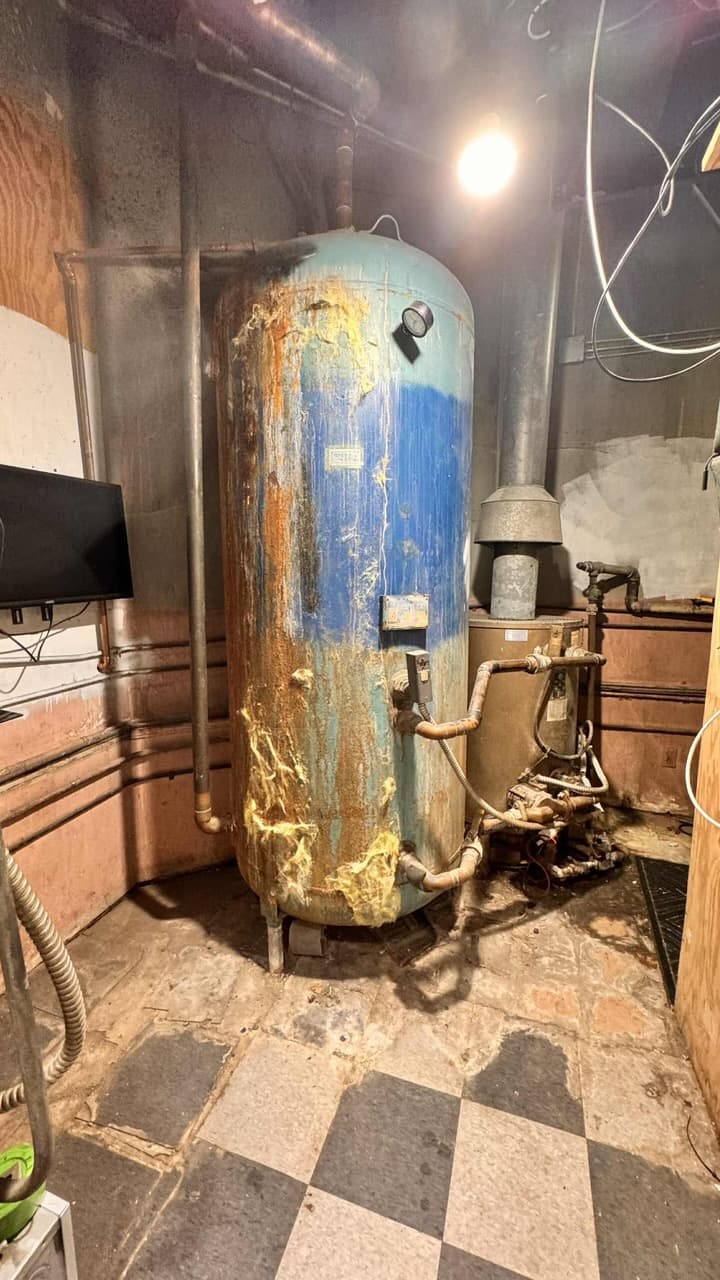
Start with the loop, not the boiler
A boiler only makes hot water. What the building feels depends on pumps, valves, air control, expansion tanks, and the terminal units at the far end of the piping. A surprising share of 'boiler problems' are actually distribution problems, and a new boiler on a bad loop will inherit every symptom of the old one.
So we walk the whole system before recommending anything: supply and return temperatures at the boiler and at representative zones, pump differential pressure, expansion tank pre-charge, makeup water usage, and whether the building is receiving the flow the design assumed. A makeup water meter that keeps climbing is often the best clue that a leak or relief valve is quietly wasting water and feeding corrosion.
Condensing, non-condensing, and why return temperature decides everything
High-efficiency condensing boilers only deliver their rated efficiency when return water is cool enough to pull flue gas below its dew point. A loop designed for high-temperature water and left unchanged will often hold a condensing boiler in its non-condensing range all winter. That does not make condensing equipment a bad choice; it means the loop has to be reviewed, and sometimes reset controls added.
| Boiler type | Works well when | Watch for |
|---|---|---|
| Condensing, modulating | Return temperatures can run low; load varies a lot; efficiency matters | Condensate neutralization and drainage, stainless heat exchanger sensitivity to water quality, venting materials |
| Conventional atmospheric or fan-assisted | High return temperatures are unavoidable or the loop is old and inflexible | Flue condensation if return water runs too cool, higher fuel use |
| Cast iron sectional | Long-life, rugged service in older buildings | Thermal shock, scale, weight and rigging, section leaks |
| Steel firetube or watertube | Larger central plants and process loads | Water chemistry, tube and refractory condition, inspection requirements |
Our commercial water heaters and boilers guide covers the fundamentals if you are comparing options.
Combustion, venting, and air-quality rules
Gas-fired boilers are regulated equipment. In the South Coast region, SCAQMD rules govern NOx emissions for many categories of natural-gas boilers and water heaters, and replacement equipment generally has to be certified to the applicable limits. Rule applicability depends on size and use, so we check current SCAQMD requirements and any permit or registration obligations before specifying a unit rather than after it arrives on a truck.
Safe combustion is also about basics that get skipped: adequate combustion air, correct vent material and slope, a clean burner, a flame signal in the proper range, and safety controls that have been tested instead of trusted. We record combustion readings at high and low fire so the next technician can compare against a baseline rather than guess.
Where boiler systems fail
- Scale and sludge: poor water treatment or constant makeup water insulates the heat exchanger and drives overheating, noise, and eventual cracks.
- Air in the system: air-bound coils and noisy pipes point to failed air separators, vents, or low system pressure.
- Failed circulators and flow switches: a pump that spins but moves little water triggers high-limit trips that look like boiler faults.
- Ignition and flame problems: dirty electrodes, flame sensor drift, gas pressure issues, or blocked intake and exhaust.
- Condensate trouble: clogged neutralizers and traps on condensing units are a common cause of lockouts that disappear when the trap is cleared and return a week later.
- Control interactions: outdoor reset curves, mixing valves, and zone call logic that fight each other and short-cycle the burner.
Seasonal readiness checklist
Heating season in Southern California is short, so boilers sit idle for months and get tested at the worst possible moment. This is the list we run before the first cold week.
- Inspect the heat exchanger, burner, and flue passages; clean per manufacturer procedure.
- Test low-water cutoff, high-limit, flame failure response, and gas valve operation.
- Verify combustion readings and compare to the prior baseline.
- Exercise pumps and motorized valves; check seals, couplings, and amp draw.
- Check system pressure, expansion tank pre-charge, and relief valve condition.
- Test water chemistry and coordinate treatment if readings are off.
- Confirm outdoor reset, schedules, and zone calls behave as intended.
- Clear condensate lines and confirm neutralizer media.
Our approach versus the quick-fix approach
The quick fix is to replace the part that threw the fault and leave. If the cause was air in the loop, bad water, or a failing pump, the new part joins the same conditions that killed the last one. We trace the fault to its source, correct that condition, and write down what we found.
On replacement proposals we present the options with their tradeoffs, including phasing in two smaller boilers for redundancy, rather than defaulting to a single like-for-like unit. Everything is recorded in the DaVinci Portal, so the next visit starts with history, not a blank page.
Replacement projects and project delivery
Replacing a boiler in an occupied building means thinking about heat during the swap. Depending on the site, that can mean a temporary boiler, a staged installation that keeps half the capacity online, or work scheduled around school breaks. We confirm gas line capacity, venting, electrical, floor loading, and access up front, and we pull the permits and handle inspections. Where a project is publicly funded or bid, we work through prevailing wage and certified payroll under our bid project process, and we are PLA-ready.
Who this is for (and who it isn't)
We are the right call for schools and districts, healthcare and senior-care operators, hotels, property managers, and institutional or industrial owners who need hydronic heat to work on the coldest day and want records to prove how it was maintained. We also take on bid-level boiler replacements with drawings and specifications.
We are not the right call for residential work, or for anyone whose goal is the cheapest temporary patch on a failing boiler. If you want the cause found and the system documented, call (714) 594-9194 or ask for a second-opinion diagnostic.
What a typical visit looks like
- Review boiler type, age, fuel, and the loads it serves
- Inspect burners, heat exchanger surfaces, venting, and combustion air
- Run combustion analysis and adjust to manufacturer specifications
- Test safeties and controls; check loop pressure, flow, and water quality
- Document results and recommend repairs or replacement timing
Problems we most often find
- Poor combustion tuning wasting fuel and fouling heat exchangers
- Condensing boilers running with return temperatures too high to condense
- Air in the loop or failing pumps causing cold zones
- Untested safeties on older boilers with no maintenance records
FAQ
Do commercial boilers need annual service?
Yes. Annual combustion tuning and safety testing is standard practice, and boilers are also subject to jurisdictional inspection requirements that vary by type.
Can you replace a boiler without a long shutdown?
Often, with planning: staged piping, temporary heat where needed, and scheduling around the heating season.
Do you work on steam systems?
We evaluate steam and hot-water systems individually. Send us the equipment details and we will confirm scope.
Boiler & Hydronic Service: where we work
Orange County is our home base. For larger commercial and public projects we also work across Los Angeles County, the Inland Empire, San Diego County, and Ventura County.