Building Controls & Automation in Corona, CA
Corona's industrial parks and multi-tenant retail centers often run units on stand-alone thermostats with mismatched schedules, so rooftops run long after tenants leave. Wired and wireless controls, correct occupancy schedules, and verified economizer operation can recover meaningful energy in a city dominated by cooling hours. We verify sensor calibration, test dampers, and document programming so a new facilities manager can pick up where the last one stopped.
A manufacturing and industrial-park city along the 91 and 15 with retail centers, Temescal Canyon heat, and plenty of mid-size rooftop and process cooling loads.
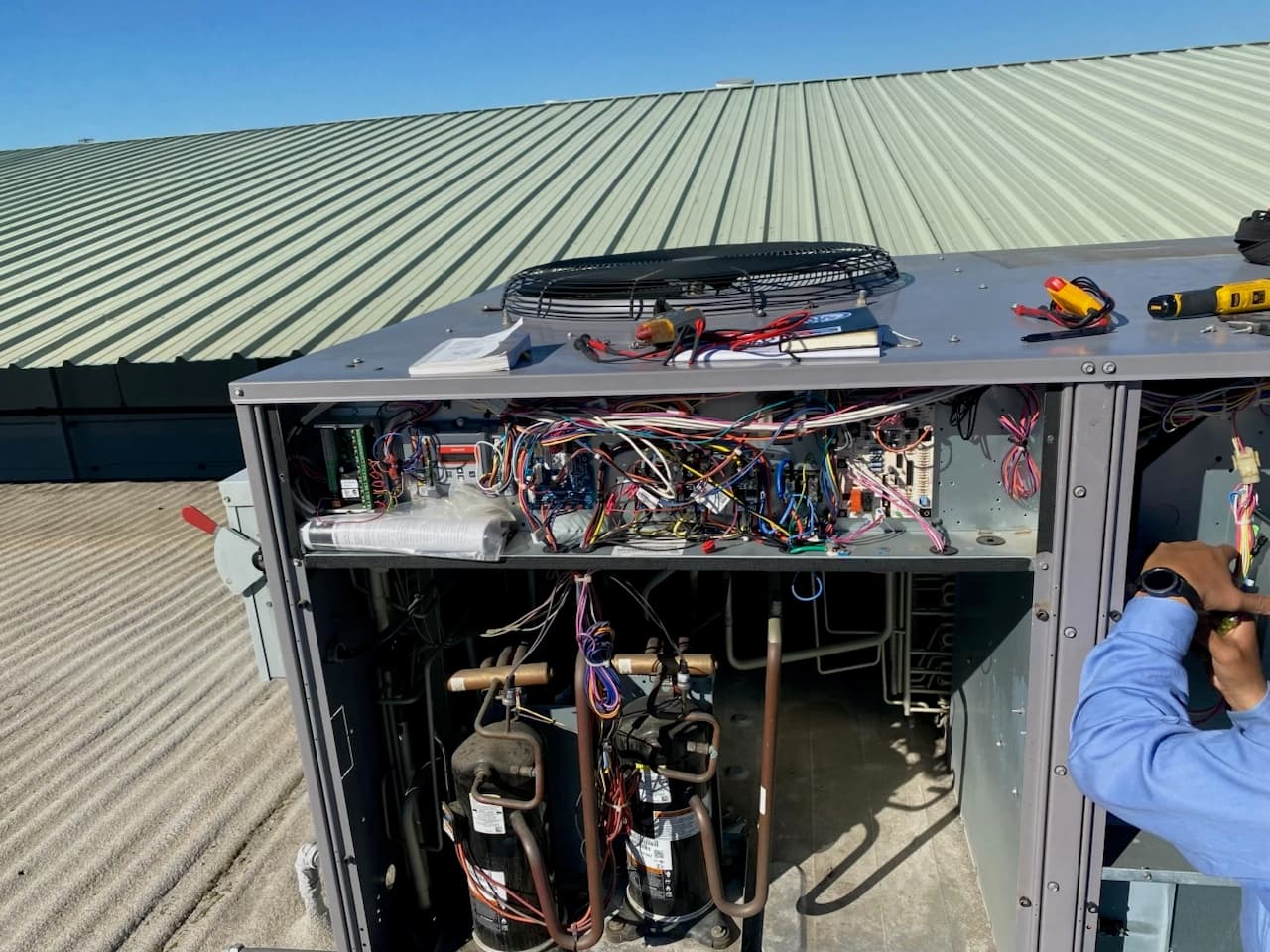
How building controls & automation work plays out in Corona
Count the thermostats on a Corona industrial roof and you will often find one per unit, each set by whoever last touched it, none on a schedule that matches the two shifts the plant actually runs. The office suite runs its cooling all weekend because the thermostat is locked at 72 and nobody reset it after a holiday. The production floor units run through the night because the night shift ended a year ago and the schedule did not change. In a city with as many cooling hours as Corona, the lost energy is substantial, and the equipment ages faster for every one of those unnecessary hours.
Multi-tenant retail near the 91 and at The Crossings and Dos Lagos has the same disease in a different form: each tenant's units on stand-alone thermostats, inline retail cooling at 5 a.m. for a store that opens at 10, and economizers that were never commissioned and have been stuck in whatever position they failed in. Stuck open is the worst outcome on a Corona afternoon, because the unit is pulling in 105-degree air while the compressor runs. Stuck closed throws away the free cooling that spring and fall nights provide. Both go unnoticed for years because a unit with a broken economizer still cools; it just costs more and wears faster.
The practical upgrade for most Corona properties is networked thermostats or a light building automation platform that enforces a real schedule, locks setpoints, alerts on faults, and gives an owner with several buildings a single view. For larger facilities with existing automation, including the hospital, public buildings, and larger plants, the work is an audit of what the system is actually controlling, sensor calibration, actuator testing, and sequence documentation. Plants with refrigerated areas gain the most from alarm thresholds that are set tightly enough to catch drift before product is at risk. Every change is documented in the DaVinci Portal, and the building controls page covers both ends of the range.
Corona's climate and what it does to this equipment
Corona is a heat pocket at the mouth of Temescal Canyon. Daytime temperatures can reach well past 100 degrees for long stretches, and when onshore flow weakens the 91 corridor traps both heat and smog. Santa Ana winds from the northeast drive dust and debris across industrial rooftops and into condenser coils, and wildfire smoke from the surrounding hills and nearby counties can load filters rapidly. The result is equipment that runs at high head pressure much of the summer, with coil fouling and belt or bearing wear that arrives earlier than the manufacturer's schedule suggests.
For the equipment background behind this page, read our building controls and energy guide or the full Building Controls & Automation service page.
- Sampson and Rimpau industrial parksManufacturing and warehouse buildings with a mix of rooftop packaged units, process cooling, and office suites sharing one mechanical footprint.
- Temescal Canyon corridorBusiness parks and industrial space along the canyon, fully exposed to heat, wind, and dust funneling toward the 15 interchange.
- Corona Mall and Auto Center areaRetail, restaurants, and big-box tenants along the 91 frontage, where rooftop equipment is dense and operating hours are long.
- Main Street and downtown CoronaThe Circle, civic buildings, older commercial storefronts, and small restaurants with aging split systems and compact rooftop units.
- Schedule, setpoint, and sequence review across rooftop and central equipment
- Sensor calibration and economizer verification
- Alarm and trend setup so problems surface early
- Programmable and networked thermostat installation
What a building controls & automation visit includes, and the problems we most often find
- Inventory controllers, thermostats, and any building automation system
- Compare schedules and setpoints to how the building is actually used
- Verify sensors, actuators, and economizer logic against measured conditions
- Correct overrides, sequences, and alarms; document the changes
- Review trends after adjustment to confirm savings and stability
- Schedules left at default so equipment runs when nobody is there
- Equipment overridden manually and never returned to automatic
- Drifting or miswired sensors producing comfort complaints
- Economizers that never actually modulate
Building Controls & Automation in Corona: questions we get
We own four industrial buildings in Corona. Is there a way to see and control all the rooftop units in one place?
Our Corona units have economizers but we have never seen them do anything. Are they broken?
Do you install building automation systems?
Can better controls really cut energy use?
Can you connect to our existing system?
Other services in Corona
Building Controls & Automation nearby in Inland Empire (Riverside & San Bernardino Counties)
Commercial HVAC and refrigeration across Inland Empire (Riverside & San Bernardino Counties)