Commercial Refrigeration in Ontario, CA
Ontario's distribution and cold-storage operations have refrigeration that cannot be allowed to drift. Dock doors, constant forklift traffic, and high ambient air load evaporators and condensers heavily. We evaluate evaporator defrost, door and strip curtain condition, condenser performance in peak heat, and controller settings, and we look for patterns that point to a developing compressor or charge problem. For smaller tenants, we service walk-ins, blast units, and reach-ins with the same documentation discipline.
Built around Ontario International Airport, enormous distribution and cold-storage buildings, Ontario Mills, and the Convention Center district, with Santa Ana wind and extreme heat exposure.
How commercial refrigeration work plays out in Ontario
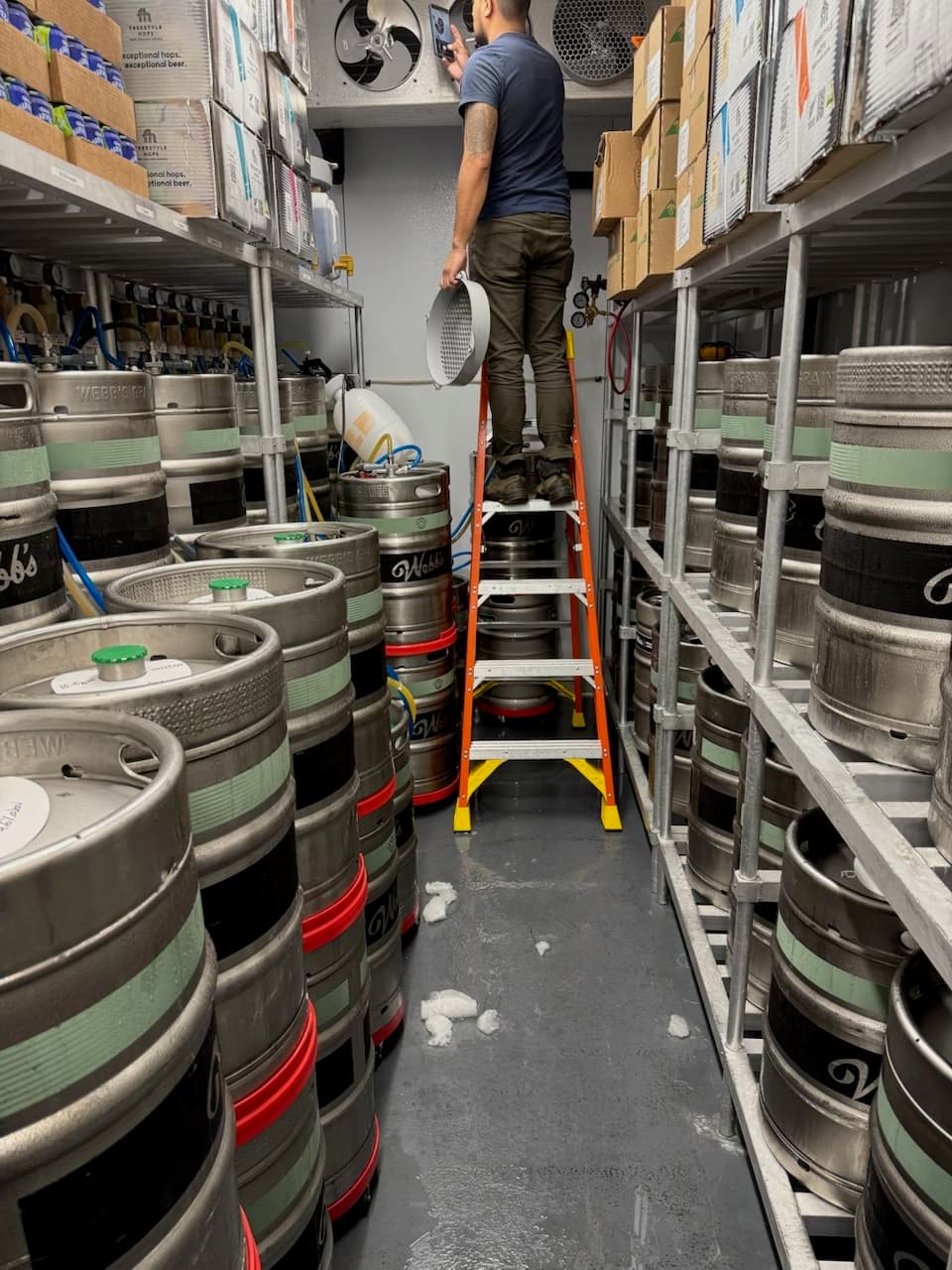
Cold storage is one of Ontario's defining building types. Temperature-controlled distribution buildings near the airport and along the industrial corridors east of Milliken Avenue hold product that moves on a schedule, with dock doors cycling all day, forklifts running in and out, and strip curtains and dock seals that take constant abuse. The refrigeration serving those spaces is often rack systems or large remote condensing units with evaporators spread across thousands of square feet, and the roof-mounted condensers sit in some of the hottest, dustiest air in Southern California during the exact weeks when inbound product volume peaks.
The failure mode that worries operators most is the slow one. A box that holds temperature with the compressors running flat out is already in trouble; it just has not alarmed yet. Fouled condensers raise head pressure, evaporator defrost falls behind because dock doors are open more than the schedule assumed, and a refrigerant leak that started small becomes a product loss on the first weekend the ambient climbs past 105. We look for those trends in the data rather than waiting for the alarm, and we check sister evaporators and condensers for the same pattern.
Ontario also has a large population of smaller refrigeration: walk-ins and reach-ins in the Ontario Mills food court and the restaurants around it, hotel kitchens near the Convention Center, grocery and food tenants along Mountain Avenue and Fourth Street, and newer restaurants in Ontario Ranch. For those, the issues are more familiar: condensing units in hot enclosed alcoves, gaskets, and defrost settings. Every system, large or small, gets readings and photos under its QR tag in the DaVinci Portal, which logistics tenants find useful when a customer or insurer asks for a temperature record. The refrigeration systems guide and the food production and cold storage sector page go deeper.
Ontario's climate and what it does to this equipment
Ontario is flat, hot, and open, so Santa Ana winds arrive with little to slow them. Dry gusts carry dust from nearby industrial sites and open ground onto huge rooftops, where condenser coils collect it quickly. Summer highs are routinely well above 100 degrees on the hottest days, and large dark roofs raise local rooftop air temperatures further. Regional smog and wildfire smoke affect filtration, and sharp swings between day and night temperatures stress controls and refrigeration defrost cycles. For cold storage, this means condensers are working against the worst ambient conditions of the year, usually with the heaviest product loads.
For the equipment background behind this page, read our walk-in cooler and freezer guide or the full Refrigeration: Walk-In & Reach-In Coolers/Freezers service page.
- Airport and logistics corridorsDistribution and cargo buildings near Ontario International Airport, including cold storage and large rooftop equipment arrays.
- Ontario Mills and Ontario GatewayLarge-format retail, entertainment, and hospitality properties with extended operating hours and heavy rooftop equipment loads.
- Convention Center and arena districtEvent venues, hotels, and surrounding offices where ventilation and cooling demand surges during conventions and games.
- Guasti, Inland Empire Boulevard, and Ontario RanchMixed office, restaurant, and newer warehouse and commercial development south and east of the core.
- Evaporator/condenser coil cleaning and defrost checks
- TXV/EEV, superheat, subcool, and pressure readings logged
- Door seals, drains, heaters, and fan packages inspected
- DaVinci Portal: temps and pressures logged by asset over time
What a commercial refrigeration visit includes, and the problems we most often find
- Check current box temperature against setpoint and recent trend
- Inspect door seals, drains, and evaporator/condenser coils for buildup
- Take superheat, subcool, and pressure readings against manufacturer spec
- Address the root cause — not just a temporary recharge
- Log readings to the asset so drift is caught early next visit
- Door seals and hinges that no longer hold a tight close
- Evaporator coils iced over from a defrost cycle issue
- Condenser coils caked with grease or debris, especially near kitchen exhaust
- Slow refrigerant leaks that show up as gradual temperature drift, not sudden failure
Commercial Refrigeration in Ontario: questions we get
Our cold storage building's compressors run almost continuously in July. Is that normal for Ontario or a sign of a problem?
Some increase is expected when ambient temperatures are over 100, but continuous running usually means the system has lost margin somewhere. The usual culprits are condenser coils fouled with dust, a slow refrigerant leak, evaporator frost from dock traffic exceeding what the defrost schedule handles, or dock seals and strip curtains that are no longer doing their job. We measure head pressure and approach temperature against the ambient to find which one, because each has a very different fix.
Can refrigeration service be done during our receiving hours, or do we need to schedule a shutdown?
Most service does not require a shutdown. Condenser cleaning, electrical checks, and controls work happen on the roof or at the rack without stopping the boxes. Evaporator work inside the cold space is coordinated with your receiving and picking schedule so we are not working above active forklift lanes. Where a compressor or rack component has to come offline, we plan it for your lightest window and confirm the remaining capacity will hold temperature with the current product load before we start.
Can you service equipment during business hours?
We can work around service windows for kitchens and retail floors, including early-morning or after-hours visits when product safety is time-sensitive.
Do you handle health-department documentation?
Yes — temperature and pressure readings are logged to the asset in the Portal, so you have a record ready for inspection.
Other services in Ontario
Commercial Refrigeration nearby in Inland Empire (Riverside & San Bernardino Counties)
Commercial HVAC and refrigeration across Inland Empire (Riverside & San Bernardino Counties)