Commercial Refrigeration in Chula Vista, CA
Restaurants and grocery operations in Otay Ranch and EastLake, along with food distribution and cold-storage uses near Otay Mesa, rely on refrigeration that runs through long warm summers. Rooftop and yard condensers on sun-baked roofs lose efficiency quickly if coils are dirty. We diagnose frost, short cycling and poor temperature holding, and keep readings for inspections and audits.
South Bay's largest city, mixing Otay Ranch and EastLake retail and office, a bayfront redevelopment area, hospitals, and Otay Mesa industrial and logistics space tied to the border.
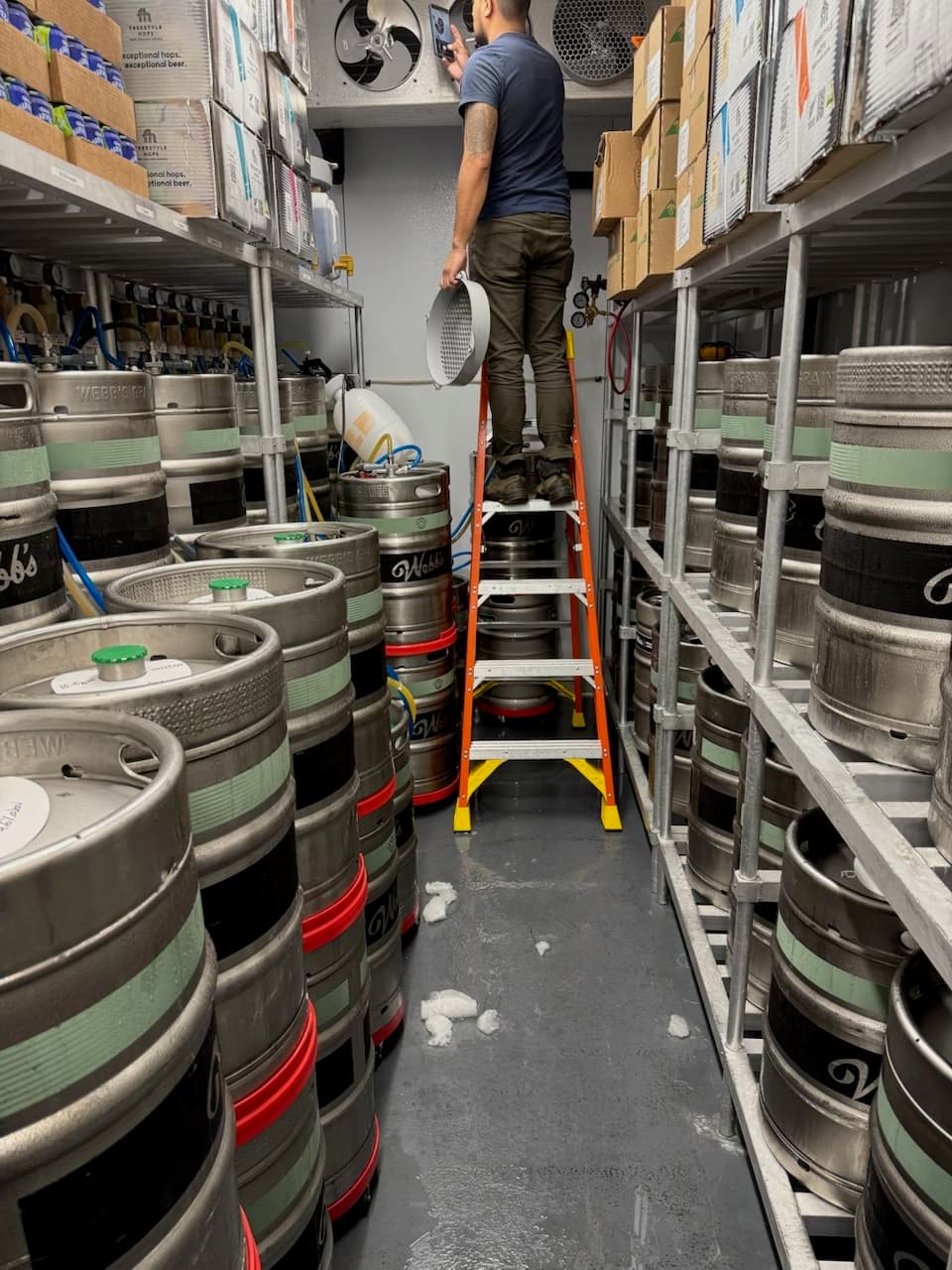
How commercial refrigeration work plays out in Chula Vista
The grocery and restaurant concentration in eastern Chula Vista, from Otay Ranch Town Center and the EastLake shopping centers to the new mixed-use blocks of Millenia, runs a lot of refrigeration through warm summers in a part of the city that gets less marine air than residents expect. Supermarkets with racks, display cases and multiple walk-ins, restaurants with walk-ins and reach-ins, and smaller markets along Third Avenue and Broadway on the west side all share the same enemies: dirty condensers on sun-heated roofs, defrost systems that drift, and door hardware worn by constant use.
A refrigeration job on an Otay Ranch supermarket is a systems job. Parallel racks, remote condensers, case controllers and defrost schedules interact, and a single case running warm can be a case problem, a rack problem or a heat-rejection problem. We read the whole system, check condenser condition and fan operation, verify defrost and controls case by case and log temperatures so the store manager has a record for inspections. On a Third Avenue restaurant with one walk-in and two reach-ins, the job is simpler but the discipline is the same: find the actual cause, fix it, record the readings.
Cold storage and food distribution near the Main Street corridor and Otay Mesa add the logistics dimension. Cold rooms there run continuously, condensing units sit in dusty, windy yards, and the operator usually needs documentation for customers as much as for inspectors. We service those systems with the same root-cause approach and record everything in the DaVinci Portal. The walk-in cooler and freezer guide and the grocery and retail industry page cover the common failure modes in more depth.
Chula Vista's climate and what it does to this equipment
Chula Vista runs from coastal to near-inland within a few miles. Properties near the bay sit in marine air with moderate temperatures, humidity and salt exposure that corrodes coils and enclosures over time. Move east toward Otay Ranch and EastLake and the marine layer thins, summers get warmer and afternoon cooling loads climb. Otay Mesa is exposed, windy and dusty, with warm summers and sun-baked roofs that load rooftop equipment heavily. Heat events and late-season Santa Ana winds can push all of these areas beyond ordinary design conditions, especially for older or undersized systems.
For the equipment background behind this page, read our walk-in cooler and freezer guide or the full Refrigeration: Walk-In & Reach-In Coolers/Freezers service page.
- Otay Ranch and EastLakeNewer retail, restaurant, medical and professional buildings, many with rooftop equipment approaching mid-life and warmer inland exposure.
- Bayfront redevelopment areaA shoreline transitioning from industrial to hospitality, civic and mixed-use, with new construction alongside older buildings exposed to bay air.
- Otay Mesa industrial and logisticsWarehouses, distribution and light manufacturing buildings with large open volumes, loading docks and ventilation or cooling needs tied to cross-border logistics.
- Medical campusesHospitals and surrounding medical offices that rely on continuous cooling, reheat, hot water and well-documented maintenance.
- Evaporator/condenser coil cleaning and defrost checks
- TXV/EEV, superheat, subcool, and pressure readings logged
- Door seals, drains, heaters, and fan packages inspected
- DaVinci Portal: temps and pressures logged by asset over time
What a commercial refrigeration visit includes, and the problems we most often find
- Check current box temperature against setpoint and recent trend
- Inspect door seals, drains, and evaporator/condenser coils for buildup
- Take superheat, subcool, and pressure readings against manufacturer spec
- Address the root cause — not just a temporary recharge
- Log readings to the asset so drift is caught early next visit
- Door seals and hinges that no longer hold a tight close
- Evaporator coils iced over from a defrost cycle issue
- Condenser coils caked with grease or debris, especially near kitchen exhaust
- Slow refrigerant leaks that show up as gradual temperature drift, not sudden failure
Commercial Refrigeration in Chula Vista: questions we get
Our Otay Ranch supermarket has one display case that runs warm while the rest of the rack is fine. Case or rack problem?
Usually the case, but confirm before replacing parts. A single warm case on an otherwise healthy rack points to that case's expansion valve, evaporator fan, defrost heater or termination control, a restricted line or a case controller setpoint that drifted. If several cases on the same suction group are marginal, the rack or the condenser is the suspect. We check both sides with readings, which is faster and cheaper than guessing at the case alone.
How often should walk-in condensers be cleaned on a Chula Vista restaurant roof in Millenia or EastLake?
At least quarterly in the warm half of the year, with an inspection more often if the roof collects grease from a nearby kitchen exhaust or dust from surrounding construction. Eastern Chula Vista roofs get hot in summer and the air is drier than the bayfront, so coils load with dust and the condensing unit needs every bit of airflow. A clean condenser is the single most effective way to keep a walk-in holding temperature through August.
Can you service equipment during business hours?
We can work around service windows for kitchens and retail floors, including early-morning or after-hours visits when product safety is time-sensitive.
Do you handle health-department documentation?
Yes — temperature and pressure readings are logged to the asset in the Portal, so you have a record ready for inspection.