Chiller & Central Plant Service in Fontana, CA
Fontana's hospital campus, larger medical and office buildings, and some industrial process cooling run on central plants. Heat and dust punish cooling towers and air-cooled condensers, while water treatment lapses cause scale and fouling. We examine chiller loading, condenser approach temperature, pumping, and controls, and prepare replacement or overhaul plans that keep critical spaces cooled throughout the project.
One of the Inland Empire's heaviest logistics and warehouse cities, with a major Kaiser medical campus, industrial corridors, and relentless heat and dust.
How chiller & central plant service work plays out in Fontana
Central plant work in Fontana is concentrated in healthcare. The Kaiser Permanente Fontana Medical Center and the medical office buildings around it rely on chilled water systems whose cooling towers face the full force of the local environment: dust that settles on fill and basins within days, ozone and particulate in the air, and ambient temperatures that push approach temperatures up through the entire cooling season. Water treatment is not optional here. A tower with lapsed treatment scales quickly, and the chiller downstream pays for it in fouled condenser tubes and lost capacity.
A representative call is a medical office building with upper floors running warm in July while the plant shows full load. The chiller is often fine; the tower fill is scaled, the condenser tubes are fouled, and the approach temperature is well above design. We measure approach, flow, and pressure drop, review the treatment log, and separate the cleaning problem from the equipment problem. Industrial process cooling in the logistics and manufacturing buildings along the corridors has a similar profile, with air-cooled condensers that lose capacity in the heat and dust and need coil cleaning on an aggressive cadence.
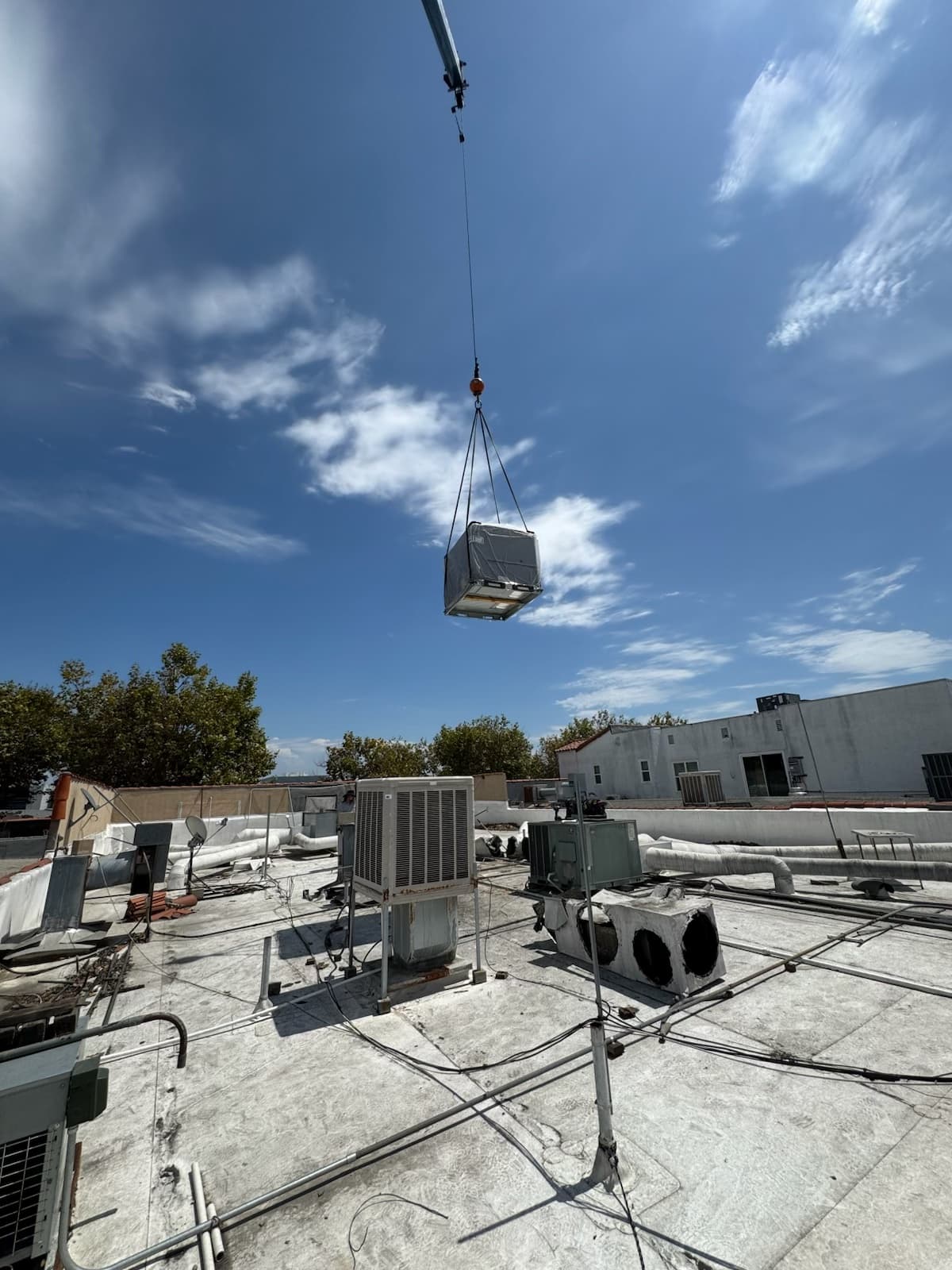
Replacement or overhaul projects at healthcare facilities carry additional requirements for infection control, construction phasing, and in some cases state oversight, and we plan around them from the beginning. The cooler months are the window for plant shutdowns, and a phased approach with temporary cooling keeps critical spaces served. The hospitals and health systems sector page for the Inland Empire and the chillers and hydronic systems guide describe how we handle these projects.
Fontana's climate and what it does to this equipment
Fontana is among the hottest and windiest parts of the region. Its position near the Cajon Pass and the base of the mountains means Santa Ana winds, and the strong gusts that come with them, strike with more force than in many neighboring cities. Dust from open ground and construction settles on coils, filters, and rooftop surfaces, and air quality is frequently poor in summer because of ozone and particulate. Wildfire smoke adds more load. Triple-digit heat is routine in summer, so condensers operate near their limits for long periods, and cold storage faces its highest loads at the worst possible ambient conditions.
For the equipment background behind this page, read our chillers and hydronic systems guide or the full Chillers & Central Plant Service service page.
- Slover, Jurupa, and Miller logistics corridorsLarge distribution and fulfillment buildings with extensive rooftop equipment, dock areas, and temperature-controlled space.
- Kaiser medical campus and Sierra AvenueHospital, clinics, pharmacies, and professional offices with high expectations for air quality, temperature stability, and uptime.
- Speedway-adjacent industrial areaLarge-scale industrial and warehouse development in the northwest part of the city, exposed to open ground and strong wind.
- Downtown Fontana and Valley BoulevardSmaller retail, restaurants, and service businesses in older buildings with split systems and compact rooftop units.
- Chiller, tower, pump, and VFD service with logged operating data
- Trend-based diagnosis: approach, delta-T, amp draw, and pressures
- Replacement planning with rigging, power, and temporary cooling considered
- Water-treatment and Legionella-control coordination for water-cooled plants
What a chiller & central plant service visit includes, and the problems we most often find
- Review the plant: chillers, pumps, towers, controls, and recent operating history
- Take full operating readings and compare against design and prior visits
- Inspect and test safeties, strainers, VFDs, valves, and control sequences
- Report findings with prioritized repairs and a forward capital outlook
- Document the plant by asset in the DaVinci Portal for the next visit
- Falling delta-T pushing chillers to run more than the load requires
- Fouled condenser tubes or coils raising approach temperature and amp draw
- Neglected water treatment causing scale, corrosion, and biological growth
- Controls overridden to manual and never returned to automatic
Chiller & Central Plant Service in Fontana: questions we get
Our medical building's chiller in Fontana cannot keep up in the afternoon. Does it need replacing?
How do you keep a Fontana healthcare building cooled during a central plant project?
Do you service both air-cooled and water-cooled chillers?
Can you help plan a chiller replacement?
Do you bid central plant projects?
Other services in Fontana
Chiller & Central Plant Service nearby in Inland Empire (Riverside & San Bernardino Counties)
Commercial HVAC and refrigeration across Inland Empire (Riverside & San Bernardino Counties)