Chiller & Central Plant Service in Ontario, CA
Ontario's Convention Center area, larger hotels, healthcare, and some airport-related facilities depend on central plants, where cooling must be available at the moment events or flights peak. Cooling towers in dry, dusty air lose efficiency quickly through scaling and debris, and water treatment becomes critical. We examine chiller performance, tower condition, pumping, and controls, and plan major work around event calendars so cooling is available when attendance peaks.
Built around Ontario International Airport, enormous distribution and cold-storage buildings, Ontario Mills, and the Convention Center district, with Santa Ana wind and extreme heat exposure.
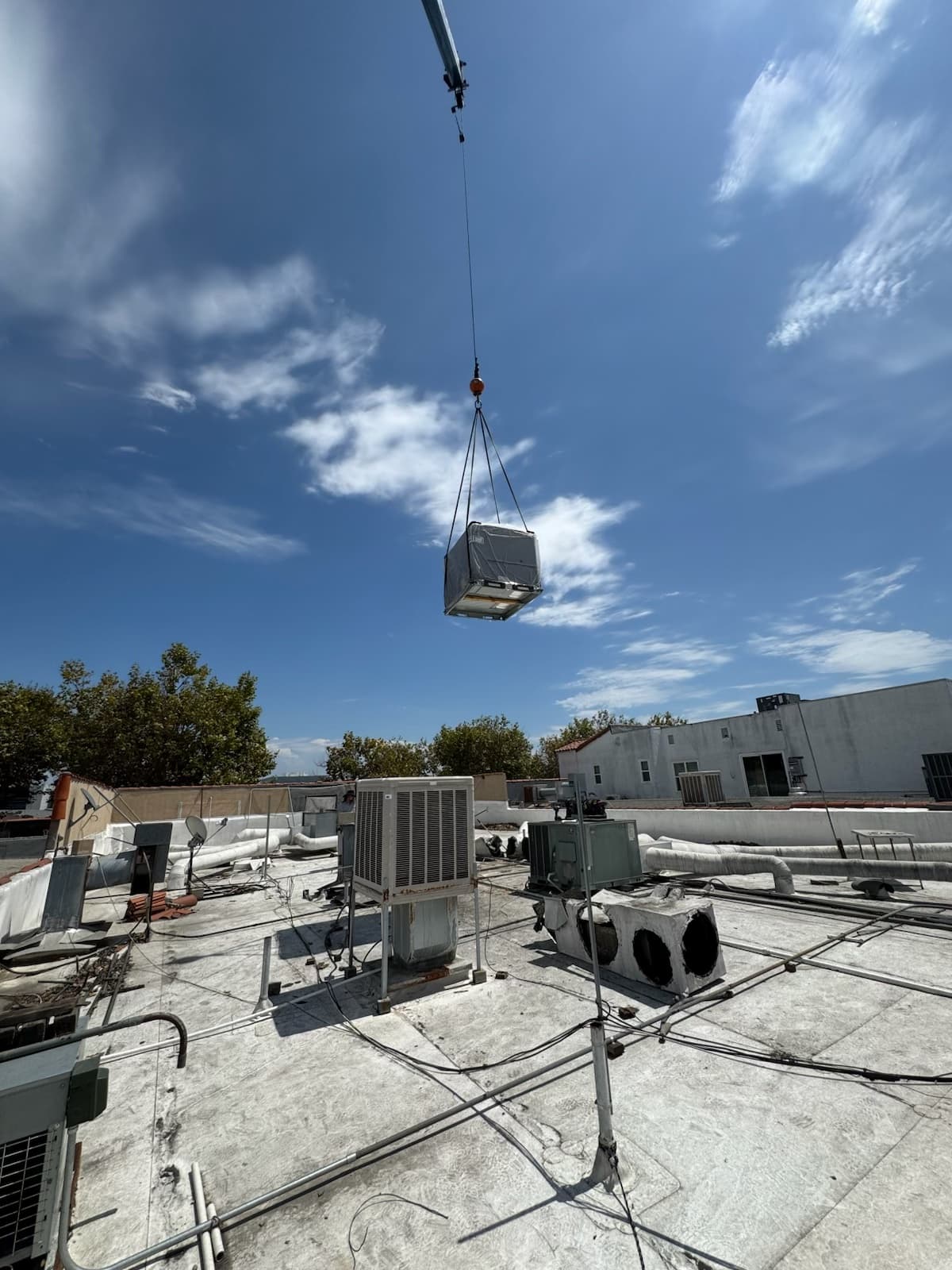
How chiller & central plant service work plays out in Ontario
Central plants in Ontario serve the buildings that cannot be cooled by rooftop units alone: the Convention Center and the arena, the larger hotels in the Gateway area, healthcare facilities, airport-related buildings, and a handful of office and institutional properties. These are also the buildings whose cooling demand jumps on short notice. A convention load-in day, a sold-out arena event, or a hot afternoon with a full hotel all ask the plant for its design capacity at the same hour the ambient temperature is at its worst.
Ontario is hard on cooling towers in particular. Dry, dusty air carries grit into the tower, where it mixes with the water and settles in the basin and the fill. Scale from the local water follows if treatment lapses, and together they raise the tower's approach temperature, which raises condenser pressure, which costs the chiller capacity exactly when it is needed. Air-cooled chillers have the same dust problem on their coils without the water to worry about. Pumps and valves in these plants are often original to the building, and controls sequences that were tuned years ago may stage the plant for a load profile the building no longer has.
We measure the plant against its design: chiller approach, tower approach and fill condition, pump performance, water treatment results, and the staging logic. Overhauls and replacements are planned in phases during the cooler months and around the event calendar, with redundancy maintained so a venue never runs without a path to full capacity. Plant work at this scale is typically bid-level, with prevailing-wage and certified payroll capability where the owner is public. See bid projects, the chillers and hydronic systems guide, and the airports, ports, and transit sector page.
Ontario's climate and what it does to this equipment
Ontario is flat, hot, and open, so Santa Ana winds arrive with little to slow them. Dry gusts carry dust from nearby industrial sites and open ground onto huge rooftops, where condenser coils collect it quickly. Summer highs are routinely well above 100 degrees on the hottest days, and large dark roofs raise local rooftop air temperatures further. Regional smog and wildfire smoke affect filtration, and sharp swings between day and night temperatures stress controls and refrigeration defrost cycles. For cold storage, this means condensers are working against the worst ambient conditions of the year, usually with the heaviest product loads.
For the equipment background behind this page, read our chillers and hydronic systems guide or the full Chillers & Central Plant Service service page.
- Airport and logistics corridorsDistribution and cargo buildings near Ontario International Airport, including cold storage and large rooftop equipment arrays.
- Ontario Mills and Ontario GatewayLarge-format retail, entertainment, and hospitality properties with extended operating hours and heavy rooftop equipment loads.
- Convention Center and arena districtEvent venues, hotels, and surrounding offices where ventilation and cooling demand surges during conventions and games.
- Guasti, Inland Empire Boulevard, and Ontario RanchMixed office, restaurant, and newer warehouse and commercial development south and east of the core.
- Chiller, tower, pump, and VFD service with logged operating data
- Trend-based diagnosis: approach, delta-T, amp draw, and pressures
- Replacement planning with rigging, power, and temporary cooling considered
- Water-treatment and Legionella-control coordination for water-cooled plants
What a chiller & central plant service visit includes, and the problems we most often find
- Review the plant: chillers, pumps, towers, controls, and recent operating history
- Take full operating readings and compare against design and prior visits
- Inspect and test safeties, strainers, VFDs, valves, and control sequences
- Report findings with prioritized repairs and a forward capital outlook
- Document the plant by asset in the DaVinci Portal for the next visit
- Falling delta-T pushing chillers to run more than the load requires
- Fouled condenser tubes or coils raising approach temperature and amp draw
- Neglected water treatment causing scale, corrosion, and biological growth
- Controls overridden to manual and never returned to automatic
Chiller & Central Plant Service in Ontario: questions we get
Our venue's cooling tower fouls faster than the water treatment vendor expected. Is that an Ontario thing?
Largely, yes. Towers here ingest more airborne dust than the same tower would in a coastal setting, and that dust ends up in the basin and the fill alongside mineral scale. The result is a shorter interval between cleanings and a treatment program that has to account for suspended solids, not just hardness. We inspect fill and basin condition, measure approach temperature, and coordinate with your treatment vendor so cleaning cadence and chemistry are set for the actual conditions on your roof.
Can chiller work be scheduled around a convention and event calendar that changes month to month?
It can, with a plan built on redundancy. We identify the windows where load is lowest and events are absent, usually midwinter weekdays, and schedule work that takes a chiller or tower cell offline into those windows. Work that does not reduce capacity, such as controls tuning and instrumentation, can proceed around events. We ask for the calendar as far out as it exists and build the project phases to fit, with a contingency for a late booking.
Do you service both air-cooled and water-cooled chillers?
Yes. We work on air-cooled and water-cooled plants and the equipment around them: pumps, towers, VFDs, valves, and controls.
Can you help plan a chiller replacement?
Yes. Replacement planning covers load verification, refrigerant choice, rigging and power, temporary cooling, and phasing so the building stays comfortable.
Do you bid central plant projects?
Yes, as prime or mechanical subcontractor, in Orange County and beyond on a project-by-project basis.
Other services in Ontario
Chiller & Central Plant Service nearby in Inland Empire (Riverside & San Bernardino Counties)
Commercial HVAC and refrigeration across Inland Empire (Riverside & San Bernardino Counties)