Ice Machine Service in Corona, CA
Restaurants, medical offices with break rooms, and plant cafeterias around Corona depend on ice machines that suffer in hot back-of-house spaces and with dust-laden intake air. A machine that cannot reject heat produces less ice and runs longer, and mineral deposits from local water compound the problem. We clean and sanitize on a defined schedule, inspect water filtration, and document condenser condition so production and quality teams can show a reliable record.
A manufacturing and industrial-park city along the 91 and 15 with retail centers, Temescal Canyon heat, and plenty of mid-size rooftop and process cooling loads.
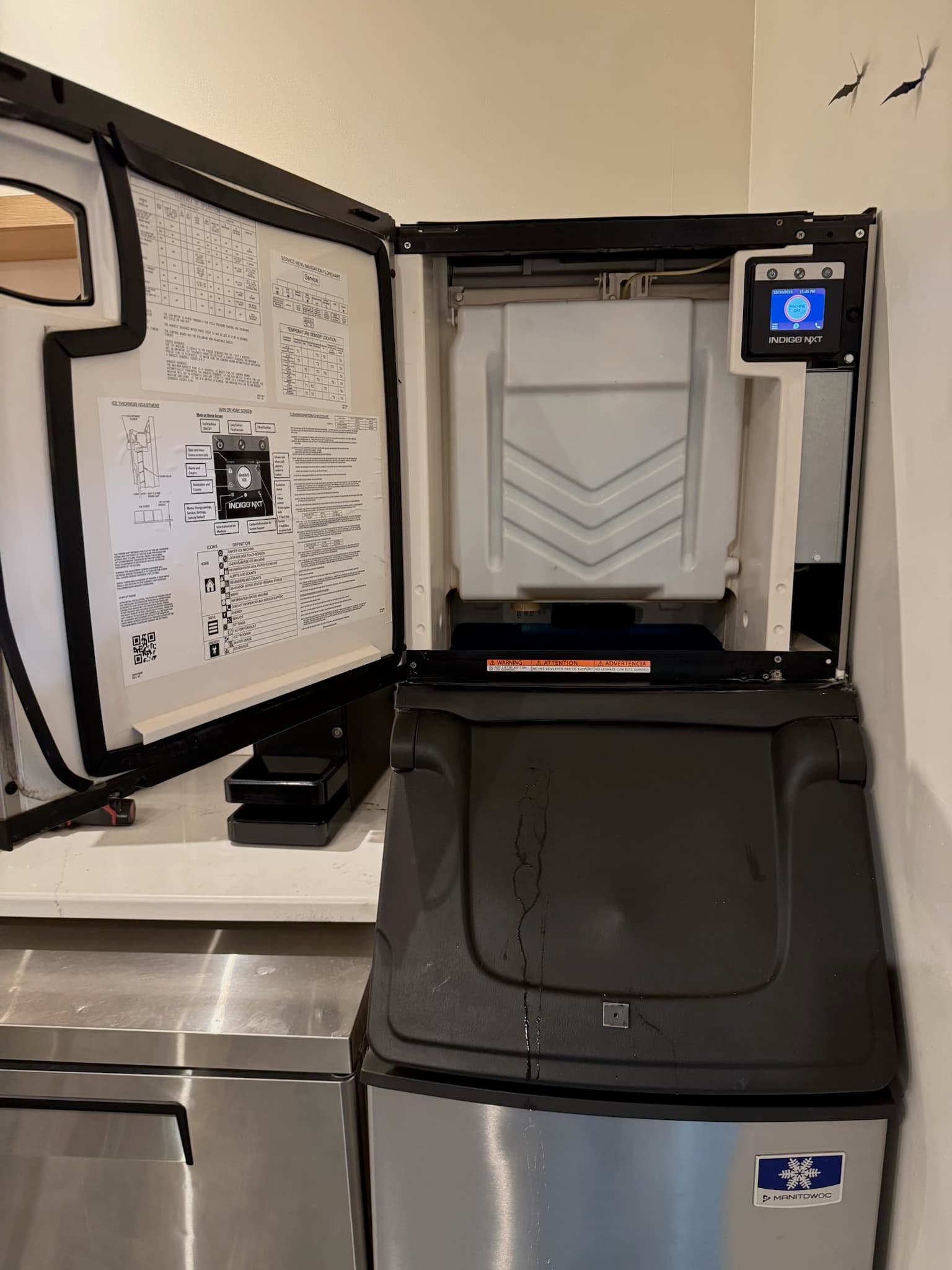
How ice machine service work plays out in Corona
Ice in Corona has an industrial customer base that most cities lack. Plant break rooms and cafeterias in the Sampson and Rimpau parks keep machines running for shift workers through summer heat that makes hydration a safety matter, not a comfort one. Then there is the ordinary demand: restaurants at Dos Lagos, The Crossings, and around The Circle, hotels near the 91 and 15, medical offices near Corona Regional Medical Center, and the school and public facilities that run kitchens. Every one of those machines is rejecting heat into a room that is already warm.
The ice machine in a Corona plant break room is often the most neglected piece of equipment in the building. It sits in a corner, nobody owns it, the filter was last changed when it was installed, and the condenser has been breathing dusty industrial air for years. It makes less ice every summer until a heat wave finishes it. Restaurant machines suffer differently: a hot kitchen, grease on the condenser filter, and scale from hard water on the evaporator plate. In both cases the fix starts with cleaning and descaling and ends with a cadence that keeps it from happening again.
We service machines in Corona on an interval set by use and water quality rather than a generic calendar, clean and sanitize to the manufacturer's procedure, confirm filtration is appropriate for the local water and is actually being changed, and clean the condenser before the heat arrives. Where a kitchen or break room cannot give an air-cooled machine the air it needs, we recommend a remote condenser or a different machine type. Each visit is recorded in the DaVinci Portal, which gives a plant safety manager or a restaurant operator a sanitation record they can produce on demand. The commercial ice machine guide explains the service steps.
Corona's climate and what it does to this equipment
Corona is a heat pocket at the mouth of Temescal Canyon. Daytime temperatures can reach well past 100 degrees for long stretches, and when onshore flow weakens the 91 corridor traps both heat and smog. Santa Ana winds from the northeast drive dust and debris across industrial rooftops and into condenser coils, and wildfire smoke from the surrounding hills and nearby counties can load filters rapidly. The result is equipment that runs at high head pressure much of the summer, with coil fouling and belt or bearing wear that arrives earlier than the manufacturer's schedule suggests.
For the equipment background behind this page, read our commercial ice machine guide or the full Ice Machines — Service & Sanitation service page.
- Sampson and Rimpau industrial parksManufacturing and warehouse buildings with a mix of rooftop packaged units, process cooling, and office suites sharing one mechanical footprint.
- Temescal Canyon corridorBusiness parks and industrial space along the canyon, fully exposed to heat, wind, and dust funneling toward the 15 interchange.
- Corona Mall and Auto Center areaRetail, restaurants, and big-box tenants along the 91 frontage, where rooftop equipment is dense and operating hours are long.
- Main Street and downtown CoronaThe Circle, civic buildings, older commercial storefronts, and small restaurants with aging split systems and compact rooftop units.
- Scale removal, deep sanitation, and filter change-out programs
- Bin sensors, harvest cycles, pumps, and valves checked
- OEM-spec readings taken against manufacturer PM intervals
- DaVinci Portal: photo-logged cleanings and reminder scheduling
What a ice machine service visit includes, and the problems we most often find
- Check ice quality, production rate, and bin sensor operation
- Full descale of water lines and evaporator plate
- Sanitize all food-contact surfaces per manufacturer spec
- Inspect water filtration and replace if due
- Photo-document the cleaning for your compliance records
- Scale buildup from hard water slowing production and clouding ice
- Bin sensors misreading and causing over- or under-production
- Water filters overdue for change, affecting both taste and machine health
- Visible slime or mold in the bin — the most common health-inspection flag
Ice Machine Service in Corona: questions we get
Our plant break room ice machine in Corona cannot keep up during summer shifts. Replace it or service it?
Service it first and measure. A machine that has not been descaled or had its condenser cleaned in years can lose a large share of its output and recover most of it with a thorough cleaning, a new filter, and a condenser wash. We time a harvest cycle before and after. If it is still short after that, the machine is either undersized for the headcount or sitting in a room too hot for an air-cooled unit, and then the discussion is a larger machine, a remote condenser, or a second unit.
How often should an ice machine in a Corona restaurant be cleaned and sanitized?
The manufacturer's baseline is usually twice a year, and in Corona that is often not enough. Hard water scales the evaporator faster, hot kitchens push the machine harder, and dusty intake air clogs the condenser. For a busy restaurant we typically recommend quarterly cleaning and sanitation with condenser checks in between, and we adjust from there based on what we find at each visit. Scale and slime that reappear quickly mean the interval is too long or the filtration is wrong.
How often should ice machines be sanitized?
Most manufacturers recommend sanitizing every six months minimum, more often in high-mineral water areas. We'll set the interval based on your machine and water supply.
Can you fix low production without a full replacement?
Often, yes. Scale buildup, refrigerant charge, and water filtration are the most common causes of low ice production and are usually repairable.
Other services in Corona
Ice Machine Service nearby in Inland Empire (Riverside & San Bernardino Counties)
Commercial HVAC and refrigeration across Inland Empire (Riverside & San Bernardino Counties)