Maintenance Plans in Riverside, CA
Riverside properties benefit from a plan built around the heat calendar. A spring visit that cleans coils, checks charge, and tests controls before the first heat wave prevents the call that comes in on a triple-digit afternoon, while a fall visit handles heating changeover and Santa Ana dust. For government and institutional buildings, we structure documentation to support audits and prevailing-wage requirements, and every unit gets a DaVinci Portal record.
A government, university, and healthcare center with historic downtown buildings, Magnolia Avenue retail, and a hot, dry summer that keeps rooftop equipment near its limits for months.
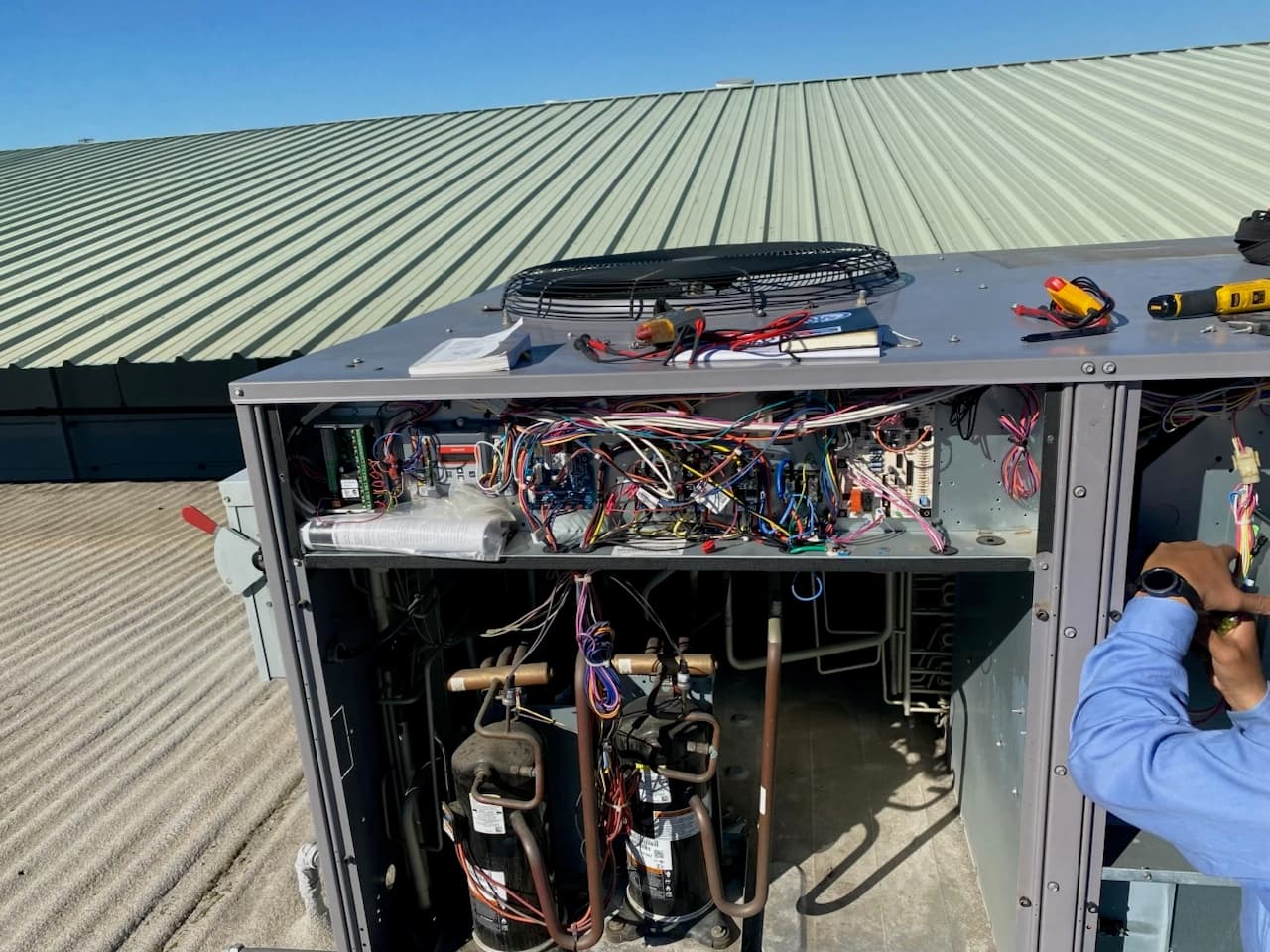
How maintenance plans work plays out in Riverside
Picture the roof of a four-story office building on Orange Street, a block from the County Administrative Center. Eleven packaged units, three generations of equipment, two of them replaced after emergency failures in consecutive summers, and no record of what was done to the other nine. That is the starting point for most maintenance conversations in Riverside. The property has been reactive for years because the summer failures were always urgent and the winter was always quiet. The program we build begins by tagging every unit, taking baseline readings, and writing down what is actually up there.
Timing is the second half of the program. Riverside's cooling season starts earlier and runs later than the coast, so the pre-summer visit belongs in March or April, not June. That visit handles condenser cleaning, refrigerant charge verification at a meaningful ambient temperature, belt and bearing checks, electrical connections, and economizer function. A fall visit covers the heating changeover, the dust and debris that Santa Ana conditions pile onto coils and intakes, and filter strategy for the smoke events that have become routine. Quarterly visits make sense for restaurant kitchens around downtown and the university corridor, grocery and medical properties, and anything with refrigeration that cannot be allowed to drift.
For the city's public and institutional owners, the program also produces the paperwork. County departments, the City of Riverside, Riverside Unified, and the community college district all answer to auditors and boards, and a service history that lives in the DaVinci Portal with readings and photos is much easier to defend than a folder of invoices. Privately owned property is no different in practice: a landlord selling a building on Magnolia or refinancing a center near the Galleria will be asked about the equipment, and a complete record changes that conversation. The preventive maintenance guide explains how we structure visit scopes.
Riverside's climate and what it does to this equipment
Riverside sits in a basin that traps heat. Summer afternoons routinely climb well past the point where a rooftop condenser is working near its design limit, and nights often fail to cool the building structure enough to give equipment a rest. Smog and fine particulate settle on coils faster than in coastal Orange County, citrus-area dust and pollen add to the load, and wildfire smoke events in the surrounding hills can clog filters in days. Santa Ana conditions in fall bring dry heat and debris. Equipment here needs coil cleaning cadence and refrigerant charge checks built around peak season, not the calendar average.
For the equipment background behind this page, read our preventive maintenance program guide or the full Commercial Maintenance Plans service page.
- Downtown and Mission Inn areaGovernment buildings, courts, restaurants, and older multi-story commercial properties where mixed equipment generations share one roof or mechanical room.
- UCR and University Avenue corridorCampus-adjacent dining, student-oriented retail, and research and instructional buildings with strict space-temperature expectations.
- Magnolia Avenue medical and retail corridorMedical office buildings, outpatient clinics, and strip retail running along one of the city's busiest commercial arteries.
- Hunter Park and Airport Industrial areasLight industrial, distribution, and manufacturing buildings near the 91 and 60 interchange and the municipal airport, many with rooftop packaged units and walk-in refrigeration.
- Free diagnostic on repairs for plan members
- Included labor per tier, with a member rate for anything over
- Photo-logged reports with temps, pressures, and amp draws
- DaVinci Portal included with QR tracking and self-service scheduling
What a maintenance plans visit includes, and the problems we most often find
- Walk every covered asset — RTUs, refrigeration, ice machines, water heaters
- Take and log readings against each unit's history, not a generic checklist
- Flag anything trending toward failure before it becomes a breakdown
- Deliver a photo-logged report after every visit
- Free diagnostic on any repair that comes out of the visit
- Equipment that 'seemed fine' failing without any maintenance history to catch the trend
- Multiple pieces of equipment aging out around the same time with no replacement plan
- Surprise repair costs that a documented PM history would have flagged months earlier
- Multi-location accounts with no consistent record across sites
Maintenance tiers for Riverside properties
Riverside's mix of government, medical, and downtown commercial properties suits a plan with a pre-summer cooling visit, a fall heating changeover, and portal-based records suitable for audits.
See maintenance plan tiersMaintenance Plans in Riverside: questions we get
We manage several medical office buildings along Magnolia Avenue in Riverside. How should visits be spaced?
Bi-annual is the usual baseline for medical office space, with the first visit in early spring before cooling load arrives and the second in fall. Suites with imaging equipment, procedure rooms, or vaccine refrigeration often justify a quarterly cadence on those specific systems while the rest of the building stays bi-annual. We also recommend a mid-summer filter check across all of them, because Riverside's particulate and smoke load can plug filters well before the fall visit.
Our Riverside restaurant has a walk-in, an ice machine, and two rooftop units. Can one plan cover all of it?
Yes, and it should. Refrigeration and HVAC in a restaurant affect each other: a dining room that the rooftop units cannot hold raises the kitchen temperature, which loads the walk-in condenser and the ice machine. A single quarterly program covers coil cleaning and charge checks on the rooftop units, condenser and gasket work on the walk-in, and descaling and sanitation on the ice machine, with every piece recorded under the one property in the portal. See maintenance plans for how the tiers are structured.
What's the difference between the plan tiers?
Tiers differ by visit frequency and included labor. Quarterly is best for kitchens and refrigeration-heavy sites; annual fits lighter-use office or retail space.
Can one plan cover multiple locations?
Yes — multi-site accounts are common. We'll set up the Portal so each location's equipment and history stay organized separately.
Other services in Riverside
Maintenance Plans nearby in Inland Empire (Riverside & San Bernardino Counties)
Commercial HVAC and refrigeration across Inland Empire (Riverside & San Bernardino Counties)