Maintenance Plans in Corona, CA
Industrial and retail properties in Corona do best on a plan that separates the heavy seasonal work from lighter interim checks. A pre-summer visit focuses on coils, charge, belts, and electrical connections, while later visits cover filters, economizers, and control verification. For multi-building owners, we organize inventories by building and unit so the plan scales without losing detail, and the portal keeps a running service history that can be pulled up during a lease or audit conversation.
A manufacturing and industrial-park city along the 91 and 15 with retail centers, Temescal Canyon heat, and plenty of mid-size rooftop and process cooling loads.
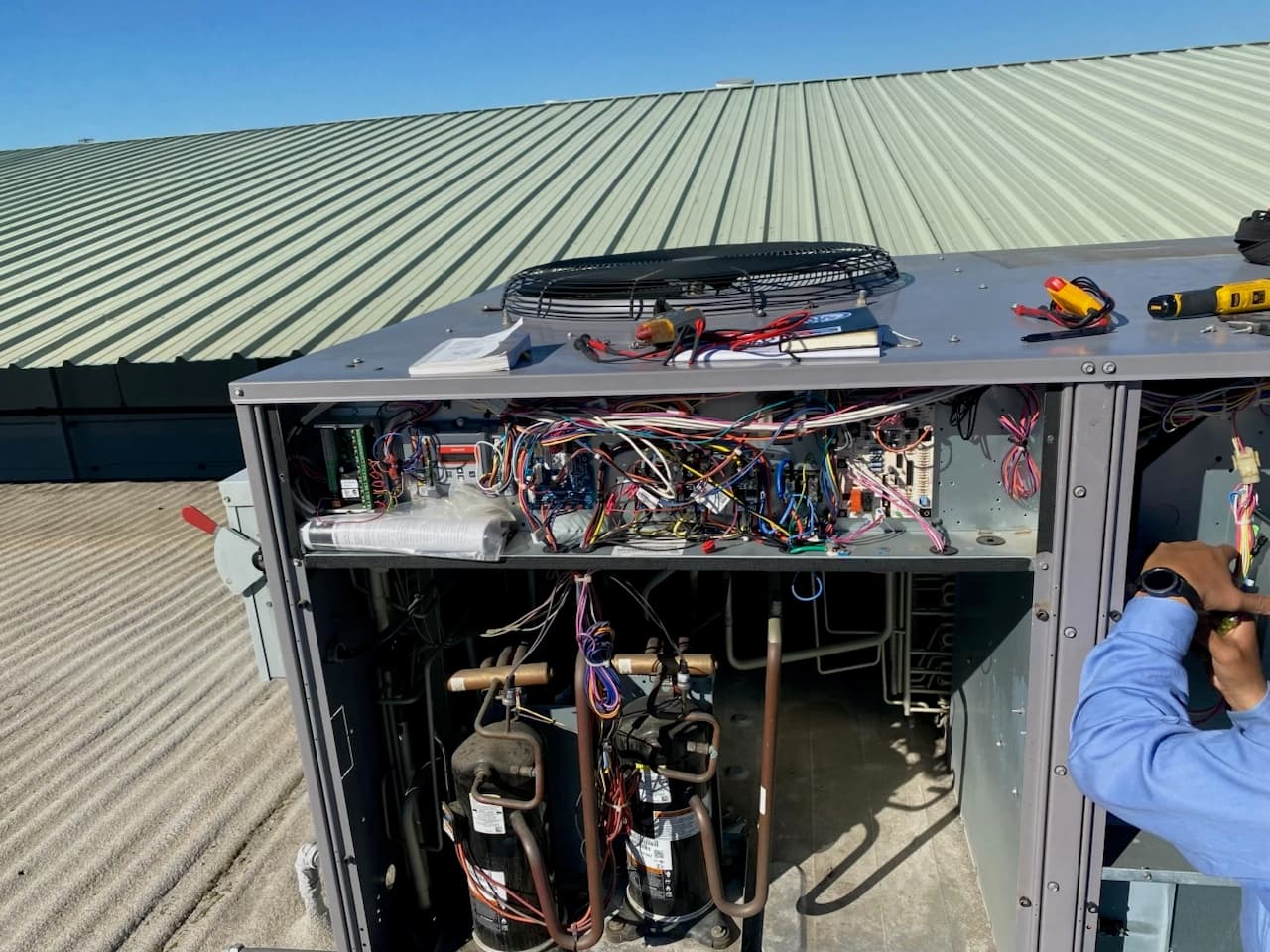
How maintenance plans work plays out in Corona
The owner of three flex buildings in a Corona business park off Magnolia Avenue has a problem that looks like bad luck and is actually a missing program. Every summer two or three units fail, each one is an emergency, each one costs more than it should, and nobody can say how old the rest of the roof is. The maintenance program that fixes this begins with an inventory: every unit tagged, photographed, and given a baseline set of readings in the DaVinci Portal, organized by building and tenant so the owner can finally see the whole portfolio.
The visit calendar in Corona is weighted toward the front of the cooling season. The heavy visit comes in March or April and covers condenser cleaning, charge verification at a meaningful ambient temperature, belts and bearings, electrical connections that have been baked for years, and economizer function. Industrial tenants with process loads get airflow and pressure measurements added, because the building changes as production changes. A second visit in fall addresses heating, the dust Santa Ana winds have driven into coils and intakes, and filter strategy for smoke season. Restaurants, grocers, and anything with refrigeration run on a quarterly cadence; offices, retail, and medical suites on a bi-annual one; light-duty spaces on an annual check.
Where the program pays off most in Corona is in multi-tenant industrial property. A landlord who can show a prospective tenant the condition and history of every unit on the roof is in a different negotiating position than one who cannot, and a plant manager who can produce temperature records for a refrigerated area during a quality audit sleeps better. For public owners, including the Corona-Norco school district and city facilities, the documentation also supports board and audit requirements. The maintenance plans page explains the tiers, and the preventive maintenance guide explains what each visit includes.
Corona's climate and what it does to this equipment
Corona is a heat pocket at the mouth of Temescal Canyon. Daytime temperatures can reach well past 100 degrees for long stretches, and when onshore flow weakens the 91 corridor traps both heat and smog. Santa Ana winds from the northeast drive dust and debris across industrial rooftops and into condenser coils, and wildfire smoke from the surrounding hills and nearby counties can load filters rapidly. The result is equipment that runs at high head pressure much of the summer, with coil fouling and belt or bearing wear that arrives earlier than the manufacturer's schedule suggests.
For the equipment background behind this page, read our preventive maintenance program guide or the full Commercial Maintenance Plans service page.
- Sampson and Rimpau industrial parksManufacturing and warehouse buildings with a mix of rooftop packaged units, process cooling, and office suites sharing one mechanical footprint.
- Temescal Canyon corridorBusiness parks and industrial space along the canyon, fully exposed to heat, wind, and dust funneling toward the 15 interchange.
- Corona Mall and Auto Center areaRetail, restaurants, and big-box tenants along the 91 frontage, where rooftop equipment is dense and operating hours are long.
- Main Street and downtown CoronaThe Circle, civic buildings, older commercial storefronts, and small restaurants with aging split systems and compact rooftop units.
- Free diagnostic on repairs for plan members
- Included labor per tier, with a member rate for anything over
- Photo-logged reports with temps, pressures, and amp draws
- DaVinci Portal included with QR tracking and self-service scheduling
What a maintenance plans visit includes, and the problems we most often find
- Walk every covered asset — RTUs, refrigeration, ice machines, water heaters
- Take and log readings against each unit's history, not a generic checklist
- Flag anything trending toward failure before it becomes a breakdown
- Deliver a photo-logged report after every visit
- Free diagnostic on any repair that comes out of the visit
- Equipment that 'seemed fine' failing without any maintenance history to catch the trend
- Multiple pieces of equipment aging out around the same time with no replacement plan
- Surprise repair costs that a documented PM history would have flagged months earlier
- Multi-location accounts with no consistent record across sites
Maintenance tiers for Corona properties
Corona's industrial and retail properties usually need a plan weighted toward pre-summer coil, charge, and electrical work, with lighter interim visits for filters, belts, and controls.
See maintenance plan tiersMaintenance Plans in Corona: questions we get
We own a multi-tenant industrial building in Corona. Should the maintenance program be ours or the tenants'?
Our Corona plant runs two shifts and cannot shut down for maintenance. How do visits work?
What's the difference between the plan tiers?
Can one plan cover multiple locations?
Other services in Corona
Maintenance Plans nearby in Inland Empire (Riverside & San Bernardino Counties)
Commercial HVAC and refrigeration across Inland Empire (Riverside & San Bernardino Counties)