For Property Managers & Multi-Site Portfolios
One contractor for HVAC and refrigeration across your whole portfolio
Multi-site maintenance plans, per-property asset tracking through DaVinci Portal, and a single point of contact instead of a different vendor for every building.
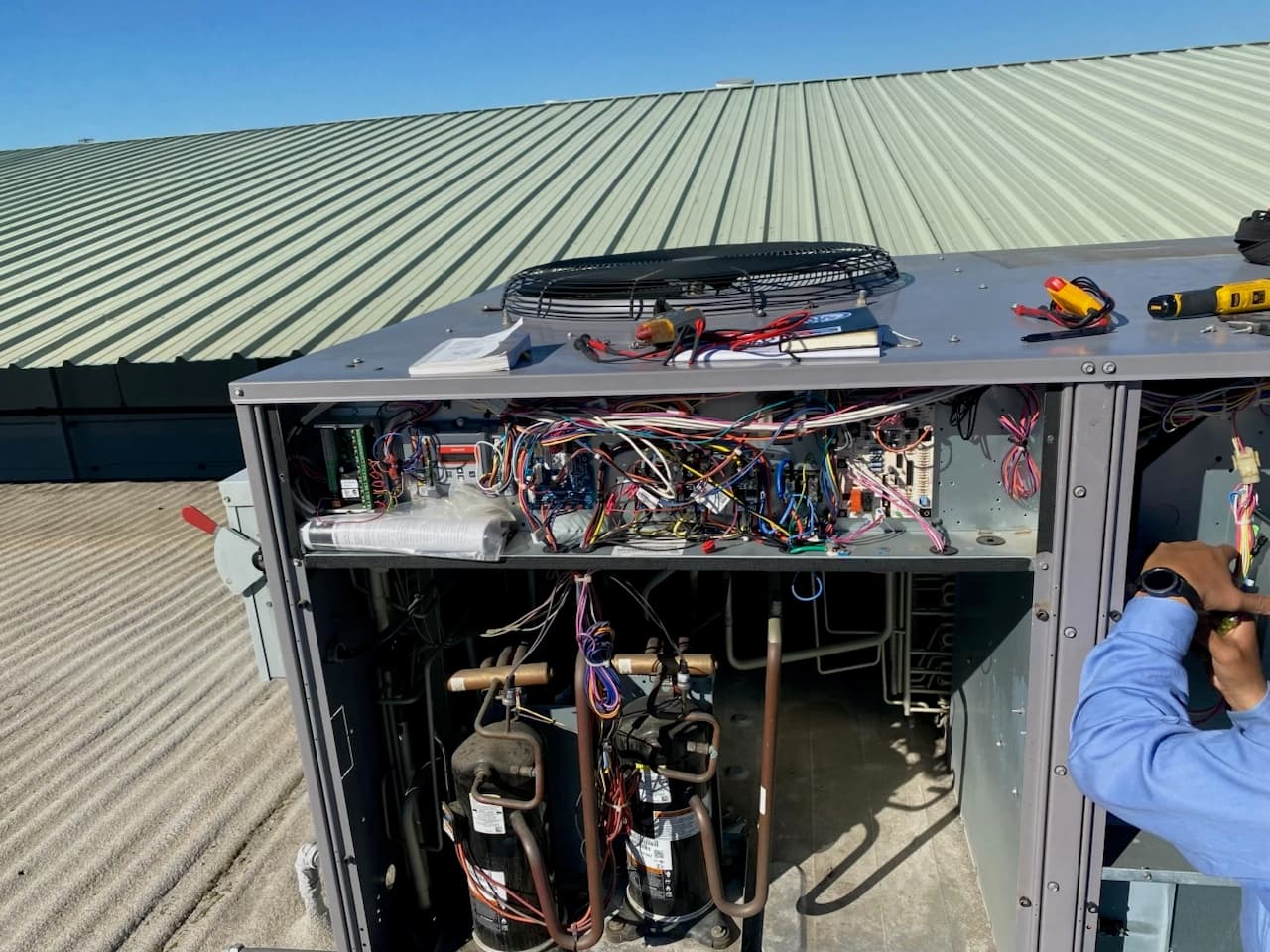
Managing HVAC and refrigeration across multiple tenants and buildings shouldn't mean juggling different vendors for each site.
A comfort complaint or a broken walk-in in a tenant's space reflects on you — we prioritize response accordingly.
DaVinci Portal keeps each property's assets and service records organized separately, so nothing gets mixed up across a portfolio.
Photo-logged reports and readings give you something concrete to hand off to ownership or a capital planning conversation.
What we handle for property management portfolios
Who owns what: the responsibility matrix property managers actually need
Multi-tenant buildings generate more HVAC conflicts from unclear responsibility than from equipment failure. A simple matrix agreed before the first emergency saves hours of back-and-forth.
| Item | Common default | What to confirm in the lease |
|---|---|---|
| Rooftop units serving a single suite | Often tenant maintains, landlord replaces (or vice versa) | Who pays for repairs vs. replacement and the dollar threshold |
| Shared rooftop units or central plant | Landlord, passed through as common-area expense | Pass-through terms and capital-expense treatment |
| Tenant refrigeration and kitchen equipment | Tenant | Whether the landlord must approve contractors |
| Water heaters | Varies | Which water heater serves which suites |
| Roof access | Landlord controlled | Notice, insurance, and roofing-warranty requirements |
- Inventory every unit and tag it with the space it serves and the responsible party.
- Set a not-to-exceed repair amount so urgent work doesn't wait for approvals.
- Choose one contractor per portfolio so you can compare sites on cost per square foot and emergency rate.
- Require the same report format for every site.
- Review the data twice a year and set the capital plan from it.
The DaVinci Portal exists for exactly this: each asset has a QR tag, a history, and a responsible party, and owners can pull records across properties.
What a portfolio HVAC program actually looks like
A property manager running eight retail centers and three office buildings does not have an HVAC problem. They have eleven separate HVAC problems that happen to share a budget, a reporting deadline, and a phone number. Treating them as one program is the difference between a vendor you call and a program you manage. The first step is an inventory: every rooftop unit, split system, exhaust fan, water heater and piece of tenant refrigeration the landlord has any responsibility for, tagged with the building, the suite it serves, the age, and the party who pays when it fails. Most portfolios have never had this done at the asset level, which is why the first year of a program tends to surface equipment nobody knew was there.
Once the inventory exists, the program itself is simple to describe: a scheduled visit cadence per building that matches the equipment and the tenant mix, a standing repair authorization so small failures do not wait a week for approval, a single report format across every property, and a twice-yearly review where the data turns into a capital list. Our maintenance plans are built to run that way across multiple sites. A strip center with twelve small rooftop units and a dialysis clinic in a medical office building do not need the same cadence, and a good program lets them differ without losing the common reporting layer.
The reporting layer is where DaVinci Portal does the work. Each unit carries a QR tag. Scanning it brings up that unit's service history, readings, and photos, and ownership can look across buildings without asking anyone to compile anything. For a manager answering to an asset manager or an ownership group, that record replaces the quarterly scramble to reconstruct what was spent and why.
- One inventory with responsible party, suite served, age, and refrigerant type for each asset.
- Visit cadence set per building, not per portfolio, with the same checklist structure everywhere.
- A standing not-to-exceed authorization for repairs so tenants are not left waiting on paperwork.
- Quarterly or semi-annual portfolio review using the same data the technicians recorded on the roof.
Tenant versus landlord: who is responsible for the HVAC
The honest answer is that it depends on the lease, and the lease is often less clear than everyone assumed until a compressor fails in August. Commercial leases allocate HVAC responsibility in a handful of recognizable patterns. In a typical triple-net retail lease, the tenant maintains and repairs the units serving its own suite and the landlord is responsible for replacement when a unit reaches end of life, sometimes with the tenant reimbursing an amortized share. In many office leases, the landlord maintains everything and passes the cost through as an operating expense. In single-tenant industrial leases, the tenant frequently takes on the whole system including replacement.
Problems come from the gaps between those patterns. A tenant who is required to maintain the unit but never signed a maintenance contract leaves the landlord with a unit that fails early and a dispute about whether neglect caused it. A landlord who controls roof access but has not told the tenant's contractor about the roofing warranty ends up with a voided warranty. Two units on the roof serve a suite that was split in a prior tenant improvement and nobody updated the drawings. None of these are mechanical failures. They are responsibility failures, and the fix is administrative before it is technical.
We approach multi-tenant buildings by asking for the responsibility matrix before the first service call, or helping the manager build one if it does not exist. When a tenant's own contractor is responsible for a unit, we can still perform the landlord's inspection and document the unit's condition, which gives the manager leverage when the lease requires the tenant to maintain it. When a replacement decision crosses the line from repair to capital, the root-cause diagnostic record shows whether the failure was age, neglect, or a design problem, which usually determines who pays.
Leases that make the tenant responsible for repairs and the landlord responsible for replacement create an incentive problem: the tenant has no reason to spend on maintenance, and the landlord has no visibility until the unit dies. A landlord-run maintenance program with cost pass-through, where the lease permits it, removes the conflict and gives the landlord the equipment data it needs.
Lease language that makes HVAC manageable
We are not attorneys and this is not legal advice; your lease counsel decides the words. What we can offer is a mechanical contractor's view of which lease provisions make our job, and yours, easier or harder. The provisions that matter most are the ones that define maintenance, define replacement, and define access.
On maintenance, the leases that work best require the tenant to carry a service contract with a licensed commercial contractor, specify a minimum visit frequency, and require that service records be provided to the landlord on request. Without that last clause, the landlord cannot tell whether the tenant is actually maintaining the unit until it is too late. On replacement, useful leases define what counts as a capital replacement rather than a repair, often by naming major components such as compressors and heat exchangers, and state how the cost is allocated. On access, the lease should address roof access notice, roofing warranty compliance, and whether the landlord must approve tenant contractors who work on building systems.
Two more provisions are worth a conversation with counsel. First, a clause requiring that the tenant's contractor hold a California C-20 license and appropriate insurance protects the landlord's roof and the other tenants' systems. Second, a clause about refrigerant: California's refrigerant rules and the federal phasedown change what a repair costs and sometimes whether a repair is even sensible, and a lease written years ago may not anticipate that. Our refrigerant compliance guide explains the landscape in general terms; confirm current requirements with the relevant agencies.
| Provision | Prevents |
|---|---|
| Tenant service contract with records on request | Discovering a neglected unit only when it fails |
| Defined repair versus replacement line | Disputes over who pays for a compressor |
| Roof access and warranty compliance clause | Voided roofing warranties from unapproved penetrations |
| Landlord approval of building-system contractors | Unlicensed work on shared equipment |
| Updated equipment schedule as a lease exhibit | Arguments about which unit serves which suite |
Capital planning across a portfolio
Ownership groups plan capital in cycles, and the manager who shows up to that conversation with a prioritized list and the data behind it gets the money. The manager who shows up with a vague sense that the roof at one property is getting old does not. HVAC equipment is well suited to this kind of planning because its failure modes are predictable. Rooftop units in Southern California have a rough service life that depends on the roof environment, the maintenance history, and the refrigerant, and a unit's readings over three or four years tell you whether it is drifting toward the end.
A portfolio capital plan ranks every unit on a small number of factors: age against expected life, refrigerant type and the cost trajectory of servicing it, repair history, the criticality of the space it serves, and whether a replacement would trigger Title 24 and permit requirements that change the scope. From that list you can see which buildings need two or three units replaced in the same year, which lets you share crane time and permit effort instead of paying for them piecemeal. Our commercial RTU replacement work is often structured exactly this way for multi-property owners.
The other half of capital planning is deciding what not to replace. A fifteen-year-old unit with a clean history and a sound heat exchanger may have years left, and spending on it ahead of a seven-year-old unit with a bad coil is the wrong order. That judgment requires condition data, which is why the maintenance program and the capital plan have to run on the same records. The Orange County commercial property types guide covers what different building types typically carry on their roofs.
- Pull the asset inventory with age, refrigerant, and repair history for every building.
- Score each unit on remaining life, criticality, and refrigerant exposure.
- Group replacements by building and year to share mobilization and permit effort.
- Flag units where a replacement would change the scope under current energy code.
- Present the three-year list to ownership with the condition evidence attached.
Turnover, tenant improvements, and the space between tenants
Vacancy is the one time a manager controls the space completely, and it is the right moment to deal with HVAC. A departing tenant's unit should be inspected before the security deposit conversation, not after, because the lease usually makes the tenant responsible for the condition of the equipment at surrender. A documented inspection with photos and readings, logged against the asset in the Portal, is far more persuasive than a verbal report when the former tenant disputes a charge.
Tenant improvements change the mechanical picture more often than anyone expects. A suite that was retail becomes a restaurant and now needs kitchen exhaust and make-up air that the existing rooftop unit cannot supply. A medical tenant moves into former office space and needs exam rooms held to tighter conditions than an open floor plan ever required. A suite is split in two and the single unit that served it now has to be rezoned or a second unit added. Each of those scenarios involves permits, often Title 24 compliance for the new work, and roof penetrations that have to respect the roofing warranty.
The practical advice is to bring the mechanical contractor into the TI conversation at the letter-of-intent stage, not after the architect has drawn the space. Knowing early that a prospective restaurant tenant will need a make-up air unit and a dedicated exhaust fan changes the TI allowance negotiation and avoids a space that cannot pass final inspection. For retail and restaurant tenants specifically, our restaurant and grocery and retail pages describe what those occupancies demand of a building's systems.
Ask for a documented HVAC condition report at move-out for every tenant who was responsible for maintaining the unit. It takes one visit, it attaches permanently to the asset record, and it settles most deposit disputes before they start.
Handling tenant complaints without becoming the dispatcher
A tenant comfort complaint reaches the property manager first, and the manager's instinct is to relay it. The better pattern is a direct line: tenants in landlord-maintained buildings call the contractor, the contractor dispatches and documents, and the manager sees the result in the record rather than fielding both ends of the conversation. This only works if the contractor already knows the building, which is another argument for a program rather than ad hoc calls.
Complaints also contain information. A suite that complains every June is telling you the unit is undersized, the economizer is stuck, or the thermostat is in the wrong place. A suite that complains after every weekend is telling you the schedule in the building controls is wrong or someone is overriding it. When complaints are logged against the asset rather than against the tenant, these patterns show up, and fixing the pattern ends the calls. Parts-swapping does not; it resets the clock until the same complaint returns.
Beyond rooftop units: tenant refrigeration and building hot water
Retail and restaurant tenants bring walk-in coolers, reach-ins, and display cases into a building, and although those are almost always tenant equipment, they still touch the landlord. Remote condensing units end up on the landlord's roof. Condensate lines run through landlord walls. A walk-in that fails over a holiday weekend becomes the manager's emergency when the tenant cannot reach their own vendor. Having one contractor who can handle both the landlord's HVAC and the tenant's refrigeration, with the responsible party recorded per asset, means the call gets answered either way and the invoice goes to the right party.
Commercial water heaters are a frequent source of confusion in multi-tenant buildings because the plumbing does not always follow the suite lines. One heater may serve three suites, or a restaurant tenant may have installed its own without telling anyone. Mapping which heater serves which space belongs in the asset inventory. When a replacement is needed, the venting, gas sizing, and seismic strapping requirements apply regardless of who pays, and the manager wants the permit record in the file.
Where we serve property management portfolios
Davinci Mechanical is based in Orange County and runs portfolio programs across Orange County cities, with maintenance plans available by city. For portfolios that extend into Los Angeles County, the Inland Empire, San Diego County or Ventura County, we take on larger multi-site programs and project work; we do not maintain local offices in those regions, and we say so up front when discussing response expectations for a given site. As the commercial and union division of Scottish Tom's Heating & Air, holding California license #1083101, we work only on commercial property.
If your portfolio includes a city or county tenant, a school district lease, or any space where prevailing wage applies to the landlord's work, our public works page covers how that changes the engagement. The preventive maintenance program guide is the right place to start if you are designing a program for the first time.