RTU & Split Installs in Corona, CA
Replacement work in Corona often involves industrial and flex buildings with long roof runs and multiple units installed in different years. We start with a roof survey, verify curb dimensions and structural capacity, and coordinate crane access around truck traffic and active production. Equipment selection favors strong high ambient capacity and corrosion-resistant coil options where airborne contaminants exist. Permits and Title 24 acceptance paperwork are handled as part of the project rather than left to the building owner.
A manufacturing and industrial-park city along the 91 and 15 with retail centers, Temescal Canyon heat, and plenty of mid-size rooftop and process cooling loads.
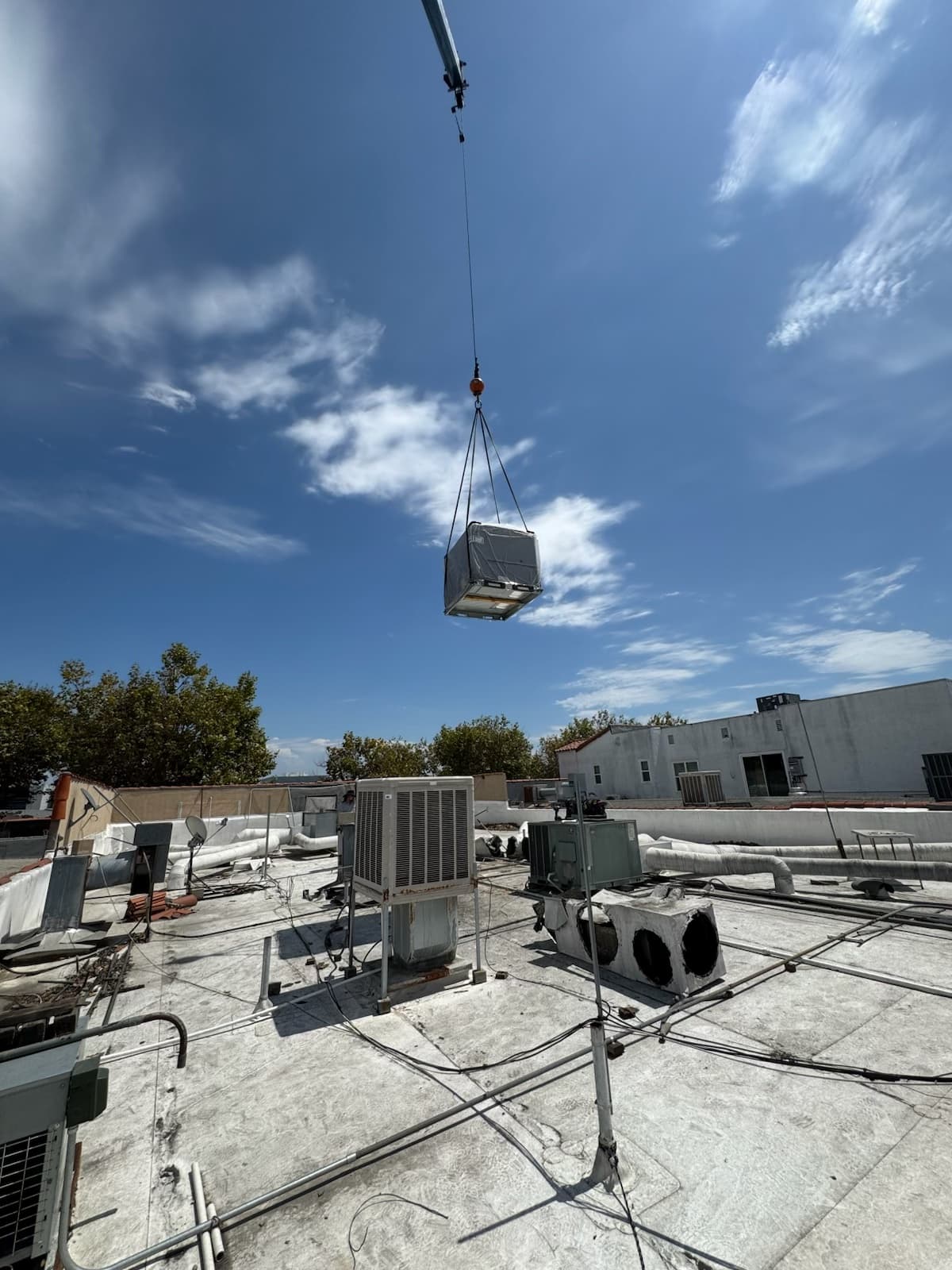
How rtu & split installs work plays out in Corona
Corona's rooftop replacement work lives mostly on industrial and flex buildings along Sampson, Rimpau, Railroad Street, Pomona Road, and the Temescal Canyon corridor. The roofs are long, the units are many, and they were installed in waves as tenants came and went. A survey of one of these roofs usually finds three or four manufacturers, curbs that do not match the current unit, abandoned penetrations, and electrical disconnects that have been cooked by two decades of sun. The project starts with cataloging all of it, because the owner usually does not know what is up there.
Then the logistics. Crane placement on an industrial site has to stay clear of truck lanes and dock aprons, picks are scheduled around shifts, and a plant that runs a continuous process needs a phasing plan that never leaves a production area without cooling. Retail work near the 91 and at Dos Lagos is more about hours and parking: early picks before stores open, staging in a corner of the lot, and coordination with a property manager answering to multiple tenants. Where airborne contaminants exist on an industrial roof, we talk through coil coating options because a standard coil near a process exhaust will not last.
Selection in Corona follows the heat. The city sits in a pocket at the canyon mouth that runs hotter than Orange County on the other side of the hills, and a unit sized at nominal conditions will fall short. We use extended performance data, consider two-stage or variable capacity where the load swings between shifts, and plan economizer settings for the cooler nights that exist in spring and fall. Permits go through the City of Corona, Title 24 acceptance testing is included, and for the Corona-Norco school district and other public owners, prevailing wage and certified payroll are built in. The Title 24 and permits guide explains the acceptance process.
Corona's climate and what it does to this equipment
Corona is a heat pocket at the mouth of Temescal Canyon. Daytime temperatures can reach well past 100 degrees for long stretches, and when onshore flow weakens the 91 corridor traps both heat and smog. Santa Ana winds from the northeast drive dust and debris across industrial rooftops and into condenser coils, and wildfire smoke from the surrounding hills and nearby counties can load filters rapidly. The result is equipment that runs at high head pressure much of the summer, with coil fouling and belt or bearing wear that arrives earlier than the manufacturer's schedule suggests.
For the equipment background behind this page, read our commercial rooftop unit guide or the full RTU & Split System Installs service page.
- Sampson and Rimpau industrial parksManufacturing and warehouse buildings with a mix of rooftop packaged units, process cooling, and office suites sharing one mechanical footprint.
- Temescal Canyon corridorBusiness parks and industrial space along the canyon, fully exposed to heat, wind, and dust funneling toward the 15 interchange.
- Corona Mall and Auto Center areaRetail, restaurants, and big-box tenants along the 91 frontage, where rooftop equipment is dense and operating hours are long.
- Main Street and downtown CoronaThe Circle, civic buildings, older commercial storefronts, and small restaurants with aging split systems and compact rooftop units.
- Site survey covering load, airflow balancing, and duct condition
- Clean rigging with code-correct gas, electrical, and condensate work
- Startup readings documented and stored in the Portal
- DaVinci Portal included: asset QR tag + warranty paperwork on file
What a rtu & split installs visit includes, and the problems we most often find
- Site survey — existing curb/duct compatibility, load, and airflow requirements
- Equipment selection sized to actual load and hours of operation, not just square footage
- Crane scheduling and rigging coordinated for roof access
- Install with code-correct gas, electrical, and condensate work
- Startup readings taken and documented; warranty registered in the Portal
- Undersized or oversized replacement units causing short-cycling or poor comfort
- Curb mismatches that turn a 'simple swap' into a bigger job mid-install
- Duct transitions that don't match the new unit's airflow requirements
- Aging units on refrigerant types that are getting harder and more expensive to service
RTU & Split Installs in Corona: questions we get
We have 14 rooftop units on an industrial building in Corona at different ages. Replace all at once or phase them?
Can a crane work on a Corona industrial site without stopping our shipping operation?
Do you handle the crane pick and rigging?
Can you match an existing curb or duct layout?
Other services in Corona
RTU & Split Installs nearby in Inland Empire (Riverside & San Bernardino Counties)
Commercial HVAC and refrigeration across Inland Empire (Riverside & San Bernardino Counties)