RTU & Split Installs in Santa Monica, CA
Corrosion protection and site access come first when replacing rooftop equipment in Santa Monica. Coastal-rated coatings, protected hardware, and careful flashing extend the life of new equipment in salt air. Downtown rooftops may be shared, screened, or hard to reach, and street lifts require coordination. Permits go through the city's building department, and local sustainability expectations can shape the scope, so confirm current requirements and Title 24 compliance before ordering anything.
A coastal commercial market of Third Street Promenade retail, Main Street restaurants, creative and tech offices, and hospitals, all exposed to salt air.
How rtu & split installs work plays out in Santa Monica
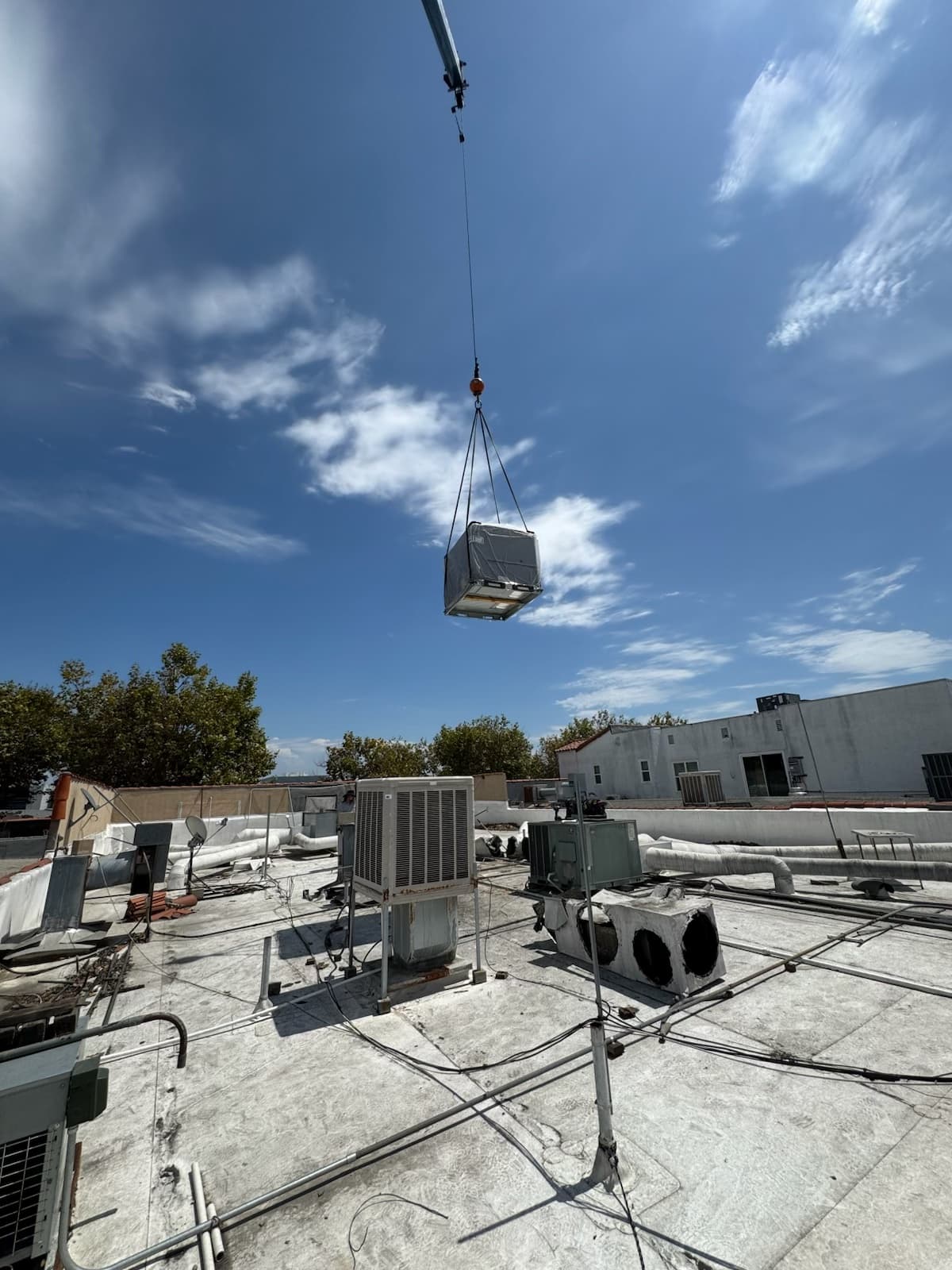
Replacing rooftop equipment in Santa Monica is as much about the lift as the unit. On the blocks around Third Street Promenade, Santa Monica Place, and the Wilshire and Santa Monica Boulevard corridors, buildings share party walls and the roof is often the only mechanical real estate the tenant has. Setting a new unit usually means a crane staged in a street or alley, which involves the city for encroachment permits and traffic control, the landlord for roof access and structural sign-off, and neighboring tenants who will lose a loading zone for a morning. Early-morning lifts before foot traffic builds are the usual answer, and weekends can be harder downtown than weekdays.
Specification is where coastal projects differ most from inland ones. We treat coated condenser coils, sealed electrical compartments, stainless or coated fasteners, and a sound curb flashing as baseline items on anything west of Lincoln Boulevard, and we discuss them for everything else in the city. The savings from skipping coil protection in Santa Monica disappear within a few years. Economizer selection also matters more here than almost anywhere in Southern California, since the mild climate offers free cooling many hours a year, and Title 24 requirements for economizers and fault detection apply to most replacements; confirm the current requirements before ordering.
A well-run Santa Monica replacement looks like this: the structural check on the existing curb is done before the unit is ordered, the curb adapter is confirmed against the old footprint, the permit is in hand, the crane and street closure are coordinated with the city and the building, and the unit is set, started, and commissioned with readings recorded. The old unit leaves the same day. The tenant below reopens without knowing anything happened except that the space is comfortable. Our RTU replacement page covers the process step by step.
Santa Monica's climate and what it does to this equipment
Santa Monica is directly on the Pacific, so salt air is the defining condition. Marine layer keeps summers mild and mornings gray, but the constant moist, salty air corrodes condenser coils, fasteners, electrical enclosures, and exposed copper far faster than inland conditions. Heat waves are less severe than in the valleys, although occasional offshore wind events can briefly drive temperatures up. Because equipment runs fewer extreme hours but suffers from corrosion, coil protection, frequent inspection, and careful hardware choices matter more than raw capacity.
For the equipment background behind this page, read our commercial rooftop unit guide or the full RTU & Split System Installs service page.
- Downtown and Third Street PromenadeDense retail, restaurants, hotels, and offices with shared rooftops, limited access, and heavy foot traffic.
- Main Street and the shorelineRestaurants, cafes, and small hotels near the beach, where salt air accelerates corrosion on exposed equipment.
- Bergamot, Olympic Boulevard, and creative or tech officesConverted industrial buildings and newer mid-rise offices with modern comfort expectations and often VRF or advanced rooftop systems.
- Hospital and medical corridorsHospital campuses and medical office buildings where filtration, redundancy, and coordination with in-house engineers are central.
- Site survey covering load, airflow balancing, and duct condition
- Clean rigging with code-correct gas, electrical, and condensate work
- Startup readings documented and stored in the Portal
- DaVinci Portal included: asset QR tag + warranty paperwork on file
What a rtu & split installs visit includes, and the problems we most often find
- Site survey — existing curb/duct compatibility, load, and airflow requirements
- Equipment selection sized to actual load and hours of operation, not just square footage
- Crane scheduling and rigging coordinated for roof access
- Install with code-correct gas, electrical, and condensate work
- Startup readings taken and documented; warranty registered in the Portal
- Undersized or oversized replacement units causing short-cycling or poor comfort
- Curb mismatches that turn a 'simple swap' into a bigger job mid-install
- Duct transitions that don't match the new unit's airflow requirements
- Aging units on refrigerant types that are getting harder and more expensive to service