RTU & Split Installs in Chino, CA
Rooftop replacement on Chino's production and storage buildings involves not just equipment but access: crane placement near truck routes, scheduling around production shifts, and roof structure checks. Where airborne contaminants are present, we discuss coil coatings and protective measures with owners. Selection prioritizes high ambient performance, and we handle permits, Title 24 acceptance, and closeout documentation as part of the project.
A food processing, manufacturing, and former dairy-region industrial city with an airport-area business cluster, Chino Spectrum retail, and heavy refrigeration demand.
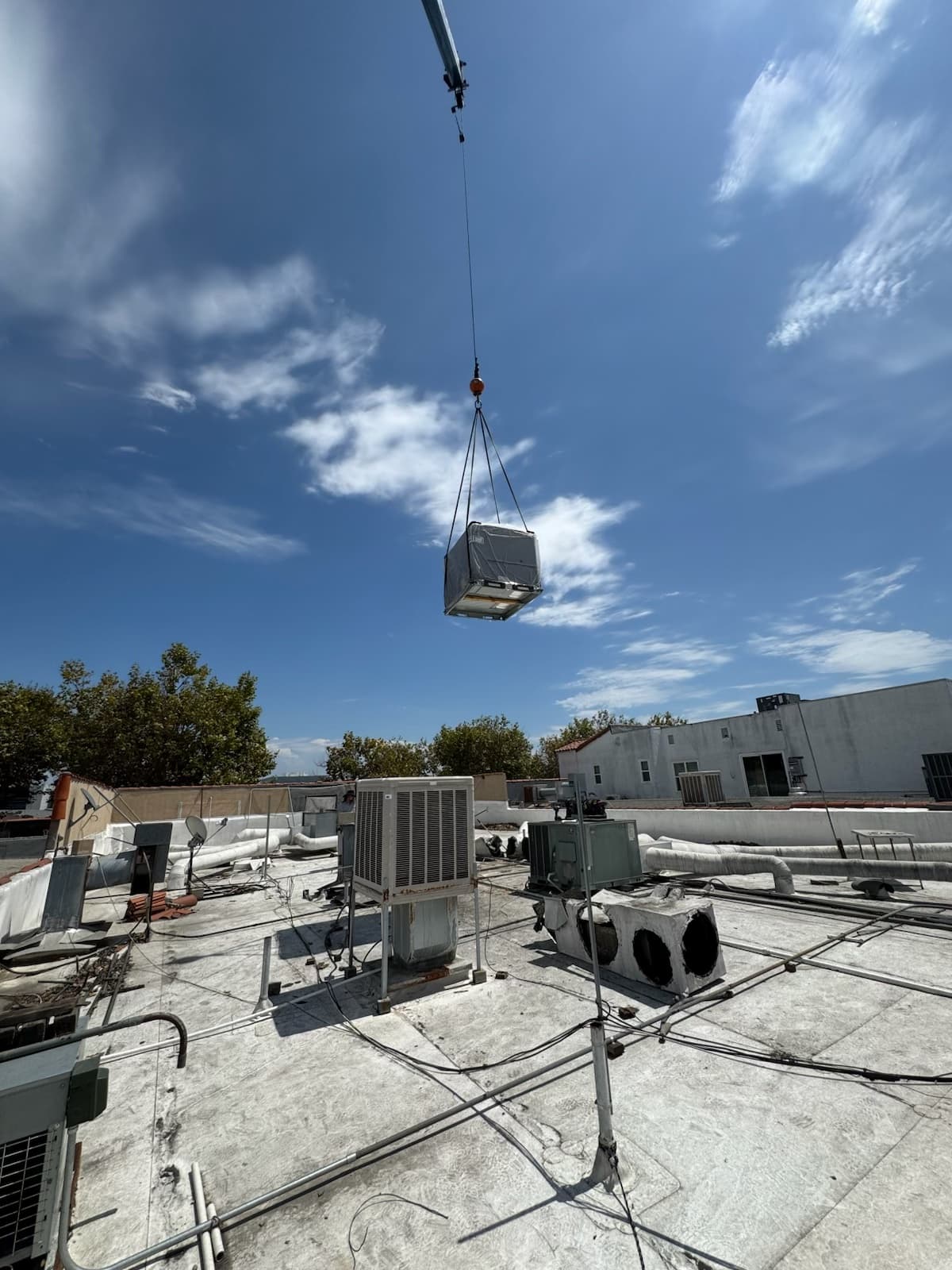
How rtu & split installs work plays out in Chino
Rooftop replacements in Chino's industrial south are logistics projects before they are mechanical ones. The buildings along Kimball, Euclid, and Schaefer run production shifts and receive trucks through most of the day, so the crane has to be positioned where it will not block a dock, the pick has to happen in a window the plant manager approves, and the roof below has to be verified for both structural capacity and the condition of old curbs and penetrations. Food plants add a sanitation layer: the work area under the roof opening may need to be protected or the line below taken down during the swap, and dust from the roof cannot be allowed into a production space.
For retail roofs at Chino Spectrum Marketplace and Towne Center near the 71 and Grand Avenue, the constraints are different but just as real. These are multi-tenant roofs with equipment owned by different parties, landlord approval for crane staging in the parking lot, and store hours that push picks to early morning. Permits run through the City of Chino, and Title 24 acceptance testing has to be completed and documented before the project closes; confirm current permit requirements with the city, as processing times and forms change.
Equipment selection in this city has to account for heat, dust, and in some areas corrosive air. We specify units with strong high-ambient capacity, discuss coated coils with owners of buildings in the former dairy areas, and verify electrical service can support the higher-efficiency units current code pushes toward. The commercial RTU replacement page and the Title 24 and permits guide explain what the project includes end to end.
Chino's climate and what it does to this equipment
Chino's flat terrain and open surroundings make it hot, breezy, and dusty. Summer highs are intense, Santa Ana winds blow through with little obstruction, and remaining agricultural land and busy industrial sites contribute dust to the air. Dairy and agricultural operations also add ammonia and organic particulate that can foul coils and filters faster than in a typical commercial area, and regional smog and wildfire smoke add more. For food processing and cold storage, hot afternoons coincide with peak production, so refrigeration condensers must hold performance exactly when the load is greatest.
For the equipment background behind this page, read our commercial rooftop unit guide or the full RTU & Split System Installs service page.
- Former dairy-region industrial areaFood processing, cold storage, manufacturing, and distribution buildings in the south and southeast, with large refrigeration and rooftop loads.
- Chino Spectrum and Ontario borderBig-box retail, restaurants, and entertainment with dense rooftop equipment and extended operating hours.
- Chino Airport and Merrill Avenue areaAviation-related users, light industrial tenants, and business space with wide-open exposure to wind.
- Downtown Chino and Chino Hills borderOlder storefronts, restaurants, medical offices, and community retail along the central corridors and at the city's northern edge.
- Site survey covering load, airflow balancing, and duct condition
- Clean rigging with code-correct gas, electrical, and condensate work
- Startup readings documented and stored in the Portal
- DaVinci Portal included: asset QR tag + warranty paperwork on file
What a rtu & split installs visit includes, and the problems we most often find
- Site survey — existing curb/duct compatibility, load, and airflow requirements
- Equipment selection sized to actual load and hours of operation, not just square footage
- Crane scheduling and rigging coordinated for roof access
- Install with code-correct gas, electrical, and condensate work
- Startup readings taken and documented; warranty registered in the Portal
- Undersized or oversized replacement units causing short-cycling or poor comfort
- Curb mismatches that turn a 'simple swap' into a bigger job mid-install
- Duct transitions that don't match the new unit's airflow requirements
- Aging units on refrigerant types that are getting harder and more expensive to service
RTU & Split Installs in Chino: questions we get
We run two shifts at our Chino food plant. When can rooftop units realistically be replaced?
Should we specify coated condenser coils for a replacement unit in Chino?
Do you handle the crane pick and rigging?
Can you match an existing curb or duct layout?
Other services in Chino
RTU & Split Installs nearby in Inland Empire (Riverside & San Bernardino Counties)
Commercial HVAC and refrigeration across Inland Empire (Riverside & San Bernardino Counties)