RTU & Split Installs in Burbank, CA
Burbank's valley heat sets the terms for rooftop replacement. Units that were adequate years ago may struggle as internal loads rise in media and office spaces, so sizing, airflow, and condenser clearances deserve careful review. Studio and airport-area buildings often provide good crane access, but active lots may have security and schedule constraints. Permits go through the city, and Title 24 compliance should be planned early, so confirm current requirements before ordering equipment.
Studio and media campuses, airport-area industrial buildings, a restaurant-rich Magnolia Park, and hospital facilities in the heat of the San Fernando Valley.
How rtu & split installs work plays out in Burbank
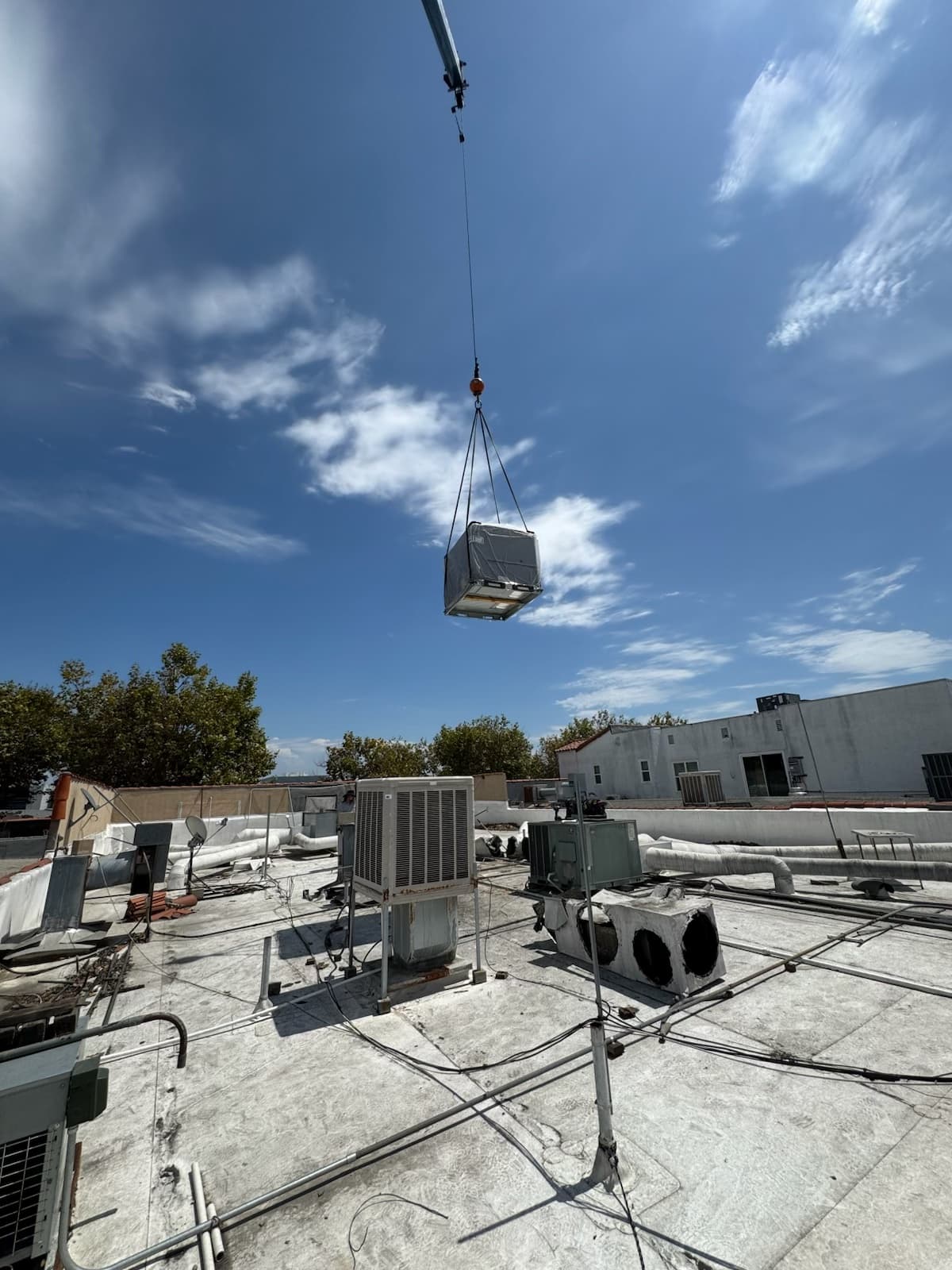
Airport-area industrial buildings are the straightforward end of Burbank rooftop replacement: wide tilt-up roofs along Empire Avenue and around the Golden State industrial blocks, open parking lots for a crane, and landlords who want many identical units replaced in a planned sequence. The complicated end is the Media District and downtown, where a unit on a studio support building has to be swapped around a shooting schedule, or a crane on San Fernando Boulevard needs a street-use permit and a quiet-hours window because of residential development nearby. Magnolia Park storefronts sit in between, with light roofs and tight alleys that sometimes rule out a conventional pick.
Burbank's heat changes the equipment conversation. Nameplate-for-nameplate replacement often falls short because loads have grown, and because a unit rated at standard conditions loses capacity when the roof is running near 105 degrees. We check actual load, duct static, and condenser clearance, and we specify for the environment the unit will actually live in. Title 24 applies to replacements, and Burbank issues its own permits, so confirm current requirements with the city before ordering. Burbank Water and Power also runs commercial efficiency programs from time to time; checking what is current can affect the equipment choice.
On the day, the sequence is tight: old unit disconnected and lifted, curb adapter set, new unit placed, electrical and controls reconnected, startup readings taken. For studio and media clients the lift is often scheduled on a dark day or weekend; for industrial landlords a run of units is done across consecutive early mornings before tenants arrive. Startup data and permit records go into the DaVinci Portal. The RTU replacement page and the rooftop unit guide cover planning in detail.
Burbank's climate and what it does to this equipment
Burbank sits in the San Fernando Valley, and the valley holds heat. Summer days regularly reach the upper 90s and into the 100s during heat waves, with warm nights that limit equipment recovery. The marine layer that cools coastal cities rarely reaches this far, so cooling seasons are long and intense. Santa Ana winds add dry air, dust, and fire-season smoke that load filters and coils. In these conditions, rooftop condensers and chillers work close to their limits more often than elsewhere in the county.
For the equipment background behind this page, read our commercial rooftop unit guide or the full RTU & Split System Installs service page.
- Media District and studio campusesProduction lots, office buildings, edit suites, and server areas with steady cooling loads and limited tolerance for interruption.
- Magnolia ParkIndependent restaurants, cafes, and shops in older commercial buildings, where kitchens, coolers, and rooftop equipment are compact.
- Airport-area industrial and business parksLarge industrial and light-industrial buildings near Hollywood Burbank Airport with substantial rooftop equipment counts.
- Downtown Burbank and hospital campusesOffices, retail, and medical buildings where comfort, filtration, and scheduling around clinical or business hours are essential.
- Site survey covering load, airflow balancing, and duct condition
- Clean rigging with code-correct gas, electrical, and condensate work
- Startup readings documented and stored in the Portal
- DaVinci Portal included: asset QR tag + warranty paperwork on file
What a rtu & split installs visit includes, and the problems we most often find
- Site survey — existing curb/duct compatibility, load, and airflow requirements
- Equipment selection sized to actual load and hours of operation, not just square footage
- Crane scheduling and rigging coordinated for roof access
- Install with code-correct gas, electrical, and condensate work
- Startup readings taken and documented; warranty registered in the Portal
- Undersized or oversized replacement units causing short-cycling or poor comfort
- Curb mismatches that turn a 'simple swap' into a bigger job mid-install
- Duct transitions that don't match the new unit's airflow requirements
- Aging units on refrigerant types that are getting harder and more expensive to service