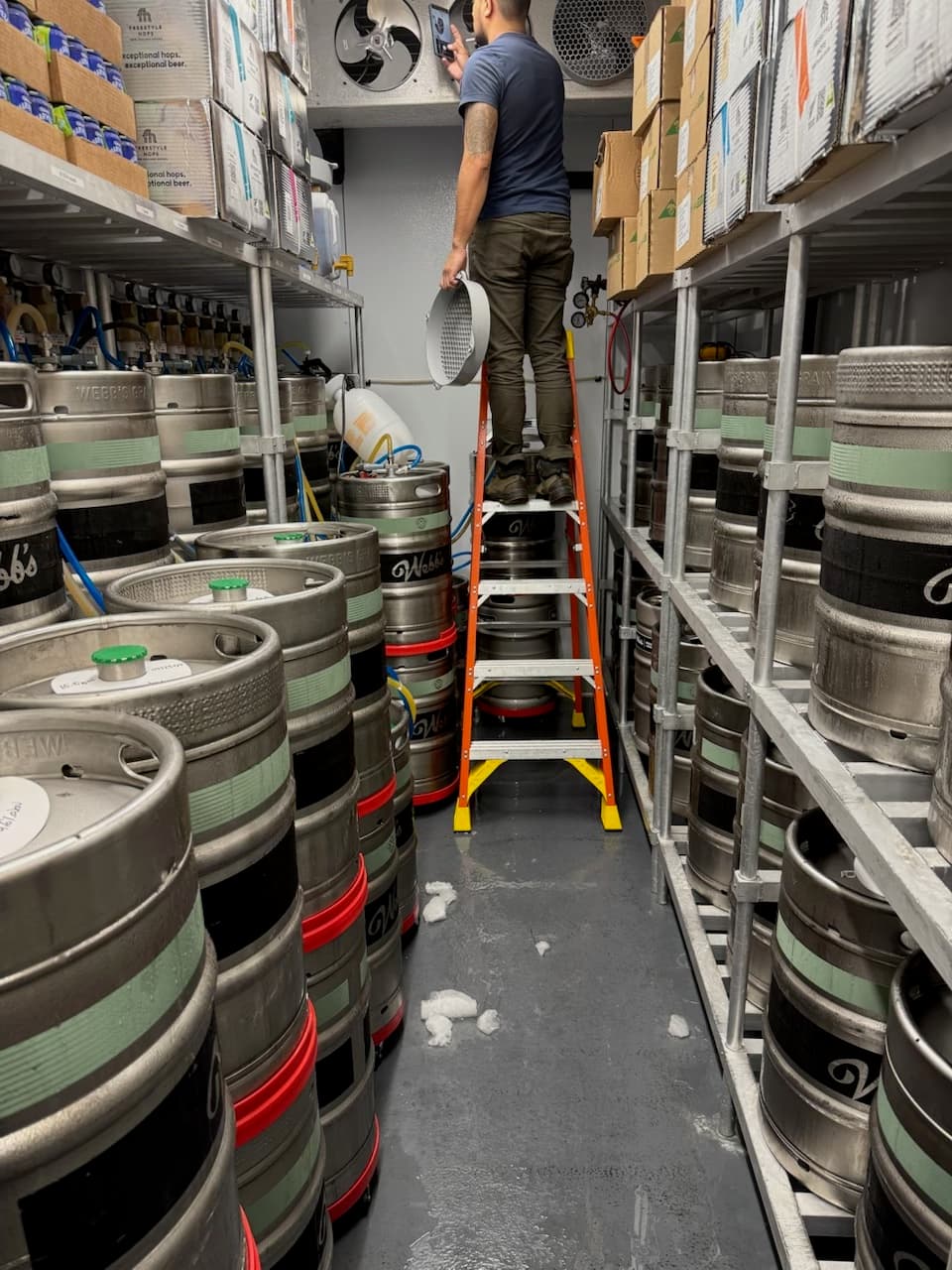
For Restaurants & Commercial Kitchens

HVAC and refrigeration that keeps the kitchen running

Restaurants don't get to close for a service call. We work around your prep and service hours, prioritize refrigeration and kitchen HVAC calls for food-service accounts, and document everything for the next health inspection.

UA Local 250 Member
PLA / Prevailing Wage Ready
Certified Payroll & Compliance
Licensed • Bonded • Insured
Commercial kitchen refrigeration service
Kitchen HVAC that can't take a night off

Cooking lines run hot and hard, service hours, weekends included. We schedule around your hours, not the other way around.

Walk-ins and reach-ins are the business

A cooler failure isn't an inconvenience — it's lost inventory and a possible health-code issue. We treat refrigeration calls with that urgency.

Ice machines get overlooked until they're a citation

Bar and beverage programs depend on consistent ice production and a sanitation record you can actually show an inspector.

Health inspections don't wait for a convenient time

Documented service history through DaVinci Portal means you're not scrambling to prove when equipment was last serviced.

What we handle for restaurant accounts

A day in a commercial kitchen, and where the equipment fails

A restaurant is the hardest mechanical environment most owners will operate: heat, grease, moisture, constant door traffic, and zero tolerance for downtime during service. Here is how the day unfolds from the equipment's point of view.

TimeWhat's happeningWhat breaks
Before open (5–9 am)Walk-ins loaded with deliveries, ice machines refilling bins, rooftop units starting upDoor left open during receiving warms the box; ice machines stall on low water pressure; units trip on first start
Lunch rushHoods and make-up air at full load, reach-ins opened constantly, dish machine drawing hot waterHot water runs out; dining room warms because make-up air fights the kitchen; reach-in compressors short-cycle
Afternoon heatRooftop condensers at peak ambient, kitchen heat load highestHigh-pressure trips, frozen evaporators from low airflow, condenser fan failures
Dinner serviceHighest covers, full kitchen, bar ice demandIce shortage, warm product in line coolers, tripped breakers
CloseCleaning, wash-downs, equipment shut downWater intrusion in electrical, drains backing up, doors left ajar overnight

The failure costs owners actually feel

  • A failed walk-in can lose thousands of dollars of product in a day and force menu changes. Temperature logs matter for insurance and inspections.
  • A failed rooftop unit pushes the dining room above comfort in summer, which shows up in reviews before it shows up in repair invoices.
  • A failed ice machine is a bar and beverage problem within hours.
  • A failed water heater stops dish sanitation and can close the line.

The common thread: nearly every one of these gives warning. Rising head pressure, frost patterns, longer run times, and slow ice production all show up in readings weeks earlier. That is what a quarterly restaurant plan is built to catch.

What a typical restaurant actually owns, mechanically

Before anyone can plan maintenance or budget replacements, the equipment list has to be honest. Most full-service restaurants in Southern California run far more mechanical equipment than the owner thinks about, and much of it was chosen by a previous tenant or a build-out contractor who is long gone. A complete inventory for a 3,000 to 6,000 square foot restaurant usually looks something like the list below. Fast-casual and quick-service locations trim the refrigeration count and add more self-contained reach-ins; bars and breweries shift weight toward ice, glycol, and draft cooling.

Typical mechanical inventory, full-service restaurant
CategoryCommon equipmentWho usually owns it
Comfort cooling and heatingTwo to four packaged rooftop units (one often dedicated to the kitchen), sometimes a ductless split for the office or a private dining roomLandlord or tenant per lease; frequently disputed
Kitchen ventilationUpblast exhaust fans on the roof, a make-up air unit (tempered or untempered), hood controls, and sometimes a dishwasher exhaust fanTenant in most leases
Walk-in refrigerationOne walk-in cooler and often a walk-in freezer, each with a remote or roof-mounted condensing unit and an evaporator coil inside the boxTenant
Reach-in and line refrigerationPrep tables, undercounter units, lowboys, upright reach-ins, glass-door merchandisers, blast chillers in higher-end kitchensTenant
IceOne or two cube or nugget machines with bins, sometimes a remote condenser on the roof, water filtrationTenant, often leased equipment
Hot waterA high-recovery commercial tank heater or a bank of tankless units, a recirculation pump, a booster heater at the dish machineVaries; booster is tenant
Bar systemsGlycol power packs, draft towers, back-bar coolers, glass frostersTenant

Every one of those items has a serial plate, a refrigerant charge or a gas input, and a service history that exists somewhere. Our first visit to a new account tags each asset in the DaVinci Portal so the inventory, the nameplate data, and the ownership question are settled once instead of being re-argued at every emergency. If your lease is unclear about who maintains the rooftop units, read the property management page for how that gets resolved.

How failures move through the year in a Southern California kitchen

Restaurants do not fail randomly. The same stresses recur every year in roughly the same order, and a maintenance program that ignores the calendar will always be reacting. Southern California adds its own rhythm: a mild winter that lulls operators into skipping heating checks, a long dry summer, and Santa Ana wind events in fall that push roof ambient temperatures and dust loading up at the same time.

Late spring and early summer

This is when condenser coils that spent the winter collecting grease-laden exhaust finally show their cost. Head pressures climb, compressors on walk-ins and rooftop units run longer, and the first ninety-degree week produces a wave of high-pressure trips. Kitchens that run a tempered make-up air unit also discover that its cooling section has not been looked at since last fall. The fix is sequencing: coil cleaning in March and April, refrigerant charge and superheat verification in May, and a check of every condenser fan motor before Memorial Day.

Peak summer and the September heat

Inland Orange County, the San Fernando Valley, and the Inland Empire routinely see roof surface temperatures far above the design ambient the equipment was rated for. Walk-in freezers run continuous defrost cycles and ice up anyway; ice machines slow down because warm incoming water and hot condenser air both cut production; dining rooms warm because the kitchen rooftop unit is pulling air from a roof that is hotter than the kitchen. September is often worse than July because the equipment has been running hard for three months and because Santa Ana conditions can arrive while the ocean is still warm. Our heat wave readiness guide walks through what to check before a forecast event.

Fall and the holiday season

Dust and wind events foul coils again. Hot water demand rises as the dish machine runs longer during holiday covers. Heating sections that have not fired since March fail on first call for heat, usually on a Friday night when the patio is full. Gas valves, ignition modules, and inducer motors are the common culprits, and all of them can be tested in October during a routine visit.

Winter

Winter is the lightest load on refrigeration and the best window for anything that requires a box to be emptied, a compressor to be swapped, or a rooftop unit to be craned. It is also when economizers matter most, since cool outside air can carry much of the dining room load for free if the dampers actually work. Rain exposes roof penetrations around curbs and exhaust fans, and water in a disconnect or control box is a common January service call.

Documentation the health inspector and your insurer actually use

County environmental health departments in Southern California inspect retail food facilities on a recurring schedule and after complaints. The inspector is not there to audit your HVAC contractor, but refrigeration and hot water show up on every report in some form: cold-holding temperatures, freezer temperatures, hot water at the three-compartment sink and hand sinks, and the sanitizing stage at the dish machine. When a unit is found out of range, the question becomes whether you can show it was a one-time event or a chronic condition. Confirm current requirements with your county, since inspection frequency and specific temperature thresholds are set by the California Retail Food Code and local health departments and are revised over time.

  • Service records tied to the specific unit. A report that says "serviced walk-in" is weak; a report that names the walk-in cooler by tag, records the box temperature, suction and discharge pressures, superheat, and door gasket condition, with a timestamped photo, is something an inspector can read in thirty seconds.
  • Temperature trend over time. If you log box temperatures daily, pair them with the service dates so a drift and its correction are both visible.
  • Ice machine sanitation records. Cleaning and sanitizing dates, the sanitizer used, filter change dates, and photos of the evaporator plates and bin interior. Mold or scale on ice contact surfaces is one of the most common refrigeration-related violations.
  • Hot water capacity and temperature. Date of last water heater service, thermostat setpoint, recovery test results, and booster heater outlet temperature at the dish machine.
  • Repair history that explains a current condition. If a case is running warm because a compressor is on order, a dated work order showing the diagnosis and the expected part arrival changes the conversation.

Insurance carriers ask for the same things after a spoilage claim, and some policies require evidence of a maintenance program before they pay. Landlords in managed shopping centers often require proof of annual rooftop and exhaust service as a lease condition. Every reading, photo, and work order we generate is attached to the asset record in the portal, which means the record exists before anyone asks for it. See the commercial ice machine guide for the sanitation specifics and the restaurant annual checklist for what should be logged each quarter.

Scheduling around service hours without cutting corners

The restaurant scheduling problem is not just that the kitchen is busy. It is that the equipment most likely to need work is the equipment that cannot be shut down while there is product in it or guests in the room. A walk-in compressor change means moving product; a rooftop replacement means a crane in the parking lot and a day without cooling; a make-up air unit repair means the hood system may not balance, and in some jurisdictions the kitchen cannot legally cook without make-up air running.

  1. Routine maintenance goes in the morning gap after deliveries and before lunch prep, or in the late afternoon between lunch and dinner for places that close between services. Roof work does not disturb the kitchen at all, so rooftop units, exhaust fans, and remote condensers can be serviced during service as long as nothing is shut off for long.
  2. Refrigeration repairs that require the box to be down get scheduled for the day after a low-volume night, with product moved to a rental reefer or a neighboring box the evening before. We tell you in advance what the window will be so staff can plan.
  3. Rooftop unit replacements are planned for a closed day or an early morning before open. Crane staging, curb adapters, and the electrical and gas connections are pre-fabricated so the unit swap itself takes hours. The RTU replacement page covers the permit and Title 24 pieces.
  4. Emergencies during service get triaged by what is at risk. A walk-in freezer at ten degrees and rising is more urgent than a dining room that is two degrees warm, and we will say so.
Multi-unit operators

If you operate several locations, a shared maintenance calendar across all of them lets us group roof work by area and keep the same technician on your equipment. Repeat visits by the same person are worth more than any checklist.

Repair or replace: the decision points that matter in food service

Restaurant margins make the repair-versus-replace question sharper than in most commercial buildings, and the wrong answer in either direction is expensive. Replacing a unit that needed a contactor wastes capital; repairing a compressor on a fifteen-year-old walk-in condensing unit with a leaking coil buys a few months. The decision should rest on a diagnosis, not on a hunch, which is why our first move on an old unit is a full set of readings rather than a quote.

EquipmentLean toward repair whenLean toward replace when
Rooftop unitFailure is electrical or a single mechanical component; heat exchanger is sound; unit is under about twelve years; refrigerant is still readily availableCompressor failure on an R-22 unit; cracked heat exchanger; multiple refrigerant leaks; cabinet corrosion from grease exhaust; unit is undersized for the current kitchen
Walk-in condensing unitComponent-level failure (fan motor, contactor, start components); coil and compressor test healthyCompressor failure on an older unit with a corroded condenser; repeated leaks; refrigerant being phased down with limited supply
Walk-in box itselfDoor, gasket, heater wire, or closer problemsPanel seams failing, floor rotting, insulation waterlogged (box runs long and never pulls down)
Reach-ins and prep tablesGasket, fan, thermostat, or condenser cleaning solves itCompressor failure on a unit past its warranty; often cheaper and faster to replace self-contained units than to rebuild them
Ice machineWater-side issues, sensors, pumps, or a dirty condenserEvaporator plate delamination, compressor failure, or production that no longer meets the bar's demand
Water heaterThermocouple, gas valve, igniter, anode, or recirc pumpTank leak, repeated flue problems, or recovery that cannot keep up with the dish machine on a busy night

Refrigerant is the hidden variable. California's phase-down of high-GWP refrigerants changes what makes sense to repair, especially on walk-in and rack systems. The refrigerant compliance guide explains the current landscape in general terms; confirm specifics with us at the time of the decision, since rules and availability shift. When a second opinion is warranted, our second-opinion diagnostic exists exactly for the moment another contractor has quoted a replacement you are not sure about.

Which maintenance tier fits which kind of restaurant

The maintenance tiers on our plans page are built around visit frequency and included labor, and restaurants nearly always belong in the quarterly tier. The reason is load, not sales pitch: a kitchen rooftop unit ingests grease aerosol every day, walk-in condensers sit in the same exhaust plume, and door traffic on refrigeration is measured in hundreds of openings per shift. Equipment that sees that kind of use drifts out of spec in weeks, not seasons.

  • Quarterly is the default for full-service kitchens, bars, breweries, and anything with a walk-in freezer. Each visit includes coil cleaning where needed, refrigerant readings, defrost verification, gasket inspection, ice machine inspection, and a look at the hot water system, with photos and readings logged to each asset.
  • Bi-annual can work for small cafes, coffee shops, and counter-service concepts with limited cooking and only self-contained refrigeration, provided the sales floor rooftop unit is the main asset and the kitchen load is light.
  • Annual is rarely a fit for a working kitchen. It is more appropriate for a commissary that operates a few days a week, or a seasonal concession that is closed for months at a time.

Ice machine sanitation deserves its own line. Manufacturers generally call for cleaning and sanitizing at least twice a year, and kitchens with hard water, flour dust, or yeast in the air (bakeries, pizzerias, breweries) usually need it quarterly. We fold that into the plan visits so it is not a separate call you have to remember. Our ice machine service page describes the procedure.

Running a program across several restaurants

Operators with three or more locations hit a different set of problems. Equipment differs by site because each build-out was a different year with a different general contractor. Service history lives in email threads and on the back of invoices. The regional manager finds out about a failure when the GM calls, and nobody can say whether the walk-in at the Costa Mesa store has had three compressor calls or one. The fix is structural rather than heroic.

  1. One asset register for the whole group. Every unit at every store is tagged, with its nameplate, refrigerant, install date, and ownership recorded. The portal lets a regional manager pull records across stores while each GM sees only their location.
  2. Standardized visit scope. The same checklist, the same readings, and the same report format at every store, so a comparison between locations means something.
  3. A shared calendar. Quarterly visits grouped by geography so roof work in Irvine, Tustin, and Santa Ana lands in the same week with the same crew.
  4. A capital list reviewed twice a year. Units ranked by age, refrigerant, failure count, and risk, so replacements are planned into slow months instead of forced in August.
  5. Clear emergency routing. Who at the store can authorize a repair up to what point, and who gets called when that point is passed.

For groups whose footprint runs beyond Orange County into Los Angeles, Riverside and San Bernardino, San Diego, or Ventura counties, we handle multi-site programs as a single account rather than as separate stores. Regional notes are on the Los Angeles County, Inland Empire, and San Diego County pages.

Southern California specifics for restaurant operators

A few regional realities shape restaurant mechanical work here more than anywhere else we have worked.

  • Coastal versus inland is a different equipment life. Restaurants in Newport Beach, Huntington Beach, Long Beach, and along the San Diego coast fight salt corrosion on rooftop coils and cabinets; restaurants in Riverside, Ontario, Corona, or the Coachella Valley fight extreme roof ambient and dust. Coil coatings and condenser placement decisions should follow the site, and the Orange County climate guide covers the microclimates.
  • Air district rules affect gas equipment. The South Coast Air Quality Management District regulates emissions from certain commercial water heaters and boilers, and rules on new gas-fired equipment continue to evolve. Replacement decisions on water heaters should account for current rules; confirm with us at the time of the project.
  • Title 24 applies to replacements, not just new construction. Replacing a rooftop unit triggers permit, efficiency, and in many cases economizer and acceptance-test requirements. The Title 24 and permits guide explains the general framework.
  • Kitchen ventilation balance is a frequent root cause. Many restaurants in older strip centers were built with hoods that exhaust more than the make-up air returns, pulling conditioned air out of the dining room and dragging in unfiltered outside air through every door. Our kitchen ventilation and make-up air work addresses the balance problem; hood and duct cleaning itself is a separate trade.
  • Patio dining is permanent now. Outdoor seating added after 2020 often brought infrared heaters, misting systems, and sometimes portable cooling with no electrical planning. Loading on the panel affects what the rooftop units and refrigeration see, and a tripped main during dinner is a mechanical problem as often as an electrical one.

Everything above feeds back into root-cause diagnostics: a restaurant that calls for the same symptom three times has a cause nobody has found yet, and our job is to find it rather than to keep swapping the part that fails downstream of it.

More questions, answered

Can you service our kitchen during business hours without shutting us down?
Most routine work, yes. Rooftop units, exhaust fans, remote condensers, and make-up air units are all on the roof and can be inspected and serviced while the kitchen runs, as long as no single system is off for long. Work inside the walk-in or on the cooking line is scheduled for the morning gap or between services. Anything that takes a box or the make-up air out of service for hours is planned for a closed day, with product moved ahead of time.
The health inspector flagged our walk-in temperature. What should we be able to show them?
The most useful record is the service history for that specific unit: dated readings, what was found, what was corrected, and photos. If the drift was caused by a known fault that is being repaired, a dated work order showing the diagnosis and the part on order demonstrates the condition is being handled rather than ignored. Daily temperature logs paired with those service dates make the picture complete. All of this lives on the asset record in the DaVinci Portal and can be pulled up on a phone.
Our rooftop unit over the kitchen has failed twice this summer. Is it time to replace it?
Not necessarily, and a diagnosis should come before a quote. Repeated failures on a kitchen unit often trace to a root cause: a condenser coil loaded with grease, a make-up air imbalance that starves the unit of return air, or an undersized unit that was never right for the current hood. If the heat exchanger and compressor are healthy and refrigerant is available, repair plus fixing the cause is usually the right call. If it is an older R-22 unit with a failed compressor or a cracked heat exchanger, replacement is the sensible choice.
How often should a restaurant ice machine be cleaned and sanitized?
Most manufacturers call for a full cleaning and sanitizing cycle at least twice a year, and kitchens with hard water, airborne flour or yeast, or heavy bar volume generally need it quarterly. The procedure covers the evaporator plates, water distribution, bin, and sensors, plus a filter change on schedule. We include ice machine inspection and sanitation within quarterly plan visits so it is documented alongside everything else, since scale and mold on ice contact surfaces is one of the common citations.
We lease. Who is responsible for the rooftop units, us or the landlord?
It depends on the lease, and the answer is frequently unclear until someone reads it carefully. Many Southern California retail leases make the tenant responsible for maintenance and repairs on units serving the premises while the landlord handles replacement, sometimes with a threshold above which the landlord contributes. Kitchen equipment, refrigeration, and exhaust are almost always the tenant's. We help settle the ownership question on the first visit by tagging each unit with the space it serves so the lease language can be applied to real equipment.
Do you handle hood and duct cleaning as part of kitchen ventilation?
No. Hood and duct cleaning is a separate trade with its own certification and fire-code schedule. What we handle is the mechanical side of kitchen ventilation: exhaust fan motors, belts, bearings, and curbs; make-up air unit heating and cooling sections and controls; and the balance between exhaust and make-up air that determines whether the dining room stays comfortable and the kitchen stays safe. If the two trades need to coordinate, for example when a fan is replaced and the duct needs cleaning at the same time, we will work with your cleaning vendor on scheduling.