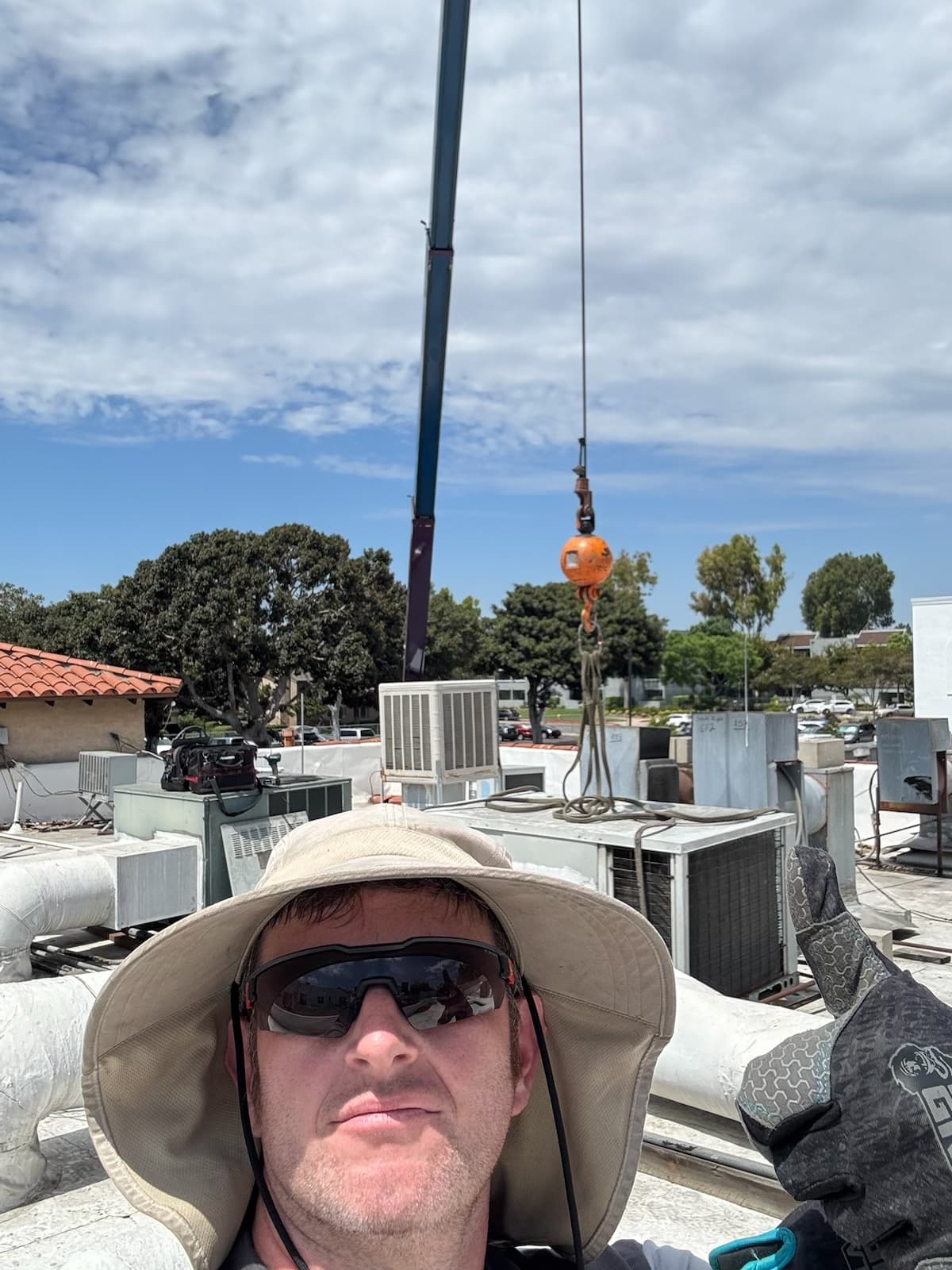
Every facility manager eventually gets the call: an RTU is down, the repair quote is in hand, and now there is a decision to make with a budget cycle, a tenant, or an operations team waiting on the answer. The quote itself is usually the least informative piece of paper in the conversation. Here is a framework that goes past the simple "50% rule" most people default to, and a set of questions that will get you a better answer from whoever is standing on your roof.
Start with the 50% rule, but do not stop there
The common guideline is: if a repair costs more than half of a new unit's installed cost, replace instead of repair. It is a reasonable first filter because it forces a comparison that otherwise does not happen. But it has two blind spots. It treats a repair on a six-year-old unit the same as a repair on an eighteen-year-old unit, and it treats a contactor the same as a compressor. Both of those distinctions matter more than the ratio.
Age relative to expected service life
Commercial RTUs are generally expected to run 15 to 20 years with proper maintenance, less in coastal or high-run-hour environments, and sometimes longer on a lightly loaded unit that has been serviced well. The useful number is not the age itself but the age as a fraction of what the unit can reasonably be expected to deliver. A repair on a unit in its first third buys a decade of additional service. The same repair on a unit in its final third buys a year or two, and the next major failure is likely to arrive before the repair has paid for itself.
Maintenance history changes the expected life more than most people assume. A unit with documented bi-annual service, clean coils, and stable readings at fifteen years is often in better shape than a neglected unit at nine. If the service history is thin or missing, be more conservative on the age estimate, because you do not know what the unit has been through. This is one reason the DaVinci Portal record matters at decision time: a unit with a readable history can be judged on evidence rather than nameplate date.
Refrigerant type
Units on legacy or phased-down refrigerants come with a real cost and availability risk on any future repair, independent of the unit's age. If a repair on an older-refrigerant unit involves the refrigerant circuit at all, that is a strong signal toward replacement; the next refrigerant-side repair may be harder to source and more expensive, and the trend is only in one direction. New equipment is moving to lower-GWP refrigerants, and a replacement ordered today should be specified with that in mind rather than as a like-for-like swap of what came off the roof. The refrigerant compliance guide covers what the current rules mean for both existing and new equipment.
What is actually failing
Not all repairs are equal, and this is where the 50% rule is weakest. Sort the failure into one of three buckets before you think about the number.
Component-level electrical and controls
Contactors, capacitors, relays, transformers, control boards, thermostats, and sensors. These fail on units of any age, the repair is quick, and a failure here says very little about the health of the rest of the unit. Repair, almost always.
Mechanical wear items
Blower motors, condenser fan motors, belts, bearings, and economizer actuators. Normal wear on a unit that has run for years. Repair on a younger unit without hesitation. On an older unit, repair, but treat it as a signal to pull the readings and look at the whole picture.
Refrigerant circuit and heat exchange
Compressors, reversing valves, condenser or evaporator coil leaks, and cracked heat exchangers in the gas section. These are the expensive failures, and they are also the ones that cluster. A compressor that fails on a sixteen-year-old unit is usually not an isolated event; the coils have the same hours and the same corrosion, and the other compressor on a dual-circuit unit has the same age. A cracked heat exchanger is a safety issue and takes the unit out of service for heating regardless of what else works.
One more point on this bucket: find out why it failed before you decide what to do about it. Compressors rarely die of old age alone. Low charge from a slow leak, a dirty condenser coil running high head pressure for two summers, liquid floodback from a metering device problem, or a voltage imbalance on the incoming power will take out a compressor and then take out the replacement compressor the same way. A second-opinion diagnostic is worth it when a major component failed with no clear cause, or when a prior repair did not hold.
Downtime cost and redundancy
A single RTU serving a server room, a surgical suite, or a kitchen with no backup has effectively zero tolerance for extended downtime, which changes the math. A faster repair may be worth a premium even if replacement is the better long-term call, simply to buy time to plan and budget the replacement properly instead of doing it under emergency conditions. Emergency replacements cost more in every dimension: crane availability, equipment lead time, permit timing, and the pressure to accept whatever is in stock rather than what the space actually needs.
Conversely, a roof with four units serving one open-plan office has built-in redundancy. One unit down in spring is uncomfortable but not critical, and that is exactly the situation where you can afford to take three weeks and replace it properly.
Efficiency and the hidden cost of keeping an old unit
An older RTU that still runs is costing more per hour of cooling than a new one would, both because of design-era efficiency differences and because worn components run less efficiently than they did when new. That difference alone rarely justifies replacing a working unit, but it is a real line in the comparison when the repair is already substantial. If the roof is being re-covered, if the building is going through a tenant improvement, or if utility incentive programs are available for high-efficiency equipment in your area, the timing argument gets stronger. Confirm current incentive requirements before counting on them.
Code and permit implications
A repair generally does not trigger a permit. A replacement in California does, and with it come Title 24 requirements that can affect the equipment specification, economizer requirements, duct sealing or testing, and acceptance testing. None of that is a reason to avoid replacement, but it is a reason to plan it rather than discover it. The Title 24 and permits guide covers what typically applies; confirm current requirements with your jurisdiction.
Thinking in portfolios, not single units
If you manage more than a handful of rooftop units, the repair-or-replace question is really a capital planning question in disguise. A roof with eight units of similar age will not fail all at once, but the failures will cluster over a few years, and handling each one as an emergency means paying crane mobilization eight times and accepting whatever equipment is in stock each time. The alternative is to use each repair decision as a data point: rate every unit on age, condition, refrigerant, and criticality, then replace the two or three worst units in a planned project each year while repairing the rest. Planned replacements can be bid, scheduled in shoulder season when crane and crew availability are better, and coordinated with roofing or tenant work. Emergency replacements cannot. A unit record that shows readings over time, which is what the DaVinci Portal provides, is what makes that rating defensible when it goes into a budget request.
A simple framework
| Situation | Usual call |
|---|---|
| Under about 10 years old, current refrigerant, component-level or wear-item failure | Repair |
| Under about 10 years old, compressor or coil failure with an identified root cause | Repair, fix the root cause, and watch the readings |
| 10 to 15 years old, moderate repair, other signs of decline in the readings | Repair now, budget for replacement within one to two cycles |
| 10 to 15 years old, refrigerant-circuit failure on a phased-down refrigerant | Lean replace; repair only to bridge to a planned replacement |
| Over 15 years old, major component failure | Replace |
| Any age, critical space with no redundancy, long equipment lead time | Repair to restore service, then plan the replacement on your schedule |
Questions to ask before you sign either way
- What failed, and what caused it to fail? If the answer is only the first half, keep asking.
- What are the current readings on the components that did not fail, and how do they compare to nameplate or to the last service visit?
- If we repair, what is the next most likely failure on this unit and when?
- If we replace, what refrigerant does the new unit use, what Title 24 items apply, and what is the realistic lead time including crane and permit?
- Can the repair be done in a way that does not waste money if we replace in twelve months?
A contractor who can answer those in plain language from readings on the unit is giving you a recommendation. One who can only point at the quote is giving you a price.
We give straight repair-vs-replace guidance based on the actual unit and its readings, not a default push toward replacement. See the commercial RTU replacement page for what a full replacement actually involves, the RTU and split system installs service page, or ask about a second-opinion diagnostic if a prior repair did not hold.