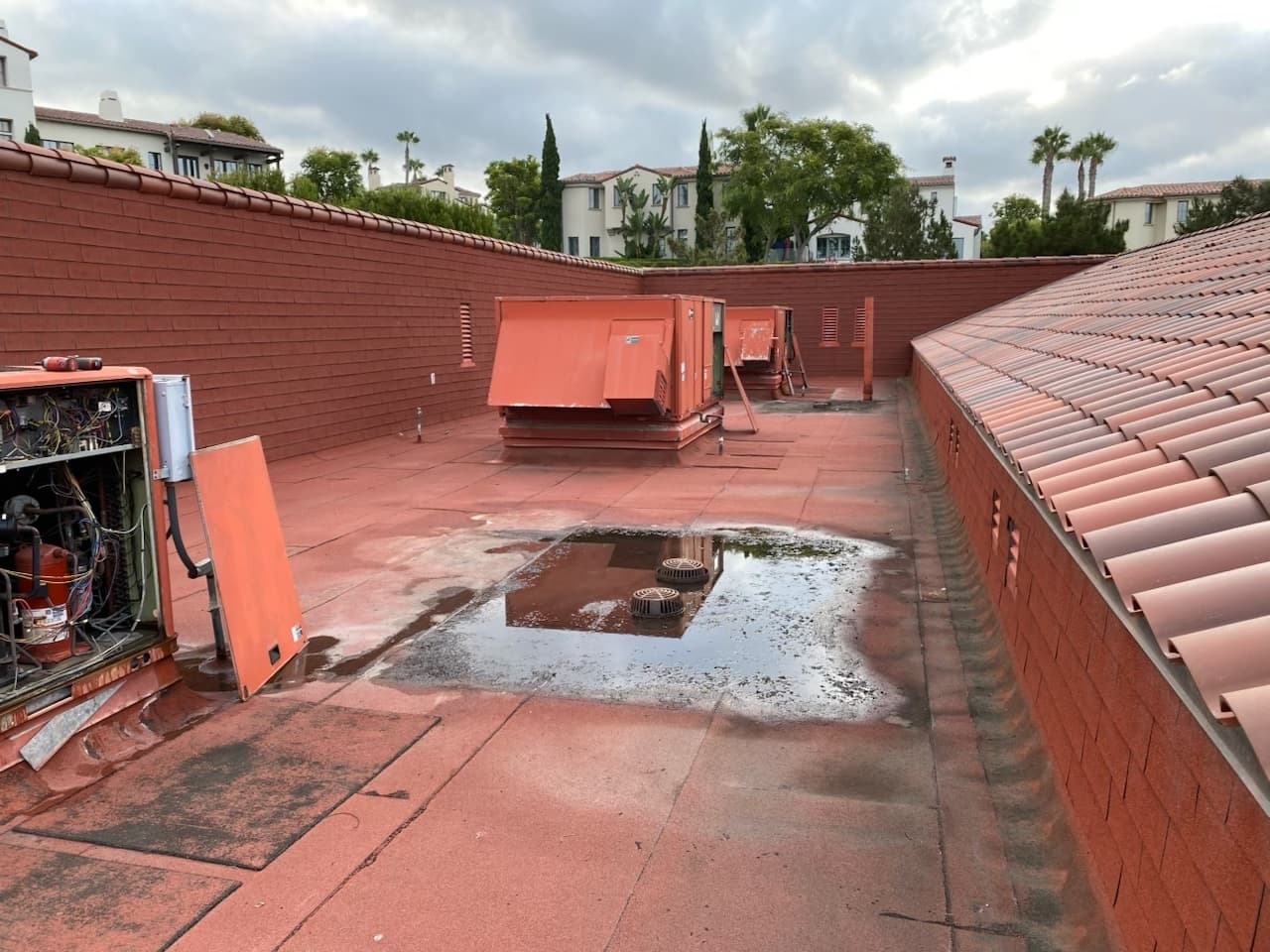
"Twice a year" is the answer most facility managers have heard for rooftop unit (RTU) maintenance, and for a lot of buildings that is close enough. But it is a starting point, not a rule. The right interval depends on how hard the unit runs, what is on the roof around it, and what happens if it goes down. Two identical units bought the same month can justify very different schedules a year later, and a program that ignores that will either overspend on the easy units or underprotect the critical ones.
This post walks through what actually drives the interval, a framework you can apply to a mixed portfolio, what each visit should contain at each cadence, and how to tell whether the schedule you have is working. If you want the longer treatment of how a program is built and budgeted, the preventive maintenance program guide goes deeper on structure and reporting.
What actually drives the interval
Run hours, not calendar time
A rooftop unit conditioning a restaurant dining room or a 24-hour operation racks up wear far faster than one serving a 9-to-5 office. Belts stretch, bearings load, contactors cycle, and condenser coils collect debris in proportion to how many hours the fans are turning. A unit that runs 4,000 hours a year has roughly twice the mechanical exposure of a unit at 2,000 hours, and the schedule should reflect that. If you do not know run hours, a thermostat or building automation system with runtime logging can tell you within a few weeks; see building controls and automation for what that looks like on existing equipment.
Roof exposure and local environment
Salt air accelerates coil and cabinet corrosion, so sites within a few miles of the coast benefit from more frequent coil cleaning and corrosion checks regardless of run hours. Inland, the issue is different: dust, wind-blown debris, and cottonwood or palm litter load condenser coils, and a roof near a freeway or an industrial neighbor picks up particulate that fouls fins faster than a quiet suburban roof. Kitchen exhaust is its own category. A condensing unit sitting downwind of a grease exhaust fan will coat with a film that ordinary rinsing does not remove, and that film insulates the coil and drives head pressure up all summer.
What is downstream of the unit
A unit tied to a server room, a medical office, a veterinary surgery suite, or a commercial kitchen has a much lower tolerance for unplanned downtime than one serving a storage mezzanine. That changes how much you should spend on prevention versus how much you are willing to risk on reaction. The question is not "what does the unit cost" but "what does an afternoon without it cost," measured in lost product, cancelled appointments, tenant complaints, or occupant safety during a heat event.
Age, condition, and refrigerant type
Older units and units on legacy refrigerants are more failure-prone and worth checking more often, especially heading into summer cooling load. A unit past its expected midlife is also a unit where a maintenance visit doubles as a condition assessment for the replacement budget. If a unit is already on the watch list, the readings from each visit are what turn a guess into a defensible repair-or-replace recommendation; the commercial RTU replacement page covers what that decision involves.
A reasonable starting framework
Use this as a first sort of your equipment list, then adjust individual units up or down based on the factors above.
| Cadence | Typical fit | Why |
|---|---|---|
| Quarterly | Restaurants, commercial kitchens, medical and lab space, 24-hour operations, coastal roofs, anything where downtime has a hard hourly cost | High run hours and heavy coil loading; filters and coils foul fast enough that a six-month gap costs efficiency and shortens compressor life |
| Bi-annual (spring and fall) | Typical retail, office, and light-industrial space with standard business hours | Catches cooling-season readiness before the first heat wave and heating-season readiness before the first cold snap |
| Annual, minimum | Light-use storage, seasonal space, or units that are genuinely low priority if they go down for a few days | Still needed for filters, drains, electrical connections, and a baseline set of readings; skipping entirely is where premature failures come from |
Notice that the framework is by unit, not by building. A strip retail center may have a bi-annual program across most of its roof and a quarterly program on the two units serving the restaurant tenant. A school may run annual service on classroom wings and quarterly on the kitchen and the IT room. Mixed cadences are normal and are usually how a program ends up once it has been tuned for a couple of years.
What belongs in each type of visit
The interval only matters if the visits themselves are substantive. A fast filter change with a glance at the belt is not maintenance; it is a filter change. Here is a reasonable scope split for a program that uses more than one cadence.
Every visit, regardless of cadence
- Replace or clean filters and record pressure drop or filter condition
- Inspect and clear the condensate drain and pan; confirm the trap is holding
- Check belt tension, alignment, and wear; inspect pulleys and set screws
- Record supply and return air temperatures and calculate the split
- Record compressor and fan motor amp draws against nameplate
- Visually inspect coils, cabinet, panels, gaskets, and curb seal
- Verify thermostat or controller setpoints and schedule match what the occupant expects
Seasonal visits (spring and fall)
- Clean condenser coils with appropriate chemistry and rinse; clean evaporator coils as needed
- Check refrigerant pressures and superheat or subcooling and compare against the last visit
- Inspect contactors, capacitors, relays, and wiring for heat damage or pitting
- Test economizer dampers, actuators, and sensors for proper operation
- Heating season: inspect burners, igniter, flame sensor, heat exchanger, and inducer; verify safe operation
- Cooling season: confirm crankcase heaters, head pressure controls, and condenser fan cycling
Annual deep inspection
- Tighten electrical connections and check for voltage imbalance across phases
- Lubricate bearings where applicable and inspect motor mounts
- Inspect ductwork connections at the curb and the first few feet of supply and return
- Review the full year of readings for trends in amp draw, pressures, and temperature split
- Produce a written condition rating and a repair-or-replace outlook for budgeting
Why the readings matter more than the checklist
A maintenance visit that does not leave a paper trail is not much better than skipping it. Every visit should log refrigerant pressures, amp draws on the compressor and fan motors, coil condition, filter status, and belt or drive condition, tied to that specific unit rather than a generic form. A single reading tells you where the unit is today; a series of readings tells you where it is going. Compressor amps that creep up over three visits while pressures drift out of range point to a coil or charge problem long before the unit trips on high pressure during an August afternoon.
This is also what separates diagnostics from parts-swapping. A technician who arrives at a breakdown with two years of readings on that unit can see what changed, instead of replacing the first failed component and hoping it was the cause. The DaVinci Portal is how we keep that history attached to the unit itself: a QR tag on the cabinet opens the service record, readings, and photos for anyone standing in front of it, which is useful for your own staff and for whoever bids the work next.
Signs your current interval is wrong
Too infrequent:
- Filters are visibly loaded well before the next scheduled visit
- Repeated nuisance trips on high pressure or freeze protection in summer
- Coils look matted or dark between cleanings
- Emergency calls cluster around the start of cooling season
- Drain pan overflows or water stains below the curb
Possibly too frequent:
- Filters come out nearly clean at every visit
- Readings are flat visit after visit with no drift
- The unit serves space that is unoccupied for long stretches
Both lists are useful. Over-servicing low-use units is money that could cover tighter intervals on the units that carry risk, and a good program moves budget from one column to the other as the readings justify it.
Adjusting for Southern California specifics
Orange County and the surrounding region have a long cooling season, a short and mild heating season, and a marine layer that keeps coastal roofs damp overnight for much of the year. In practice that means cooling-side checks carry more weight than they would in a colder climate, coastal corrosion deserves a line item of its own, and the fall visit should still cover the gas heat section even though it runs relatively few hours. Santa Ana wind events load coils with dust in a matter of days, so a coil inspection after a significant wind event is a reasonable add-on for exposed roofs even outside the regular cadence. The Orange County climate guide covers these patterns in more detail.
Putting it together
- List every RTU with its age, tonnage, refrigerant, and what it serves
- Assign a starting cadence from the table above
- Move coastal, kitchen-adjacent, and critical-space units up one tier
- Require readings on every visit and review them annually for trends
- Revisit the cadence each year based on what the readings and the call log show
We structure commercial maintenance agreements on exactly this framework, with cadences set per unit rather than per building and every reading logged to the equipment record. The tier breakdown is on the maintenance plans page, and the service overview is under commercial preventive maintenance.