A walk-in cooler going down on a Friday night is one of the most expensive failures a kitchen or grocery operation can have: lost product, an emergency service call, and possibly a health-code issue if the temperature drift is not caught fast. Most of the time, though, the unit gave warning signs for weeks before it actually quit. The signs are not subtle once you know what they mean. Here is what to watch for, what each one usually points to, and what a kitchen manager can check before calling anyone.
A quick refresher on how the box works
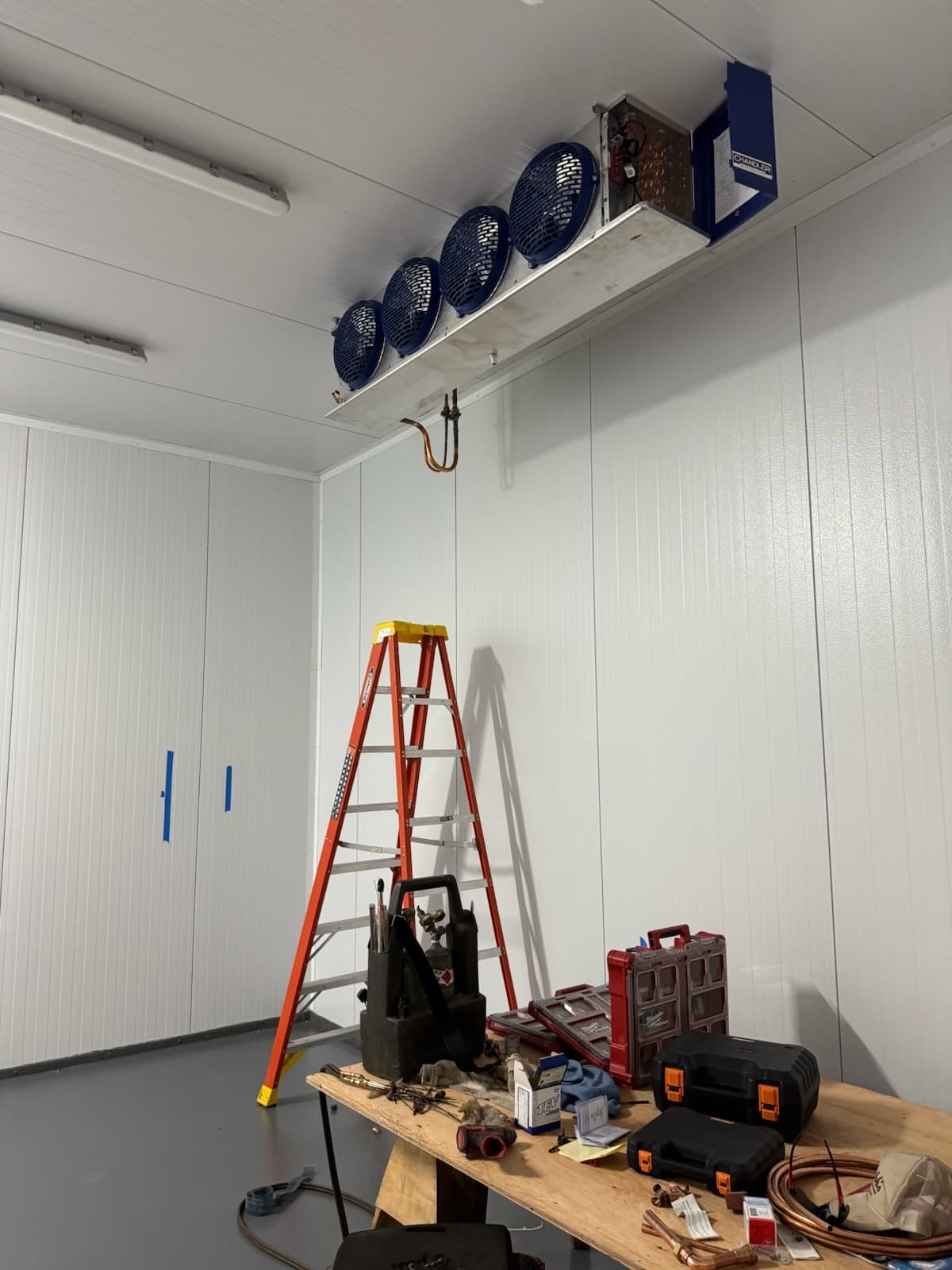
A walk-in has two halves. The evaporator inside the box absorbs heat from the air and carries it out in refrigerant. The condensing unit, usually on the roof, outside on a pad, or on top of the box, rejects that heat and sends the refrigerant back. Between them are a compressor, a metering device, a defrost system to clear frost off the evaporator, and a control that cycles everything to hold setpoint. Almost every warning sign below is one of those parts losing margin. The walk-in cooler and freezer guide covers the system in more depth if you want the full picture.
1. Longer, more frequent run cycles
A healthy walk-in cycles: the compressor runs, the box reaches setpoint, the compressor stops, the box warms slowly, and the cycle repeats. If the compressor seems to be running almost constantly, the system is working harder to hit setpoint and may not be getting there. The usual causes, roughly in order of how often we find them:
- A dirty condenser coil that cannot reject heat, especially in summer or next to a kitchen exhaust discharge
- A door gasket that is no longer sealing, or a door that is being propped open during deliveries and prep
- Low refrigerant charge from a slow leak
- A failing condenser fan motor, so the coil is clean but the air is not moving across it
- Warm product loaded in bulk, which is a usage issue rather than a mechanical one but looks identical from the outside
What you can check: stand near the condensing unit and listen for the compressor cycling off during a quiet period. If it has not stopped in an hour on a mild day with the door closed, something is wrong. Look at the condenser coil with a flashlight; if you cannot see light through the fins, it needs cleaning.
2. Ice buildup where it should not be
Frost on the evaporator coil that does not clear, ice on the ceiling panel near the evaporator, icicles from the drain pan, or frost around the door frame all point to a problem. The common causes:
- A defrost cycle that is not running or not running long enough: failed defrost timer or control, a bad defrost heater on a freezer, or a defrost termination sensor that is out of place
- A door gasket or door closer that lets humid kitchen air in continuously, so the evaporator is fighting moisture it was never sized for
- A low refrigerant charge, which drops the evaporator temperature and frosts the coil unevenly, often from the inlet end
- Evaporator fan motors that have failed, so the coil freezes solid behind a dead fan
Left alone, frost restricts airflow across the coil, the box warms, the compressor runs longer, and the frost gets worse. This is the sign most likely to be ignored because the box is still cold; by the time the evaporator is a block of ice, there is usually a second problem that the ice was hiding.
3. Temperature swings instead of a steady hold
A well-running box holds within a couple of degrees of setpoint. If you are seeing swings, especially wide ones after the door has been open for a delivery, that often means the system no longer has enough reserve capacity. It is still cooling, just not with the margin it used to have, and on a hot afternoon with a busy kitchen the margin runs out. Temperature swings also come from a thermostat or sensor that has drifted, a metering device that is hunting, or a compressor that is losing capacity as its valves wear.
What you can check: put a calibrated thermometer in the box, away from the door and the evaporator discharge, and log it a few times a day for a week. A box that reads fine in the morning and high every afternoon at 3 pm is telling you something specific about condenser capacity in the heat of the day.
4. Unusual noise from the condensing unit
Compressors and condenser fans are supposed to be fairly quiet and consistent. New rattling, grinding, a noticeably louder hum, or a compressor that clicks on and off repeatedly in short bursts is worth a diagnostic visit before it becomes a full failure. Bearing wear in a fan motor and failing contactors rarely fix themselves. Short cycling in particular is often an electrical problem, such as a weak start component or a pressure control tripping, and the repeated starts are hard on the compressor even if it has not failed yet.
5. Water where it does not belong
Water pooling near the condensing unit, on the floor inside the box, or dripping from the evaporator usually means a clogged or frozen condensate drain. It seems minor until it is not: a blocked drain line backs up into the evaporator pan, the water freezes, and frost buildup accelerates, which circles back to warning sign number two. Inside the box, standing water is also a slip hazard and a sanitation issue. Causes include a drain line without enough slope, a missing or failed drain line heater on a freezer, algae in the pan, or a trap that has frozen because the line runs through unconditioned space.
Warning sign to likely cause
| What you notice | Most likely causes | Urgency |
|---|---|---|
| Compressor runs constantly | Dirty condenser, door seal, low charge, fan motor | Days; schedule a diagnostic |
| Frost on evaporator or ceiling | Defrost failure, door infiltration, low charge, dead evaporator fan | Days; worsens quickly in summer |
| Afternoon temperature climb | Condenser capacity, high ambient, weak compressor | Before the next heat wave |
| Short cycling or new noise | Start components, pressure controls, bearings | Soon; each short cycle stresses the compressor |
| Water on the floor or dripping | Drain clog, drain heater, slope, algae | Same week; sanitation and frost risk |
| Box above safe temperature and climbing | Any of the above, now past the margin | Emergency; move product and call |
Why this matters for product safety, not just comfort
Unlike an office HVAC system where a slow decline mostly means people are uncomfortable, a slow decline in a walk-in means product temperature is drifting, which is a health-code and liability issue, not an inconvenience. Health inspectors look at product temperature, not just the box thermometer, and a cooler holding at the edge of the safe range gives you no margin for a delivery, a propped door, or a hot afternoon. Catching these signs early is the difference between a scheduled repair and an emergency call plus a walk-in full of product that has to be thrown out and documented.
What a good diagnostic visit does differently
A walk-in that is running long and frosting up can be "fixed" by adding refrigerant and running a manual defrost. It will also be back in the same state in a month if the actual cause was a leak, a failed defrost control, or a door that does not close. A proper diagnostic records suction and head pressures, superheat and subcooling, evaporator and condenser air temperatures, compressor amps, and defrost control operation, then compares them against what the system should be doing. That is how you tell a low charge from a restriction, or a dirty coil from a weak compressor, and it is the standard behind our commercial repair work. Every reading goes on the unit's record in the DaVinci Portal, so the next visit starts from data rather than from scratch.
What a kitchen manager can do this week
- Walk the condensing unit and look at the coil; if it is matted, ask for a cleaning
- Close the door and check the gasket with a sheet of paper; if it slides out easily anywhere, the gasket is not sealing
- Confirm the door closer and sweep work and that staff are not propping the door during prep
- Put a thermometer in the box and log it morning and afternoon for a week
- Look at the evaporator for frost that does not clear and at the floor for water
- Ask whoever services the unit for the last set of pressures and amps; if there is no record, that is its own warning sign
If any of this sounds familiar, it is worth a diagnostic before it becomes a shutdown. See the walk-in and reach-in cooler service page, or ask about a maintenance plan that puts eyes on the coil, the gaskets, and the readings on a schedule so these signs get caught before they become breakdowns.